

The anxious-avoidant cycle is a predictable pursue-withdraw loop: one partner chases closeness, the other retreats to protect their independence, and the chasing only intensifies the retreat. The fastest way to start changing it is to self-regulate your own nervous system, name the loop out loud when you notice it starting, and pause before reacting. Real change takes repeated practice, and sometimes professional support, but it starts with that one shift.
TL;DR:
- The anxious-avoidant cycle is reinforced by intermittent relief, making both partners believe pursued closeness and withdrawal will eventually stabilize their relationship.
- Recognizing bodily signs, logging triggers, and practicing self-regulation are essential steps for breaking the cycle before attempts at communication.
- Long-term change requires consistent nervous-system regulation, with therapy or coaching that includes both individual practice and joint application.
- Avoidant attachment often stems from early caregivers' responses and can improve through time, therapy, and persistent nervous-system training.
- Pulling away from an avoidant partner can trigger a temporary relief for them but ultimately increases their anxiety about loss, perpetuating the push-pull dynamic.
Table of Contents
- What Is the Anxious-Avoidant Cycle, Step by Step?
- What Are the Signs and Triggers to Watch For?
- Why Does This Pattern Form in the First Place?
- How Do You Actually Break the Cycle?
- When Should You Get Help or Consider Ending It?
- How Coaching Fits Alongside Attachment Work
- What Progress Actually Looks Like
- Ready for Guided Practice? Here's What Jay Scott Coaching Offers
- Sources
- FAQ
What Is the Anxious-Avoidant Cycle, Step by Step?
The anxious-avoidant cycle, sometimes called the anxious-avoidant trap or the pursuit-distance cycle, is widely considered the most common painful pattern in adult romantic relationships. It runs on a push-pull dynamic: one partner reaches for closeness while the other pulls back to protect a sense of independence, and each move triggers the other's next move like clockwork.
The pattern tends to follow a recognizable sequence:
- Honeymoon phase. Things feel close, easy, and connected. Both partners feel safe enough to lower their guard.
- Trigger event. A partner feels distant, criticized, or unheard. It might be a slow text reply or a canceled plan.
- Pursuit. The anxious partner reaches for reassurance. Extra texts, repeated calls, questions about where things stand.
- Withdrawal. The avoidant partner feels crowded and pulls back. Shorter answers, more time alone, a sudden need for space.
- Escalation. Pursuit intensifies as reassurance dries up. Withdrawal deepens in response, sometimes into full silent treatment.
- Brief reunion. Exhaustion or guilt brings a quick apology, a good conversation, maybe real intimacy. Relief sets in.
- Reset. Nothing about the underlying pattern actually changed, so the honeymoon phase begins again, on borrowed time.
What makes this loop so sticky is that it feels like it's working. Every reunion after a withdrawal confirms to the anxious partner that pursuing eventually gets a response. Every bit of space the avoidant partner claws back confirms that withdrawing eventually stops the pressure. Both partners get intermittent relief, which is exactly the kind of reward schedule that makes a behavior harder to quit, not easier.
Over time, each cycle digs the pattern in deeper. The anxious partner's fear of abandonment gets "confirmed" by the withdrawal, and the avoidant partner's fear of losing autonomy gets "confirmed" by the pursuit. According to SimplyPsychology's breakdown of the cycle, this is precisely why the loop feels inevitable rather than optional. It isn't fate. It's a habit loop with two people unconsciously running the same script.
What Are the Signs and Triggers to Watch For?
Spotting your own role in the cycle is the first practical skill worth building, because you cannot interrupt a pattern you can't see yourself performing.
Anxious partner signs typically include:
- Checking your partner's phone activity, social media, or location more than feels comfortable to admit.
- Sending multiple follow-up texts when one goes unanswered for a few hours.
- Asking for reassurance about the relationship's stability, sometimes several times a week.
- Protest behaviors: picking a fight, withdrawing dramatically yourself, or issuing ultimatums to provoke a reaction.
Avoidant partner signs typically include:
- Stonewalling: going quiet mid-conversation, especially when emotions rise.
- Physically or emotionally distancing after conflict, work stress, or even good news that feels like "too much."
- Repeating variations of "I need space" as a reflex response to almost any emotional request.
- Minimizing the relationship's importance out loud, even when actions suggest otherwise.
Both roles come with physical warning signs worth learning to notice in real time. Anxious activation often shows up as a racing heart, tight chest, or a hot, urgent feeling in the stomach. Avoidant shutdown tends to feel more like numbness, a foggy head, or an urge to physically leave the room. HelpGuide's overview of attachment and adult relationships notes that these bodily responses are automatic, not chosen, which is exactly why willpower alone rarely stops the cycle mid-argument.
Pro Tip: Keep a simple note on your phone logging the date, what triggered you, and what you felt in your body. After three or four entries, the pattern usually becomes obvious in a way it never is in the heat of the moment.

Why Does This Pattern Form in the First Place?
Attachment theory traces back to the foundational work of Mary Ainsworth and John Bowlby, who identified how infants develop secure, anxious, avoidant, or disorganized attachment based on how consistently a caregiver responded to their needs. Adult attachment researchers later refined this into a two-dimensional model, measuring people on attachment-related anxiety and attachment-related avoidance rather than sorting them into rigid boxes. The Fraley attachment research summary at UC Davis lays out this dimensional model in detail, and it explains a lot about why anxious and avoidant partners so often end up paired together.
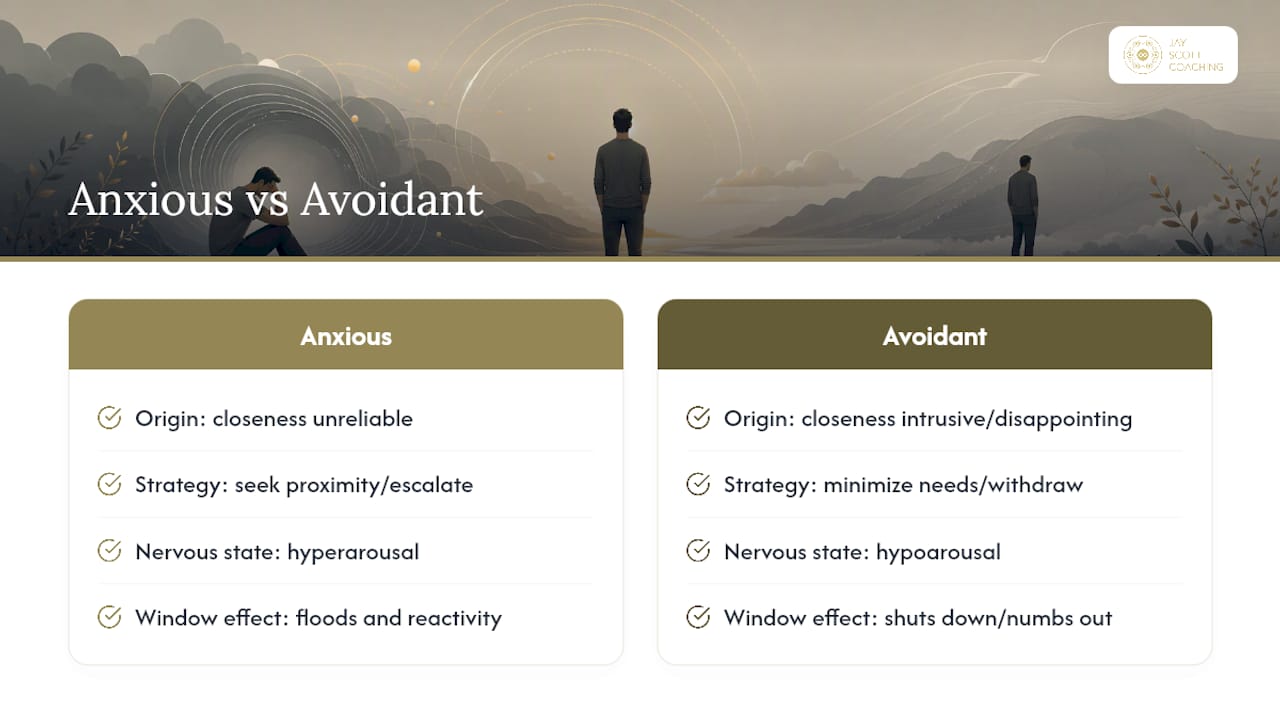
Someone high in attachment anxiety learned early that closeness is unreliable, so their nervous system defaults to hyperactivation: scanning for threat, seeking proximity, escalating until they get a response. Someone high in avoidance learned that closeness often meant intrusion or disappointment, so their system defaults to deactivation: minimizing needs, suppressing emotional expression, creating distance before it's forced on them. Both strategies made sense once. Both were adaptive responses to whatever caregiving environment shaped them.
The nervous-system piece matters as much as the psychological one. When the anxious partner escalates, their body often moves into hyperarousal: fight-or-flight, flooded, unable to think clearly. When the avoidant partner withdraws, their body often drops into hypoarousal: shut down, numbed out, checked out. Both states sit outside what therapists call the window of tolerance, the zone where a person can stay present, think clearly, and respond instead of react. Two dysregulated nervous systems cannot reason their way out of a fight, because reasoning requires a level of nervous-system calm neither partner has access to at that moment.
How Do You Actually Break the Cycle?
Interrupting the loop starts with regulation, not conversation. You cannot talk your way out of a nervous system that's already flooded or shut down. Positivepsychology is direct on this point: both partners need to recognize their role and learn to regulate before real communication becomes possible.
In the moment, try this sequence:
- Name the loop out loud. Something as simple as "I think we're doing the thing" creates a small pause and shifts both partners from autopilot into awareness.
- Ground your body first. Feet on the floor, one slow exhale longer than the inhale, a hand on your own chest. This isn't a stalling tactic. It's the only way to get back inside your window of tolerance.
- Ask where you feel it. Naming a bodily sensation, tight chest, hollow stomach, buzzing hands, moves the conversation from accusation toward vulnerability far faster than arguing about who's right.
- Pause with a return plan. Instead of "I need space" with no timeline, try: "I need twenty minutes to calm down, and I will come back and talk with you." A pause without a return plan reads as abandonment to an anxious partner. A pause with one respects both people's needs.
- Return on time. This step matters more than almost anything else on this list. Following through on the return plan is what rebuilds trust in the pattern itself.
Communication shifts help outside of active conflict too. Replace "You always shut down on me" with an I-statement: "I feel scared when the conversation goes quiet." Build in low-intensity check-ins, a five-minute daily conversation about how the day felt, rather than saving all emotional discussion for crisis moments. Negotiate boundaries explicitly: how much space is reasonable, how long a pause should last, what a "checking in" text actually looks like. Our guide on setting healthy personal boundaries walks through scripts for exactly this kind of negotiation.
Longer-term, the goal is building a nervous system that doesn't need the cycle to feel safe. That means daily grounding practice, breathwork, progressive exposure to closeness for avoidant partners, and structured self-soothing for anxious partners, paired with either individual therapy or attachment-informed couples therapy. Emotionally Focused Therapy in particular is built almost entirely around interrupting exactly this loop. None of this rewires a pattern overnight. It rewires it through repetition, the same way the original pattern got wired in the first place.
When Should You Get Help or Consider Ending It?
Some situations call for more than communication scripts. If the relationship involves abuse, active addiction, or conflict that keeps escalating in intensity or frequency, safety planning comes first, before any attachment work. That conversation belongs with a licensed professional, not a self-help article.
For couples without those red flags, therapy genuinely helps. Emotionally Focused Therapy and other attachment-informed couples approaches are built specifically to work with the anxious-avoidant loop rather than around it, and Dara King Counseling's clinical overview of the trap recommends these modalities as a starting point. Look for a therapist who names attachment work or EFT specifically in their listed specialties. An effective treatment plan usually includes individual sessions alongside joint ones, since lasting change tends to require both personal regulation work and shared practice.
How Coaching Fits Alongside Attachment Work
Therapy diagnoses and heals. Coaching drills and builds. Both matter, and for many men caught in the pursuit-distance pattern, the missing piece isn't insight, it's practiced, embodied capacity under pressure.
Jay Scott Coaching's Unshakable Man Method™ trains the nervous-system side of this equation directly. Rather than talking through why withdrawal happens, the work focuses on catching the shutdown reflex as it starts and building a different response through repetition. Coaching exercises map closely onto the strategies above: pattern mapping to identify a client's specific trigger sequence, somatic drills to practice staying grounded instead of going numb, and structured return-agreement practice so a man who used to disappear for hours learns to come back on time and follow through.
Some clients report clearer communication with partners, a rekindled sense of purpose, and relationships that feel steadier instead of exhausting. That kind of change comes from consistent, coached practice, not a single insight or a single hard conversation.
What Progress Actually Looks Like
Real change is slower and messier than people want it to be, and I'd rather tell you that upfront than let you get discouraged three weeks in. Most people notice real shifts, catching the loop sooner, fewer blowups, clearer boundaries, within a few months of consistent practice. The deeper, more durable change, where secure patterns start to feel automatic instead of effortful, tends to unfold over a longer period of sustained effort.
Early wins are usually small: you name the loop before it escalates, or you hold a boundary without guilt. Those count. Don't wait for a crisis to try structured practice. Start while things are calm enough to actually learn.
— Jay
Ready for Guided Practice? Here's What Jay Scott Coaching Offers
Reading about the cycle gets you insight. Changing it requires repetition under real pressure, which is hard to do alone and even harder to do without someone tracking your blind spots. Jay Scott Coaching works with high-performing men who want that structure: nervous-system training paired with direct accountability, not another round of talk-focused insight without practice behind it.

Private coaching offers one-on-one sessions with focused pattern mapping and somatic drills. Group coaching sessions provide a shared environment for practicing nervous-system training. Workshops and immersions offer concentrated, in-person programs for faster momentum than weekly sessions alone provide. An initial consult maps your specific pattern and clarifies whether coaching, therapy, or both fit your situation best, since the two approaches complement rather than compete with each other. If you're ready to stop reading about the loop and start practicing your way out of it, book a consultation through Jay Scott Coaching and see what a structured plan looks like for your specific pattern.
Sources
- Anxious-Avoidant Cycle: How to Fix It — SimplyPsychology
- Positivepsychology
- Attachment theory and attachment styles — Richard Fraley / UC Davis lab (summary)
- Attachment styles and how they affect adult relationships — HelpGuide
This article is general information, not a substitute for advice from a qualified doctor. Consult a qualified healthcare professional about your own circumstances before acting on anything here.
FAQ
How Do You Break the Anxious-Avoidant Cycle?
Breaking it starts with self-regulation on both sides, not with getting the other person to change first. Name the loop out loud when you notice it, ground your nervous system before reacting, and build return agreements so pauses don't feel like abandonment. Lasting change usually combines individual work with joint practice, ideally supported by attachment-informed couples therapy.
Do Avoidant Partners Ever Heal?
Yes. Avoidant attachment is a learned strategy, not a fixed trait, and it responds to consistent nervous-system practice and, often, therapy or coaching focused on tolerating closeness. Many people experience gradual shifts with focused work over time.
Can an Anxious and Avoidant Partner Actually Work Long-Term?
They can, but only if both partners recognize their role in the cycle and actively practice new responses instead of waiting for the other to change first. Structured support, whether Emotionally Focused Therapy or focused coaching like the Unshakable Man Method™, dramatically improves the odds by giving both people a shared framework and language.
What Happens When You Pull Away From an Avoidant Partner?
Pulling away from an avoidant partner often triggers a temporary sense of relief in them, followed by anxiety about losing you if the distance continues too long. This can create a confusing "hot and cold" dynamic, since avoidant partners frequently want connection but need it to feel safe and unforced rather than pursued.