
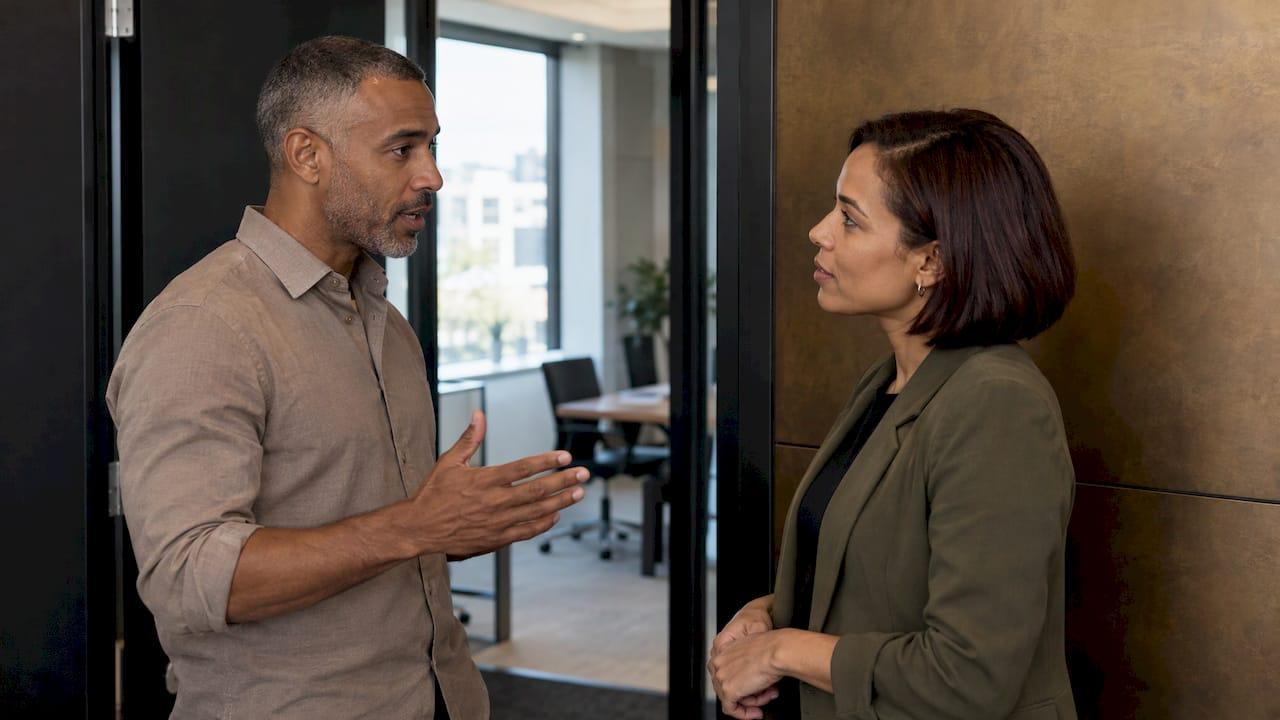
Assertiveness training teaches you to say what you think, need and won't accept, clearly and calmly, without steamrolling anyone and without swallowing your own voice. For most men, the hard part isn't knowing the words. It's staying steady enough to say them when your chest tightens and your mind starts bargaining. This guide covers both: the skills, and the nervous-system side that decides whether you use them.
If you've spent years being the reliable one, the guy who keeps the peace and absorbs the stress, this is for you. Speaking up isn't a personality you either have or lack. It's a set of habits you can train.
TL;DR
- Assertiveness is direct, honest communication that respects both you and the other person. It sits between passivity and aggression.
- Calm comes first. Slow breathing, a short pause and a steady voice make the words land.
- Simple formulas work: name the problem, name the feeling, make the ask. Practice them in low-risk moments first.
- At home, a softer start to a hard conversation keeps your partner from getting defensive.
- If speaking up stays hard despite practice, or anxiety feels out of proportion, a mental health professional or structured coaching can help.
Table of Contents
- What assertiveness actually means
- Why knowing what to say isn't enough
- Step one: get calm before you speak
- Assertive communication techniques you can use this week
- Assertiveness at work
- Assertiveness in your marriage or relationship
- A four-week practice ladder
- Our perspective
- When to get extra support
- Work with us on this
- FAQ
- Sources
What assertiveness actually means
The Association for Behavioral and Cognitive Therapies describes assertiveness as direct, honest communication that respects other people's rights and dignity, a middle point between passivity and aggression. The University of New Hampshire's counseling service puts it in practical terms: expressing your feelings, asking for what you want, and saying no to what you don't want, in a clear and non-threatening way.
That definition clears up a common confusion. Many men avoid assertiveness because they picture the alternative they dislike: the loud, dominant guy who needs to win. Cleveland Clinic's Dr. Lee draws the line this way: aggression tries to dominate, harm or instill fear, while assertiveness responds rather than reacts, thoughtfully and calmly.
Passive, aggressive, passive-aggressive, assertive
| Style | What it sounds like | What it costs you |
|---|---|---|
| Passive | "It's fine, whatever works for you." | Your needs go unmet and resentment builds. |
| Aggressive | "You always do this. Fix it." | Trust and respect erode. |
| Passive-aggressive | Sarcasm, silence, "forgetting" | Problems never get solved, only punished. |
| Assertive | "When the deadline moved, I felt stretched. I'd like to talk through priorities." | Short-term discomfort, long-term clarity. |
Mayo Clinic notes that passive behavior can signal that your thoughts and feelings matter less than other people's, while aggression weakens trust and mutual respect. ABCT adds that when we can't express ourselves openly, we may become depressed, anxious or angry, and our sense of self-worth can suffer. If you've felt tired, invisible or quietly furious at people you love, this is often part of the story.
Why knowing what to say isn't enough
Most men who search for assertiveness training already know they should say something. They rehearse the sentence in the car. Then the meeting starts, or their wife raises her eyebrow, and the sentence disappears. They agree, deflect, joke, or go quiet.
We call this self-abandonment: leaving yourself at the exact moment you need to show up. It usually looks like overthinking beforehand and avoidance in the moment. Underneath it, the body is reading the situation as a threat. Your heart rate climbs, your throat tightens, and the old safe move (agree, appease, withdraw) takes over.
That's why we treat assertiveness as two skills:
- Regulation: staying grounded enough to choose your response.
- Expression: having clear language and the willingness to use it.
Talking about it, or understanding it, builds the second skill. The first has to be practiced under real pressure, in small doses, until your system learns that speaking up is survivable.
There's research behind that idea of gradual exposure. A 2023 randomized trial from Sweden describes assertiveness practice as expressing feelings, wishes and demands in anxiety-evoking situations where a person used to hold back, so that over time the anxiety response becomes less uncomfortable. You don't wait until you feel confident. You act in small steps, and confidence follows.
Step one: get calm before you speak
Mayo Clinic's guidance is refreshingly simple: breathe slowly, keep your voice even and firm, and wait a bit if you feel too emotional going in. Cleveland Clinic suggests that before a difficult conversation you might take a deep breath, and even wait five minutes or a day or two, so you're calm and clear.
In practice, that looks like this:
- Slow the exhale. Breathe in through your nose for four counts, out for six to eight. Do it three or four times before you open your mouth.
- Drop your shoulders and unclench your jaw. Notice where you brace.
- Name the feeling privately. "I'm anxious and I want to avoid this." Naming it takes some of the charge out.
- Give yourself permission to pause. "Let me think about that and get back to you" is a complete, assertive sentence.
This isn't about eliminating nerves. It's about staying in the room with them.
Assertive communication techniques you can use this week
The three-part formula: problem, feeling, ask
Cleveland Clinic's Dr. Lee offers a simplified formula: state the problem, state the feeling, make the ask. For example:
"The report was moved up again without a heads-up. I'm frustrated because I can't plan my week. Can we agree to a day's notice going forward?"
Notice what's missing: blame, a speech, an apology. Using "I" statements also shows you're taking responsibility for your own feelings. The Centre for Clinical Interventions in Western Australia adds a useful side effect: simply saying "I feel nervous" can lower your own anxiety and help you take charge of yourself.
The broken record
When someone pushes past your first no, you don't need a new argument. The same CCI module describes the broken record technique: prepare what you're going to say and repeat it as often as necessary, calmly. It's especially useful for saying no and for dealing with articulate people who can out-talk you.
"I can't take that on this quarter." "I understand it's important. I can't take that on this quarter." Same words, same tone, no heat.
Say no without a legal brief
Over-explaining invites negotiation. Every reason you offer is something the other person can argue with. Try: "No, I won't be able to make it." Then stop talking. The silence will feel long. Let it be long.
Acknowledge, then state your position
Assertive doesn't mean cold. You can acknowledge the other person's situation and still hold your line: "I get that you're under pressure, and I can't cover that shift." You're not dismissing them. You're being honest about what you can do.
Let your body say the same thing your words do
Mayo Clinic recommends an upright posture with a slight lean forward, regular eye contact, a neutral or positive expression, uncrossed arms and legs, and facing the person. It also suggests practicing in front of a mirror or with a friend or colleague. Steady eye contact isn't a staring contest. Look, look away to think, and come back.
Assertiveness at work
Work is where many high-performing men feel the gap most. You're competent, trusted and busy, which is exactly why people hand you more. Common moments where assertiveness matters:
- Pushing back on a deadline or scope that doesn't fit your capacity.
- Disagreeing with a senior colleague in a meeting without apologizing first.
- Giving direct feedback to someone you manage.
- Asking for the raise, the title or the resources.
A workable approach: prepare one sentence in advance, breathe before you speak, and use the problem, feeling, ask structure. "We're committing to three launches in six weeks. I'm concerned about quality. I'd like to cut it to two or add a person." If you lead a team and want ready-made exercises to practice communication together, there is free communication skills training material built for workplace use.
Our own articles go deeper on this side of the skill, including how men can speak up confidently and boosting confidence when speaking up.
Assertiveness in your marriage or relationship
Home is often harder than work. The stakes feel higher, the history is longer, and one wrong tone can turn a small request into a fight. Many men swing between going quiet for weeks and then blowing up. Assertiveness is the third option.
Research on couples points the way. A University of Georgia publication, drawing on Gottman and Silver's work, explains soft startups: raising a difference in a way that's sensitive to your partner's perspective and free of criticism, blame and contempt makes the other person less defensive and a productive talk far more likely.
Biola University's Center for Marriage and Relationships suggests a four-part structure: "I feel…", "About what…", "I need or I would appreciate…", "Can we…". It also advises validating your partner before clarifying your own point.
Here's how that might sound:
"I feel disconnected lately, about how often we're both on our phones at dinner. I'd appreciate us putting them away during meals. Can we try that this week?"
A study of 72 couple conversations found that specific requests and "we" requests were linked to less resistance from the spouse and better problem resolution. So skip "you never listen." Try a concrete ask framed as something you do together.
For more on this, see our pieces on assertive communication for better relationships and expressing needs clearly.

A four-week practice ladder
Assertiveness works like a muscle. Start light and add load. Mayo Clinic recommends starting small, practicing in low-risk situations. Here's a simple progression you can run on your own:
- Week one: tiny asks. Send back the wrong order. Ask for the quieter table. Say "I'd prefer the other option" about something that barely matters.
- Week two: low-stakes no. Decline a favor or invitation from an acquaintance without an excuse.
- Week three: mild discomfort. Voice a different opinion in a meeting, or tell a friend a plan doesn't work for you.
- Week four: real stakes. Raise the conversation you've been avoiding: workload with your boss, or a recurring issue with your partner.
Each day, write one complete problem, feeling, ask statement for a situation you expect, then say it out loud a few times. Afterward, spend two minutes noting what happened in your body, what you said, and what you'd tweak. You're collecting evidence that you can handle it.
A few ground rules keep this honest:
- Choose situations where the worst outcome is mild awkwardness.
- Expect your voice to shake at first. That's a sign you're practicing, not failing.
- Repeat each rung until it feels ordinary before moving up.
- Notice the urge to apologize and skip it.
Our perspective
We've seen the same pattern in high-performing men again and again. They're sharp, successful and quietly worn out, because they've been editing themselves for years: swallowing the opinion, taking on the extra task, keeping the peace.
Scripts help, and we use them. But we don't believe assertiveness is mainly a communication problem. It's a nervous-system problem. When pressure hits, your body decides before your mind does, and if speaking up has ever felt unsafe, your system defaults to agreeing, avoiding or shutting down.
That's why our Unshakable Man Method™ trains regulation first. We help you build inner safety, so you can stay grounded when someone is disappointed, angry or silent. From there, pattern mapping lets you see exactly when and how you abandon yourself, and session tools and accountability turn insight into action between calls.
Our approach is designed for men who want to move from anxiety to confidence and from indecision to clear leadership, at work and at home. Our clients describe changes in how they communicate, how they feel about their purpose, and how connected they feel to the people they love.
You don't have to white-knuckle this alone.
Jay
When to get extra support
Self-practice takes many men a long way. Sometimes it stalls. Mayo Clinic says that if you're not making progress despite your best efforts, consider formal assertiveness training, and if anger, stress, anxiety or fear are getting in the way, consider talking with a mental health professional.
Signs it's time:
- You freeze or panic even in low-stakes situations.
- Your anxiety feels out of proportion to what's happening.
- You hold back because being direct with a particular person doesn't feel safe.
- You've practiced for weeks and the same pattern repeats.
If anxiety, depression or trauma is part of the picture, a licensed clinician is the right first call. Coaching is a different thing: it's forward-looking, practical and built around your goals. Many men find that the two work side by side.
Our article on common challenges men face that individual coaching can solve can help you judge which route fits.
Work with us on this
If you're ready to stop rehearsing and start speaking, we offer private coaching, group coaching, and workshops and immersions built around the Unshakable Man Method™. Sessions focus on regulating your nervous system under pressure, mapping the patterns that pull you off course, and taking decisive action in your career and relationships. You can see how each format works on our coaching options page, then apply or book a consultation call.
You'll find more reading in our assertiveness article library, including a guide to assertive communication for men.
FAQ
Is assertiveness training the same as therapy?
No. Assertiveness training is a skills-focused approach to expressing yourself clearly and respectfully, and it's often used within cognitive behavioral therapy. Therapy treats clinical conditions such as anxiety or depression. Coaching focuses on practical change toward your goals. If anxiety or fear is heavily in the way, Mayo Clinic suggests talking with a mental health professional.
How long does it take to become more assertive?
It depends on how long the pattern has run and how often you practice. Most men notice small shifts within a few weeks of deliberate practice in low-risk situations. Bigger changes, like holding your ground with a boss or spouse, build over months as your comfort with discomfort grows.
Won't being assertive make me seem aggressive?
Not when it's done well. Aggression aims to dominate or intimidate, while assertiveness is calm, direct and respectful of the other person's rights. A steady voice, "I" statements and a specific request keep you on the right side of that line.
What if I freeze when it's time to speak?
Freezing is a stress response, not a character flaw. Breathe out slowly, drop your shoulders, and use a pause line such as "Let me think about that." Then practice in smaller situations until your body learns that speaking up is safe. If freezing happens often, consider working with a coach or a licensed clinician.
Sources
- Assertiveness Training fact sheet, ABCT
- Assertiveness, University of New Hampshire Psychological & Counseling Services
- How to Be Assertive, Cleveland Clinic
- Being assertive: Reduce stress, communicate better, Mayo Clinic
- How to Behave More Assertively, Centre for Clinical Interventions
- Efficacy of transdiagnostic cognitive-behavioral therapy, PMC
- Manage, University of Georgia Family and Consumer Sciences
- How to Communicate with a Defensive Person, Biola University
- The Differential Association between Change Request Qualities, PMC