
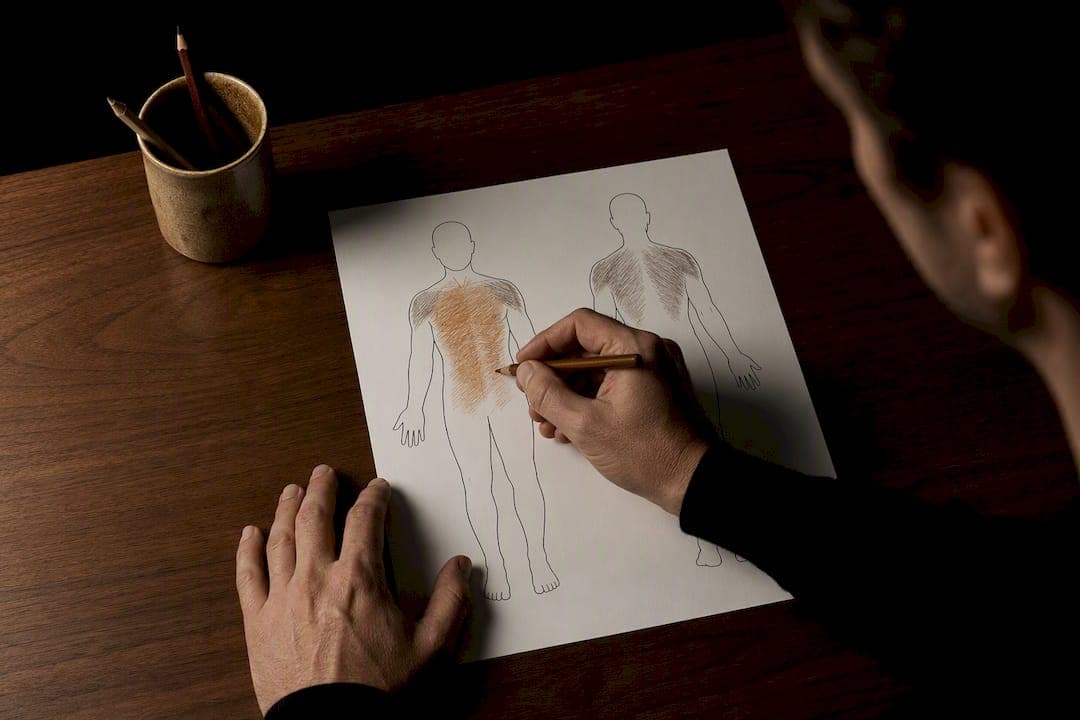
A body map of emotions is a visual tool that links felt sensations, like a tight chest or a warm face, to specific locations on a body outline, giving you a concrete way to notice what an emotion actually feels like before you try to name or manage it. The approach has real backing from peer-reviewed research, most notably the PNAS study on bodily maps of emotions, and it works as a practical bridge between vague emotional overwhelm and specific, actionable self-regulation.
TL;DR:
- Repeating body mapping over weeks reveals consistent patterns, like anger often beginning in the jaw or anxiety showing a gut signature hours before awareness.
- Cross-cultural studies confirm that many bodily sensation patterns associated with emotions like anger, fear, or sadness are similar across diverse populations.
- Individual variation from factors such as medication, pain, or culture influences sensation maps, making them useful for tracking trends rather than diagnosing states.
- Pairing sensation-focused body maps with targeted regulation techniques enhances emotional awareness and can lead to meaningful shifts in physical and emotional states.
- Regular practice and logging of body maps support the development of interoceptive skills crucial for emotional regulation and understanding personal patterns.
Table of Contents
- What Body Mapping Emotions Actually Looks Like
- What the Science Shows: Core Studies, Replication, and Key Metrics
- How to Use Body Mapping in Real Life
- Clinical and Personal Uses: From Alexithymia to Everyday Regulation
- Where Body Maps Get It Wrong: Limits and Interpretation Pitfalls
- Step-by-Step: Build and Use Your Own Body Map
- Reliable Templates and How to Choose One
- How Jay Scott Coaching Uses Body Mapping in Nervous-System Training
- Why the Science Matters More Than the Worksheet
- Ready to Go Deeper Than a Worksheet?
- Sources
What Body Mapping Emotions Actually Looks Like
Strip away the science for a second and a body map of emotions is just a blank human silhouette, front and back, that you color or mark to show where a feeling shows up physically. Some people shade in a hot patch across the chest for anger. Others draw arrows radiating from the stomach for anxiety. The format varies, but the goal stays the same: turn an abstract feeling into something you can point to.
Researchers distinguish between two main types of maps, and knowing the difference helps you use the right one for the right question. Activity maps track where sensation intensifies or numbs out, essentially asking "where does this feel more active or less active than baseline?" Valence or weight maps ask a different question: does the feeling sit heavy, like a stone in the gut, or light, like helium in the chest? A 2022 study in Psychological Research found that weight-based maps add real diagnostic value, especially for sadness and depressive states, where activity alone doesn't tell the full story. Combining both dimensions gives a fuller picture than either one on its own.
In practice, you'll encounter body mapping in a few common formats:
- Blank silhouette coloring, the simplest version, where you shade sensation intensity by hand on paper.
- The emBODY digital method, the topographical self-report tool researchers use to collect standardized data across large groups.
- Hotspot click labs, interactive online versions where you click regions of a digital figure to mark sensation.
- Printable worksheets, often adapted for classrooms, therapy intake sessions, or home journaling.
One thing worth stating plainly: a body map of emotions is not a diagnostic instrument. It doesn't tell you that you have an anxiety disorder or a mood condition. It's a psychoeducational tool, a way to build the skill of noticing, which happens to be the exact skill most people skip when emotions run hot.
What the Science Shows: Core Studies, Replication, and Key Metrics
The foundational study here is Lauri Nummenmaa and colleagues' 2013 paper, published in the Proceedings of the National Academy of Sciences, and it remains the most cited piece of evidence in this entire field. Researchers asked participants to view emotion-inducing words, stories, and faces, then paint on a blank silhouette where they felt sensation increase or decrease using the emBODY method. Across multiple experiments totaling roughly 701 participants, the resulting bodily maps of emotions showed distinct, statistically separable patterns for basic emotions like anger, fear, happiness, and sadness. Anger and fear both lit up the chest, but with different peripheral patterns. Happiness activated broadly across nearly the entire body. Sadness and depression showed reduced sensation in the limbs, a kind of physical withdrawal.
A classifier trained on these maps correctly distinguished basic emotions from each other well above chance, a signal that the topographies weren't random noise but something structurally consistent across people.
Statistic to know: In the original PNAS experiments, classifier accuracy for identifying basic emotions from bodily sensation maps was notably higher than chance, demonstrating consistent and meaningful differences rather than random noise.
That replication came fast and from multiple directions. A 2018 follow-up in PNAS expanded the scope dramatically, mapping 100 distinct subjective feelings rather than just a handful of basic emotions, and found that bodily topographies clustered in ways that matched broader patterns of how people mentally group feelings. Love and joy mapped close together. Shame and embarrassment shared similar bodily signatures. The feeling space, it turned out, had real structure.
Cultural universality was the next question, and it mattered because a finding that only holds up in one country doesn't tell you much about human emotion generally. A large-sample study covering 3,954 participants across 101 countries found that many of these bodily-sensation patterns held consistent across wildly different cultural contexts. That's a sample size and geographic spread that few psychology studies ever achieve, and it's part of why this line of research gets cited so often in clinical and coaching contexts alike.
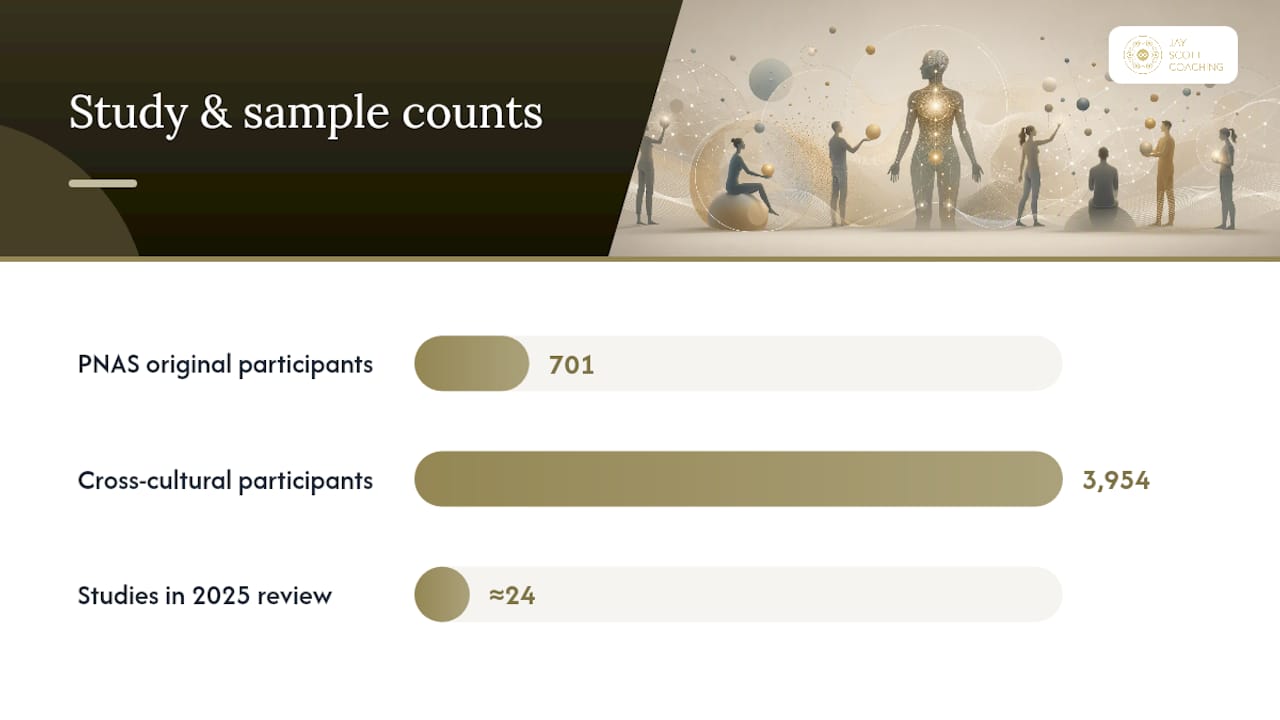
The most recent addition to this evidence base is a 2025 integrative review that synthesizes roughly two dozen empirical studies into what it calls a tripartite framework. The review argues that bodily maps emerge from three interacting sources: bottom-up physiology (what your nervous system is actually doing), top-down behavioral engagement (what you're inclined to do in response), and conceptual construction (the mental categories and metaphors you use to interpret sensation). This framework matters practically because it explains why your map of "anxiety" might look different from your neighbor's, without undermining the broader pattern that most people's maps do converge.
Here's how the core evidence stacks up:
| Study | Sample | Key finding |
|---|---|---|
| Nummenmaa et al., PNAS 2013 | ~701 participants | Distinct, classifiable bodily maps for basic emotions |
| Maps of Subjective Feelings, PNAS 2018 | Multiple experiments | 100 feelings mapped; topographies cluster with feeling categories |
| Cultural replication, Emotion 2019 | 3,954 participants, 101 countries | Cross-cultural consistency in many emotion maps |
| Tripartite framework review, 2025 | two dozen studies synthesized | Explains individual variability via three interacting mechanisms |
What remains uncertain is how much individual variation matters clinically. The maps are statistically distinct at the group level, but no study claims your personal map will match the population average exactly. Chronic pain, medication, culture, and personal history all shift the picture, a point the tripartite framework takes seriously rather than glossing over.
How to Use Body Mapping in Real Life
Getting started with body sensation mapping doesn't require a lab or a therapist in the room, though both can help. The core exercise, whether you're doing it with a paper worksheet or a digital tool, follows the same basic logic as the original emBODY research: notice a feeling, then locate where it shows up physically before you try to interpret it.
Start with the low-tech version. Print or sketch a simple front-and-back body outline. When you notice a strong emotion, take sixty seconds to shade in the areas where you feel something, using color intensity or hatching to show strength. Don't worry about being artistic. The point is the noticing, not the drawing.
The digital emBODY-style approach works similarly but with more structure. You typically see two silhouettes side by side and click or paint regions where sensation increases (often in warm colors) and where it decreases or feels numb (often in cool colors). This format works well if you like a bit of built-in guidance rather than a blank page.
A few adaptations matter depending on who's using the tool:
- For children, simplified outlines with just a handful of preset emotion words work better than open-ended prompts; the NHS-affiliated worksheet used in UK schools is a solid reference for this format.
- For neurodivergent people, offering sensation-quality word banks (tight, buzzy, heavy, hollow) instead of asking someone to freehand a description can lower the barrier to entry.
- For people with alexithymia, the difficulty naming or identifying emotions, skip straight past the "what emotion is this" question and start with "what does this sensation feel like." That single reframe often unlocks participation that a feelings-first approach blocks.
Pro Tip: Don't ask yourself "what am I feeling?" first. Ask "where in my body do I notice something right now?" The sensation usually arrives before the label does, and starting there keeps you from getting stuck trying to name an emotion you can't yet identify.
For templates worth trying immediately, the SimplePractice emotional body chart offers a clinician-designed printable that works equally well for self-guided journaling. Interactive click-based labs modeled on the original emBODY method are also widely available for anyone who wants the closer-to-research-grade experience without needing a therapist to administer it.
Clinical and Personal Uses: From Alexithymia to Everyday Regulation
Therapists and coaches use body maps for one primary reason: most people are far better at describing what's happening in their body than they are at naming what they feel. That gap is the entire premise behind using sensation as the entry point rather than emotion vocabulary.
For clients dealing with alexithymia, or anyone who just goes blank when asked "how do you feel," a body map sidesteps the naming problem entirely. Instead of demanding a word, it asks for a location and a quality: hot, cold, tight, loose, heavy, fluttery. That's a much lower cognitive bar to clear, and it builds the skill of interoception, your internal sense of what's happening inside your own body, gradually rather than all at once. Treating the map as an interface for noticing, not an exact physiological readout, keeps the exercise useful without overpromising precision.
A simple clinical protocol looks like this in practice:
- Present a blank silhouette and ask the client to mark where they notice anything right now, without labeling it yet.
- Ask about sensation quality (temperature, pressure, movement) before asking about emotion name.
- Once a location and quality are established, introduce a regulation technique matched to what showed up.
- Re-check the map a few minutes later to see if anything shifted.
That last step matters more than people expect. Pairing the map with a regulation technique gives you a before-and-after comparison, which turns a static drawing into a feedback loop. Common pairings include:
- Breathing techniques for sensations concentrated in the chest or throat, where tightness often responds to slower exhales.
- Grounding exercises for sensations that feel diffuse or disconnected, particularly useful for dissociation-adjacent states.
- Progressive muscle relaxation for sensations described as tight or clenched, especially in the jaw, shoulders, or hands.
- Movement or shaking out for sensations that feel stuck or heavy, particularly in the legs or gut.
None of this requires clinical training to try on your own, but a therapist or coach trained in nervous-system work can help you interpret patterns that repeat across sessions, which is often where the real insight shows up.
Where Body Maps Get It Wrong: Limits and Interpretation Pitfalls
A body map of emotions is a snapshot, not a permanent record, and treating it as fixed truth is the most common mistake people make with this tool. The same person can map "anger" completely differently on a stressful Tuesday versus a calm Sunday, and that variability isn't a flaw in the method. It's the method working correctly, because emotional embodiment genuinely shifts with context.
Several factors reliably move the picture:
- Chronic pain or illness can dominate a body map regardless of emotional state, making it hard to separate physical baseline from emotional signal.
- Medication, particularly anything affecting the autonomic nervous system, can blunt or amplify sensations the map is trying to capture.
- Cultural background shapes which sensations get noticed and reported, even when underlying physiology is similar.
- Individual differences in interoceptive sensitivity mean some people will produce richly detailed maps and others will produce sparse ones, with no correlation to how intensely they're actually feeling something.
The bigger pitfall is treating a single map session as diagnostic. One drawing doesn't tell you that you have generalized anxiety or that your gut issues are "all emotional." Body maps are strongest as a pattern-tracking tool across repeated use, not as a one-shot verdict.
There's also a line worth drawing clearly: if a physical sensation is persistent, severe, or unexplained by emotional context (chest pain that doesn't resolve, numbness that spreads, sensations tied to a physical injury), that calls for a medical evaluation, not another round of body mapping. The tool is built for emotional awareness, not for ruling out a physical health problem.
Step-by-Step: Build and Use Your Own Body Map
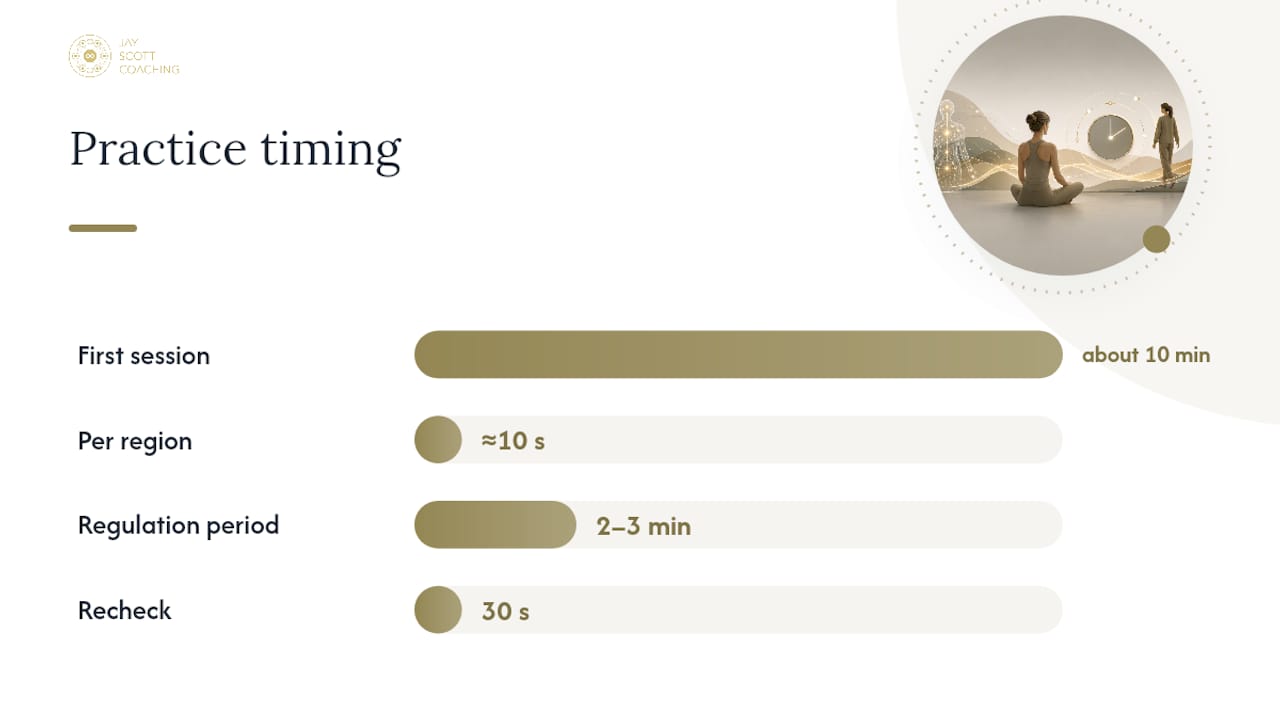
This exercise takes about ten minutes the first time and gets faster with repetition. You'll need a printed or hand-drawn body outline (front and back), something to color with, and a quiet few minutes where you won't be interrupted.
- Ground first. Take three slow breaths before you start. You're trying to notice what's actually there, not what you expect to find, and a rushed nervous system tends to report noise instead of signal.
- Scan from head to feet. Move your attention slowly through your body, roughly ten seconds per region, without judging what you find.
- Mark where something shows up. Shade or hatch any area with noticeable sensation, using intensity (light to dark) to show strength.
- Label the sensation quality, not the emotion, first. Write a word next to each marked area: hot, tight, buzzing, heavy, hollow. The emotion label can come after, if it comes at all.
- Choose one regulation technique matched to what you found. Tight chest, try slower exhales. Heavy legs, try standing and shaking them out. Diffuse or foggy sensation, try grounding through your feet on the floor.
- Re-scan briefly. After two or three minutes of the regulation technique, do a fast thirty-second recheck of the same areas. Note any change, even small ones.
- Record it. Date the map and keep it, either in a folder or a simple journal entry noting the trigger, the sensation, and what shifted.
Tracking matters more than any single map. Do this two or three times a week, ideally around moments of noticeable emotional intensity rather than on a rigid schedule, and patterns start to surface after four to six weeks that a single session would never reveal. Maybe your anger always starts in your jaw before it reaches your chest. Maybe your anxiety has a consistent gut signature that shows up hours before you consciously register worry.
Pro Tip: Keep your old maps instead of tossing them. Comparing a map from a stressful week against one from a calm week often teaches you more about your patterns than any single session ever will.
Reliable Templates and How to Choose One
Not every body-mapping template fits every situation, and picking the wrong format can make an otherwise useful exercise feel clinical or confusing.
For self-guided practice, the SimplePractice emotional body chart offers a clean, clinician-designed template that works well for journaling without oversight. For children or classroom settings, the NHS-style worksheet simplifies the prompts and works better with preset emotion words rather than open-ended sensation description. Interactive digital labs modeled on the original emBODY research method give a closer approximation of what researchers actually use, useful if you want a bit more structure than a blank page provides.
Choosing between them comes down to two questions: is this for a child or an adult, and is this self-guided or something a clinician will review with you? Clinical settings tend to favor structured templates with built-in emotion labels, since that gives a therapist a faster read across sessions. Self-guided practice benefits more from open blank silhouettes, since the goal there is building your own noticing skill rather than generating comparable data.
Whichever format you pick, log entries with a date, the triggering context, and a brief note on what shifted after regulation. That log is what turns a one-off curiosity into a genuinely useful self-awareness practice over months.
How Jay Scott Coaching Uses Body Mapping in Nervous-System Training
Inside the Unshakable Man Method™, body mapping shows up as one entry point into a larger nervous-system training process. High-performing men often override physical signals for years, pushing through tension, tight breathing, and gut-level warning signs because slowing down to notice feels unproductive. A body map interrupts that override pattern by giving a concrete, low-stakes way to pause and ask what's actually happening physically before a stressful conversation, decision, or confrontation.
A typical coaching workflow looks like this: a client maps where tension shows up during a recent high-stakes moment, names the sensation quality without rushing to an emotion word, then practices a specific nervous-system regulation technique matched to that pattern. Over repeated sessions, the map becomes a tracking tool, revealing whether the same tightness in the chest keeps showing up before difficult decisions, or whether a new pattern is emerging as regulation skills build.
This work operates alongside, not instead of, clinical care. If a client's sensations point toward something requiring medical or licensed mental health attention, coaching is not a substitute for that referral.
Why the Science Matters More Than the Worksheet
Most articles on this topic treat body mapping like a self-help novelty, a fun coloring exercise with a psychology veneer. That undersells what the Nummenmaa research and its follow-ups actually established: emotional states have measurable, classifiable physical signatures, replicated across cultures and thousands of participants. That's not a minor footnote. It's the difference between "this might help you feel more centered" and "this reflects something real about how your nervous system organizes emotional experience."
Where conventional advice falls short is treating a single mapping session as insight. The value compounds only with repetition, the way any interoceptive skill does. A body map done once is a curiosity. A body map done weekly for two months is a data set about your own nervous system that no amount of talking about feelings will replicate.
If you take one thing from this, prioritize the tracking over the drawing. The sensation quality matters more than the emotion label, and the pattern across ten sessions matters more than any single map's accuracy.
— Jay
Ready to Go Deeper Than a Worksheet?
Body mapping is a strong starting point for noticing what's happening inside you, but noticing is only the first half of the work. The harder part, especially for men who've spent years overriding physical signals to push through pressure, is building a nervous system that can hold steady once you notice the tension instead of numbing past it again. That's where structured coaching earns its place: it turns a one-time mapping exercise into a repeatable skill you can rely on under real stress, not just in a quiet journaling session.

Jay Scott Coaching's Unshakable Man Method™ builds directly on this kind of body awareness work, pairing it with nervous-system training designed for high-performing men who've learned to override their own signals for too long. An initial consultation typically focuses on identifying specific patterns, where tension shows up, what triggers override, and where self-abandonment tends to creep in during high-stakes moments at work or at home. If you've tried a body map on your own and noticed something worth understanding further, the next step is a conversation about individual coaching to see if structured, guided practice fits where you are right now.
Sources
- Bodily maps of emotions. Proceedings of the National Academy of Sciences. 2013
- Bodily maps of emotions are culturally universal (PubMed entry)
- Mapping emotional feeling in the body: A tripartite framework for understanding the embodied mind
- Emotional body chart (SimplePractice resource)