

The fastest reliable path to a good decision under pressure starts in your body, not your head. Do a physiological sigh or two, take a two second tactical pause before you speak, then apply one structured decision rule (a time box, a weighted matrix, or a simple default) instead of freezing or rushing. That sequence, physiological reset first, structure second, consistently produces clearer thinking and fewer rushed errors than trying to "think harder" through the noise.
TL;DR:
- Taking a physiological sigh or cold face pressure in the first minute greatly reduces stress and restores focus before decision making.
- Using a structured decision rule like a default, time box, or weighted matrix can prevent rushed errors under pressure.
- Combining stress with time tightens attention, shrinks working memory, and increases cognitive biases, reducing decision accuracy by up to 26 points.
- Training with rehearsed protocols, checklists, and decision frameworks in calm moments prepares teams to act decisively when under stress.
- Physical regulation techniques and nervous system training automate composure, making clear decision making more reliable during high-pressure situations.
Table of Contents
- What To Do In The First 30 to 90 Seconds Of Decision Making Under Pressure
- Why Stress And Time Pressure Wreck Your Judgment
- Decision Frameworks That Work When The Clock Is Running
- Body-First Techniques That Restore Clarity In Seconds
- Training Your Brain To Handle Pressure Before It Hits
- Keeping Your Team Aligned When You're Deciding Fast
- How Pressure Hijacks Attention And Memory
- The Biases That Get Worse When You're Under Pressure
- Regulating Emotion So You Can Actually Think
- What Effective Decision Making Under Pressure Actually Looks Like
- Why Military, Medical, And Emergency Teams Decide So Differently
- Why Nervous System Training Changes Everything Else
- A Faster Route To Steady Composure Than Willpower Alone
- Sources
What To Do In The First 30 to 90 Seconds Of Decision Making Under Pressure
Pressure hits your body before it hits your judgment. Your heart rate spikes, your visual field narrows, and your brain starts hunting for the fastest exit rather than the best one. The moves below are ordered by how fast they work, not by how important they are. Run them in sequence.
- Reset your physiology first. Take two physiological sighs (a double inhale through the nose, then a long, slow exhale through the mouth), or switch to box breathing at a 4:6 count if you have more than ten seconds. If neither is available, press a cold water bottle or cold hand to your face for a few seconds.
- Call the pause out loud. Say something like "Pause, give me 30 seconds" to your team. Naming the pause keeps people from mistaking it for indecision.
- Isolate the one factor that actually matters. Ask yourself what single variable, if it changed, would flip your decision. Ignore the rest for now.
- Apply a default rule instead of debating. If you have a preset rule for this category of decision, use it. If not, apply the 40 to 70 rule described below.
- Set a time box and commit. Give yourself a hard stop, sixty seconds, five minutes, whatever the stakes justify, and decide when the clock runs out.
- Announce the decision and the next step. State what you decided and what happens next in one sentence. Ambiguity after a fast call causes more damage than the call itself.
Pro Tip: Keep a written, one-page list of your personal default rules for recurring high-pressure moments (a difficult client call, a budget overrun, a safety flag). Reading a rule you already trust is faster than inventing a new judgment mid crisis.
Why Stress And Time Pressure Wreck Your Judgment
Stress alone rarely ruins a decision. Stress combined with a deadline is what actually breaks people, and the research on this is stark.
One study tracking decision accuracy found performance dropped significantly under combined stress and time pressure, showing a marked decrease from normal conditions (https://pubmed.ncbi.nlm.nih.gov/41315734/). That is not a small dip. It is the difference between a decision-maker you'd trust with something important and one you would not. The mechanism behind that collapse has a few distinct parts:
- Attention narrows. Your brain stops scanning the full picture and locks onto the most obvious or threatening detail, missing quieter but relevant signals.
- Pessimism creeps in. Under combined stress and time pressure, people become more likely to answer "no" on problems that actually have a workable solution, rejecting good options simply because evaluating them feels expensive.
- Working memory shrinks. Holding multiple variables in mind at once gets harder, so decisions collapse toward whatever is simplest, not whatever is best.
The gap in numbers: Accuracy fell from 83% to 57% once time pressure joined the stress response, a 26 point swing that shows up specifically when both factors hit at once.
Practically, this tells you when to slow down versus when to delegate or box the clock. If a decision is reversible and low stakes, a fast, imperfect call is fine. If it is irreversible or high stakes, the data says buy yourself time, even sixty extra seconds, before committing.
Decision Frameworks That Work When The Clock Is Running
Different pressure situations call for different tools. Using the wrong one wastes the exact time you're trying to protect.
OODA (Observe, Orient, Decide, Act) fits fast, fluid situations where the environment keeps changing and information keeps arriving. Originally built for fighter pilots, it works anywhere the picture shifts faster than you can plan around it: a live negotiation, a server outage, a market swing. The loop is meant to run again and again in seconds, not once.
A weighted decision matrix fits the opposite scenario: a small number of discrete options where you have a moment to compare them. List your two or three options across the top, your key factors down the side, score each combination, and let the totals break the tie your gut can't.
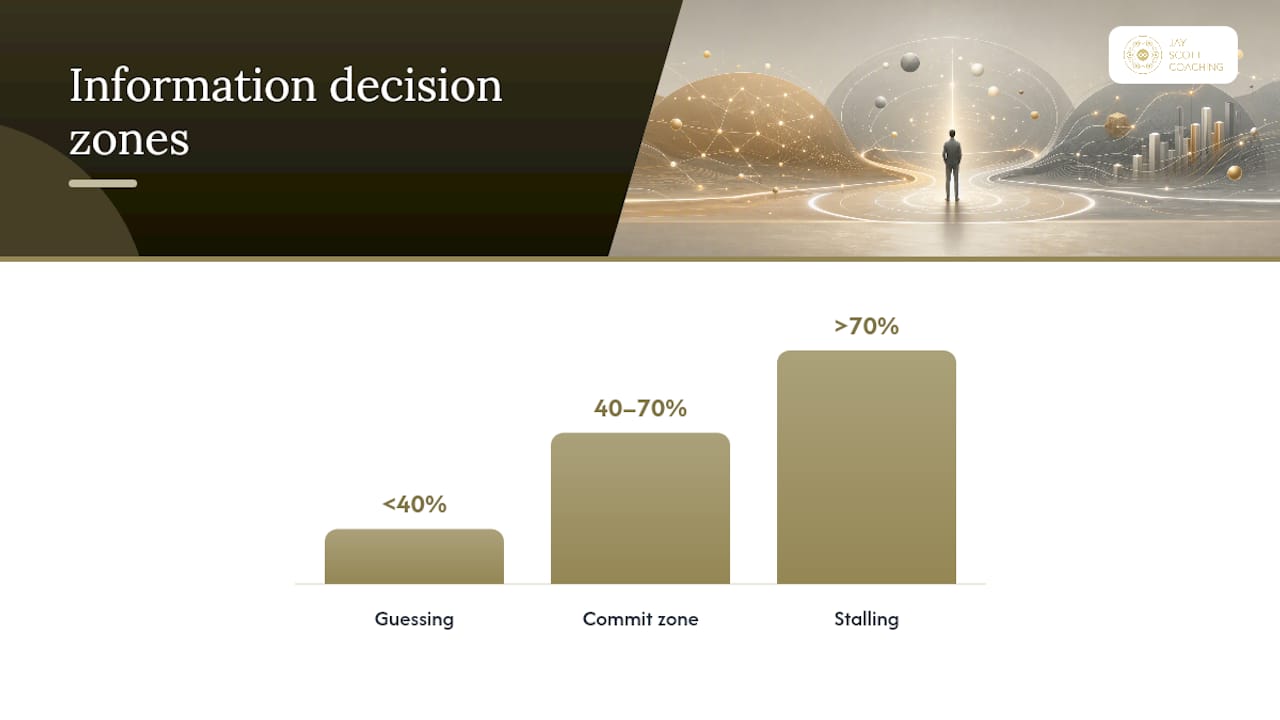
The 40 to 70 rule governs how much information to gather before acting. Below 40% of the information you'd ideally want, you're guessing. Above 70%, you're stalling and the moment has usually already cost you something. The zone between is where a leader should commit.
Preset rules and defaults remove the decision entirely for recurring situations. A pilot's checklist, a trading stop loss, a manager's "escalate if the client uses this word" rule. Building these in calm moments is what makes them usable in loud ones.
- OODA: fast-moving, information-changing scenarios.
- Weighted matrix: a handful of stable, comparable options.
- 40 to 70 rule: gauging when you have enough information to move.
- Preset defaults: recurring decision types you can template in advance.
Pro Tip: Write a one-line micro-template for each model before you need it: "Observe: what changed. Orient: what matters now. Act: say it out loud." A script under pressure beats a framework you have to reconstruct from memory.
Body-First Techniques That Restore Clarity In Seconds
Thinking clearly starts with calming the body, and the fastest tools work in under a minute.
The physiological sigh is the quickest reset available. Take a full inhale through the nose, add a second short inhale on top of it, then exhale slowly and completely through the mouth. The double inhale reinflates collapsed air sacs in the lungs, and the extended exhale is what actually slows the heart rate. Two or three rounds is usually enough to feel the shift.
Tactical or box breathing works well when you have a slightly longer window, say before walking into a meeting rather than mid-crisis. Inhale for four counts, hold for four, exhale for six to eight, hold briefly, repeat. Harvard Health notes that longer exhale patterns lower heart rate and help restore attention faster than shallow, even breathing does.
For moments of genuine overwhelm, the DBT-based TIP skills offer a faster override:
- Temperature: cold water on the face or wrists triggers the body's dive reflex, dropping heart rate quickly.
- Intense exercise: even thirty seconds of jumping jacks or a fast stair climb burns off excess adrenaline.
- Paced breathing: slow, exhale-heavy breathing as described above.
- Paired muscle relaxation: tense a muscle group hard for five seconds, then release, working through the body.
These techniques can rapidly reduce distress when thinking is impaired, though the temperature and intense-exercise options carry real cautions for anyone with cardiac conditions or blood pressure issues. If ice water isn't available or appropriate, a cold hand pressed to the cheeks or back of the neck offers a milder version of the same reflex.
Training Your Brain To Handle Pressure Before It Hits
Composure under pressure is trainable the same way a muscle is: through repeated, deliberate stress rather than reading about it. Deliberate practice and crisis simulation transfer directly to real events, which is why fire departments run live burns and airlines run full-motion simulator failures instead of relying on lectures.
- Run time-boxed decision drills. Give your team a scenario and a hard deadline, five minutes, then debrief what information they used and what they ignored.
- Use knapsack-style puzzles. Constraint problems (limited resources, limited time, competing priorities) build the specific skill of deciding well when you can't have everything.
- Add a short expressive-writing exercise before high-stakes events. A few minutes writing out your worries before a big presentation or negotiation reduces the anxious thoughts competing for your attention once you're in the room.
- Run a five-minute after-action review. Ask three questions only: what did we decide, what information did we actually have, what would we do differently with sixty more seconds.
None of this requires a training budget or a simulator. It requires doing it on purpose, on a schedule, before the real event forces the lesson on you.
Keeping Your Team Aligned When You're Deciding Fast
A leader who decides well alone but communicates poorly under pressure still produces chaos. The fix is mostly about deciding who talks, and when, before the pressure ever hits.
- Name a decision owner in advance. Ambiguity about who has final say is what turns a fast decision into a slow argument.
- Script your announcement language. A line as simple as "Here's the call, here's why, here's what happens next" keeps a team from filling silence with speculation.
- Use micro-commands to cut chaos. Short, specific instructions ("Sarah, own the client call. Mike, hold the budget line.") outperform open discussion when seconds matter.
- Set clear escalation triggers ahead of time. Decide now what conditions mean "stop and get a second opinion" so nobody has to negotiate that threshold mid-crisis.
- Protect the tactical pause publicly. Saying "give me thirty seconds" out loud, rather than going silent, signals control rather than panic.
The goal isn't speed for its own sake. It's removing every unnecessary decision (who talks first, how to phrase it, when to escalate) so the only decision left is the one that actually matters.
How Pressure Hijacks Attention And Memory
Pressure doesn't just make you feel rushed. It measurably changes what your brain can process. The most consistent finding across stress research is attentional narrowing: under acute pressure, your visual and cognitive focus shrinks toward the most immediate or threatening stimulus, and everything at the periphery, literally and figuratively, gets filtered out.
That narrowing has a direct cost to working memory. Holding four or five variables in mind while weighing a decision is hard enough without stress. Under pressure, that capacity often drops to two or three, which is why complex trade offs get replaced by oversimplified either/or thinking exactly when nuance matters most.
Memory retrieval takes a hit too. Under acute stress, people struggle to access information they know well under calm conditions, a phenomenon familiar to anyone who has gone blank mid-presentation despite knowing the material cold. The information isn't gone. Access to it is temporarily blocked by the same physiological state driving the attention narrowing.
The practical takeaway is that you cannot out-think a narrowed attentional field. You have to widen it back out first, physically, before your brain will reliably retrieve what you already know or weigh more than the single loudest factor in front of you. That is precisely why the physiological reset comes before any decision framework in this article's sequence. Skipping it and jumping straight to "just think it through" is asking your brain to do something it is temporarily unable to do well.
The Biases That Get Worse When You're Under Pressure
Every cognitive bias you carry gets amplified when stress and time pressure combine, and a few show up consistently enough to name.
Confirmation bias intensifies because your narrowed attention grabs the first plausible explanation and stops looking for disconfirming evidence. Under calm conditions you might weigh three interpretations. Under pressure you often latch onto the first.
Negativity and pessimism bias grows sharply too. The same research showing the 83% to 57% accuracy collapse also found that combined stress and time pressure make people more likely to reject solutions that would actually work, simply because evaluating a "yes" feels more effortful than defaulting to "no."
Anchoring gets worse because the first number, opinion, or option you encounter under pressure gets disproportionate weight, since you no longer have the cognitive bandwidth to properly compare it against alternatives.
Sunk cost thinking intensifies as time runs short, pushing leaders to keep defending a failing plan rather than switch course, because switching feels like it costs time you don't have.
Mitigation for all four follows the same pattern: build in a mandatory second look. A weighted matrix forces you to score alternatives instead of anchoring on the first one. A preset rule bypasses the pessimism bias by removing the "should I say yes" evaluation entirely. And the physiological reset described earlier genuinely widens your attention back out, which is often enough on its own to loosen a bias's grip before you even apply a framework.
Regulating Emotion So You Can Actually Think
Emotional regulation and clear thinking aren't separate skills. They're the same skill viewed from two angles. High performers don't suppress the nervous energy pressure creates. They redirect it.
One useful reframe: treat high arousal as excitement rather than anxiety. Behavioral research on performance under pressure shows that simply relabeling the physical sensation, faster heart rate, tighter chest, from "I'm anxious" to "I'm activated" improves outcomes on pressured tasks, because the label changes how your brain interprets and uses the same physiological signal.
A second lever is what IMD researchers describe as holding multiple perspectives without needing to suppress the emotion entirely. Calm, in this framing, isn't the absence of feeling. It's the capacity to feel something intense and still consider more than one interpretation of the situation.
A third, more mechanical lever is the micro-routine: center, breathe, command. Grounding your feet and posture, running one physiological sigh, then giving a short verbal command is a repeatable sequence that trains faster than long-form meditation for leaders who need composure on demand rather than composure after twenty minutes of practice.
None of this requires becoming unflappable. It requires a fast, repeatable way to move from raw reaction to regulated response, and doing that same sequence enough times that it stops requiring conscious effort.
What Effective Decision Making Under Pressure Actually Looks Like
Abstract frameworks earn their keep when you can see them working in a real moment. A few patterns recur across the settings where high-stakes, high-speed decisions are routine.
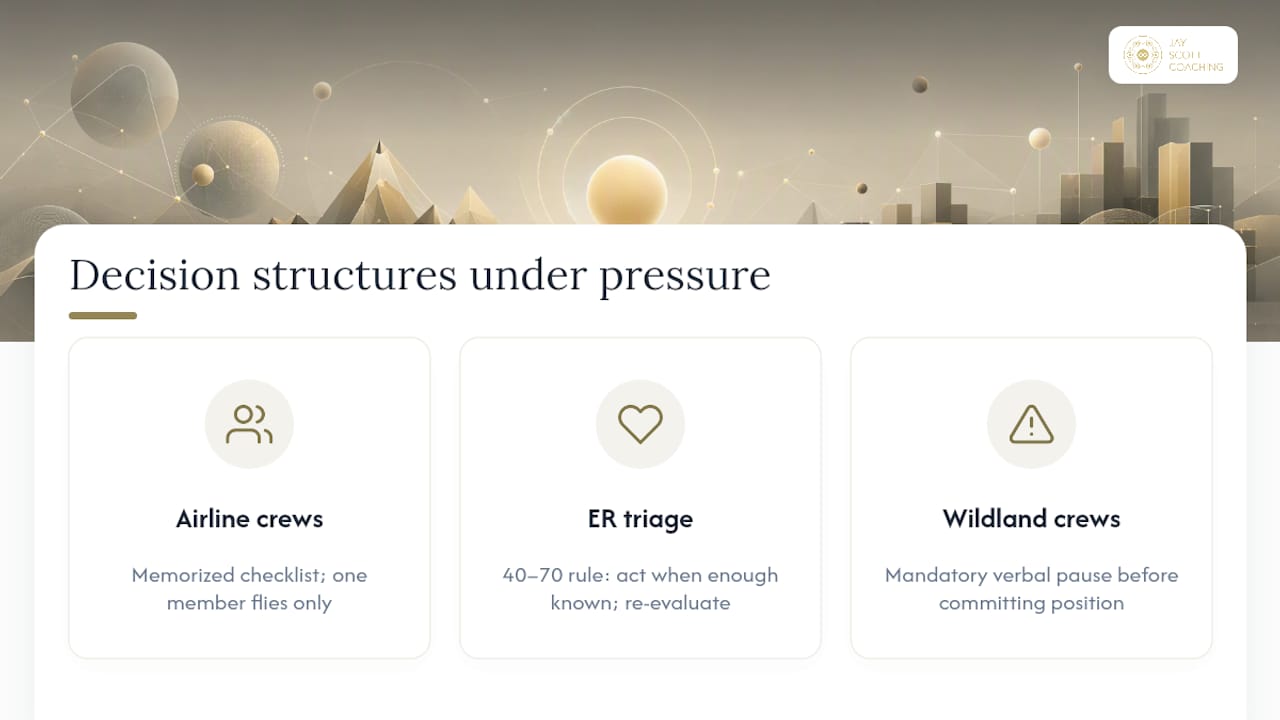
Commercial airline crews train for exactly the scenario where an engine failure, a fire warning, and a communication breakdown might all hit within the same ninety seconds. The standard response isn't creative problem solving. It's running a memorized checklist while one crew member is explicitly assigned to fly the plane and nothing else, a real-world weighted default that removes debate from the moment it's least useful.
Emergency room triage nurses apply something close to the 40 to 70 rule dozens of times a shift. They do not wait for complete information before sorting patients by urgency, because waiting itself carries risk. They act at roughly the point where enough is known to rank the cases correctly, then keep re-evaluating as new information arrives, which is the OODA loop running continuously rather than once.
Wildland firefighting crews use a version of the tactical pause built into their protocols: a mandatory verbal check-in before committing to a new position, specifically because the data on fireground fatalities shows most fatal decisions happen when someone skips that pause under time pressure. The pause isn't a nice-to-have. It's a structural safeguard built from the cost of skipping it.
What connects these examples isn't heroics. It's that each field replaced in-the-moment judgment, the thing pressure degrades most, with a pre-built structure, a checklist, a triage rule, a mandatory pause, decided in advance and rehearsed until it runs on its own.
Why Military, Medical, And Emergency Teams Decide So Differently
The core problem, degraded judgment under stress and time pressure, is identical across fields. The solutions diverge because the failure costs differ.
Military decision making leans hardest on OODA-style rapid iteration because the environment itself keeps changing faster than any static plan can track. Rank and clear command hierarchy exist specifically to answer the "who owns this call" question before the moment arrives, which is why military teams tend to decide fast even in total chaos: the ambiguity was resolved in advance, not in the field.
Medical decision making, particularly in emergency medicine, leans on structured protocols and checklists because the cost of a missed step (a drug interaction, a skipped vital sign) is often more dangerous than a slightly slower decision. Triage systems exist to convert an overwhelming, ambiguous situation into a small number of pre-ranked categories, which is a weighted matrix running at the speed of a glance.
Emergency response and firefighting blend both approaches. Incident command structures borrow the clear ownership rules of military hierarchy, while on-the-ground tactics rely on trained defaults (search patterns, retreat triggers) that function like OODA loops with a hard safety ceiling built in.
What none of these fields do is ask their people to freestyle a decision under maximum pressure with no framework at all. That is the pattern worth borrowing regardless of industry: decide the structure in the calm moment, then let the structure carry the weight when calm is no longer available.
Why Nervous System Training Changes Everything Else
Most of the techniques in this article work. They also share a limitation: they're conscious tools you have to remember to reach for in the exact moment your conscious mind is least reliable. That gap is where coaching earns its place.
The Unshakable Man Method™ exists because training the nervous system directly, rather than only teaching techniques, makes composure automatic instead of effortful. Men who go through it report the same shift, from overthinking and avoidance to decisive, grounded action, not because they memorized more frameworks, but because their baseline capacity for pressure changed. Self-practice with breathing and structured decisions gets you real gains. Guided nervous-system work tends to get those gains to stick under real duress, not just in a calm rehearsal.
— Jay
A Faster Route To Steady Composure Than Willpower Alone
Reading about the physiological sigh and running it once during a real crisis are two different skills, and the gap between them is exactly what focused coaching programs are built to close. Rather than leaving you to piece together breathing techniques, decision frameworks, and emotional regulation on your own, some nervous system training methods aim to make composure under pressure automatic instead of effortful.
This approach fits leaders and high performing men who already know the frameworks but still find themselves overthinking, avoiding hard conversations, or losing their edge exactly when the stakes are highest. Coaching sessions may build steadiness through guided practice, pattern mapping, and direct feedback, providing repetition that self-study alone rarely delivers fast enough. If you recognize yourself in that gap between knowing what to do and actually doing it under real pressure, the next step is a straightforward one: start with an application or consultation call and find out whether the method fits where you're stuck right now.
Sources
- Acute stress impairs decision-making at varying levels of decision complexity (Communications Psychology / PubMed listing)
- Six strategies for making better decisions under pressure — IMD
- Try this: Take a tactical breather — Harvard Health
- Practical DBT interventions (TIP skills) — OSF preprint / clinical summary
- Stressed and rushed? Your decisions might suffer — University of Melbourne / Pursuit
This article is general information, not a substitute for advice from a qualified doctor. Consult a qualified healthcare professional about your own circumstances before acting on anything here.