
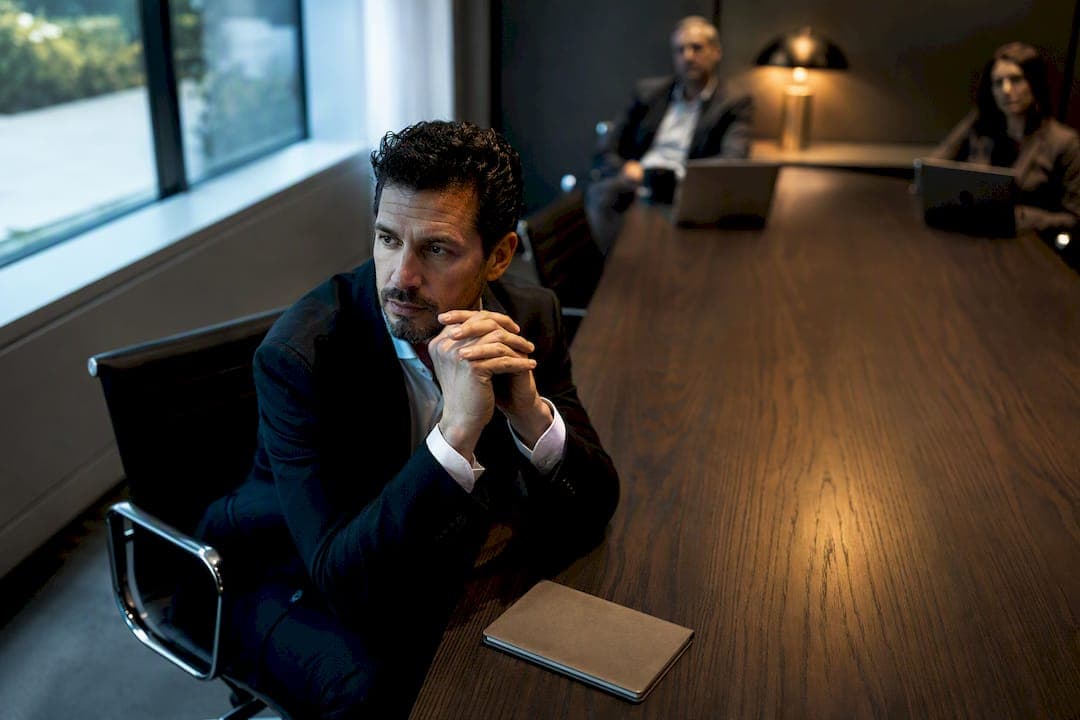
Embodied leadership means leading through bodily sensing, regulation, and presence rather than through title, volume, or willpower alone. It is a somatic, relational process: your nervous system state shapes how a room reads you, and how you regulate it shapes how the room regulates itself. The payoff is measurable in the moment: steadier presence under pressure, sharper emotional regulation, and more genuine influence with the people you lead.
TL;DR:
- Embodied leadership influences group regulation through physiological steadiness, which spreads via nonverbal cues like breath pacing and posture.
- Training involves simple, quick practices such as breath control and posture adjustments that can be integrated into daily work routines.
- Building embodied presence requires awareness and deliberate repetition of micro-practices, followed by applying regulation in high-stakes situations.
- Research indicates that a regulated nervous system enhances trust and team cohesion, especially during conflict, change, and pressure.
- Facilitators must be trauma-sensitive and cautious, as embodied work can reveal emotional material that needs careful handling.
Table of Contents
- What Embodied Leadership Actually Means
- Core Somatic Practices You Can Use Today
- What Does the Research Say About Embodied Leadership?
- How to Build Embodied Leadership: A 6-Step Pathway
- Where Embodied Leadership Changes Outcomes in Organizations
- Facilitation Standards and Ethical Cautions
- How Jay Scott Coaching Applies These Principles
- Why the Conventional Advice on Presence Misses the Point
- Ready to Train Presence Instead of Just Talking About It
- Sources
What Embodied Leadership Actually Means
Most leadership advice still treats the body as scenery. Fix your mindset, sharpen your strategy, learn the right words, and the body will follow. Embodied leadership rejects that split. An integrative conceptual review defines it as a group-level influence process built on three linked capacities: bodily sensing, regulation, and what researchers call "leader-like enactment," meaning your physical state gets read and mirrored by everyone around you before you say a word.
That last part is the piece most executives miss. This is not a self-improvement framework aimed at making one person feel calmer. It is relational by design. A dysregulated leader walking into a tense meeting does not just feel anxious. He transmits that anxiety through posture, breath rate, and vocal tension, and the room absorbs it. A grounded leader does the opposite: his physiological steadiness becomes a kind of contagion, lowering reactivity in everyone else at the table.
Three terms are worth knowing before you go further. Interoception is your ability to sense internal states, a tight chest, a shallow breath, a clenched jaw, before they become a reaction you regret. Proprioception is your sense of where your body is in space, which governs posture, stance, and the subtle signals of confidence or collapse. Co-regulation is the process by which one nervous system stabilizes another, the mechanism that makes a leader's calm actually spread.
This differs sharply from trait-based leadership models, which treat charisma or decisiveness as fixed personality features you either have or lack. It also differs from purely cognitive leadership training, which assumes better frameworks and sharper arguments are enough. Embodied leadership treats presence as trainable physiology, closer to an athletic skill than a personality trait.
Core Somatic Practices You Can Use Today
You do not need a retreat or a two hour ritual to shift your nervous system. Most of the highest leverage practices take under five minutes and fit inside a normal workday.
Breath is the fastest lever available, because it is the one autonomic function you can consciously control. A few patterns worth knowing:
- Physiological sigh (double inhale through the nose, long exhale through the mouth): use it 60 seconds before walking into a tense conversation to drop reactivity fast.
- Box breathing (four seconds in, four seconds hold, four seconds out, four seconds hold): use it before a high-stakes presentation to steady your voice and pacing.
- Extended exhale (exhale longer than you inhale): use it mid-meeting when you feel your jaw tighten or your responses speeding up.
Posture works on a similar principle, but through proprioception instead of breath. Standing or sitting with your weight evenly distributed, shoulders open, and feet grounded changes how your own brain interprets your state, and it changes how others read your authority in the room. Slouched, collapsed posture reads as low confidence even when your words say otherwise.
Interoceptive scans take fifteen seconds and can be done at a conference table without anyone noticing. Silently name one sensation, tight shoulders, warm face, shallow breath, before you respond to a difficult question. Naming the sensation, even privately, interrupts the automatic reactive loop and buys you a beat of choice.
Meeting-ready micro-routines round this out: pause for a full breath before answering a loaded question, deliberately slow your speech pace when tension rises, and practice embodied listening, staying physically still and grounded while someone else speaks instead of visibly preparing your rebuttal.
Pro Tip: Pick one practice, not five. Nervous system training compounds through repetition, not variety. Run the physiological sigh before every meeting for two weeks before adding anything else.
What Does the Research Say About Embodied Leadership?
The evidence base here is still young, but it is coherent, and it converges from two different directions: organizational scholarship and executive coaching practice.
The Emerald Publishing integrative review frames embodied leadership as a group-level influence process, meaning the research is explicitly not about individual calm for its own sake. It is about how one regulated nervous system changes the regulation of everyone connected to it, largely through nonverbal channels like breath pacing and vocal timing rather than explicit direction.
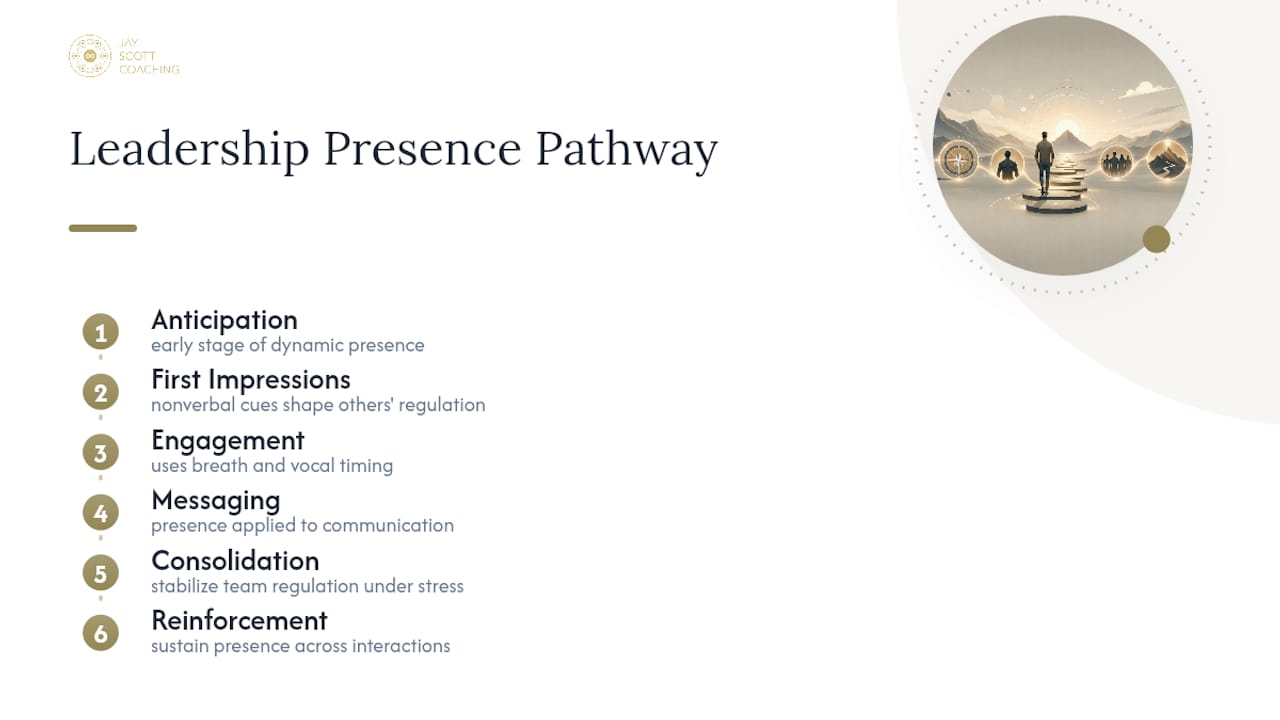
Separately, the Leadership Presence Pathway model treats presence as dynamic rather than fixed, unfolding across six stages: Anticipation, First Impressions, Engagement, Messaging, Consolidation, and Reinforcement. That staged framing matters because it turns "presence" from a vague trait into a sequence of practicable checkpoints.
What the research suggests, in practical terms: stronger embodied presence tends to precede stronger trust, which tends to precede smoother team regulation under stress. Organizations continue investing heavily in this territory. Training expenditures in the United States remain substantial year over year, a signal that companies see leadership development, presence work included, as worth funding rather than a soft extra.
The honest caveat: much of this field still rests on conceptual review and practitioner case study rather than large randomized trials. The mechanisms are plausible and the practitioner evidence is consistent, but longitudinal, outcome-tracked research on embodied leadership specifically is still catching up to the theory.
How to Build Embodied Leadership: A 6-Step Pathway
Scholarly definitions are useful, but they will not change how you walk into your next board meeting. What actually shifts presence is a structured practice sequence, not a single insight. Here is a six-stage pathway drawn from presence development research and adapted for a working leader's calendar.
- Awareness. Spend one week simply noticing your body's baseline state during normal meetings, jaw tension, breath depth, posture, without trying to change anything yet. You cannot regulate what you have not first noticed.
- Micro-practice. Choose one breath or posture practice from the list above and run it daily for two weeks, ideally at the same trigger point (before your first call of the day, for instance).
- Rehearsal. Practice a specific high-stakes scenario, a difficult conversation, a tense negotiation, using embodied scripting: physically rehearse your posture and breath alongside your words, not just the words alone. Practical presence research suggests this transfers to live situations faster than mental rehearsal by itself.
- Co-regulation. Apply your regulated state deliberately inside a group setting, a tense meeting, a team conflict, and watch for whether your own steadiness shifts the room's tone.
- Integration. Fold the practice into your existing calendar rather than treating it as a separate task. Five to fifteen minutes before your highest stakes meeting of the week is enough; you do not need a dedicated hour.
- Measurement. Track simple behavioral indicators: did you pause before reacting, did your voice stay steady, did a colleague comment on your calm. A short weekly reflective prompt, "where did I stay grounded, where did I collapse", works better than a formal scorecard.
Pro Tip: Do not skip stage one. Leaders who jump straight to micro-practice without first building baseline awareness tend to abandon the routine within a week, because they cannot tell whether it is working.
Where Embodied Leadership Changes Outcomes in Organizations
Embodied practice shows up most clearly under three conditions: conflict, change, and high-pressure decisions, exactly the moments where cognitive frameworks tend to break down fastest.
- De-escalation. A leader who slows his breath and drops his shoulders during a heated disagreement tends to lower the emotional temperature of the whole exchange, not just his own.
- Boardroom presence. Grounded posture and paced speech change how proposals land, independent of their content.
- Facilitating inclusion. Embodied listening, staying physically still while others speak, signals genuine attention in a way that verbal encouragement alone does not.
- Remote meeting presence. Breath and posture cues still transmit through video, though more faintly, which is why deliberate practice matters more, not less, on camera.
The mechanism behind all four is co-regulation: a leader's nervous system state measurably shapes the group's affect and interaction rhythm. Watch for shifts in meeting tone, faster decision momentum, and, over weeks, informal reports of higher trust as signals the work is landing.
Facilitation Standards and Ethical Cautions
Somatic work touches the nervous system directly, which means it carries real responsibility. Movement-based facilitation can surface tacit emotional material that a purely verbal coaching session never would, and facilitators without trauma-awareness training can mishandle what surfaces.
Before running embodied exercises with a team, confirm the facilitator has specific training in trauma-sensitive practice, not just general coaching credentials. Screen participants informally for anything that suggests deeper unresolved material, a strong emotional reaction to a simple breath exercise is a signal, not a nuisance. If a practice triggers a response that looks more like a trauma reaction than ordinary discomfort, pause the exercise and refer that person to a licensed clinician rather than pushing through. Embodied practice is powerful precisely because it bypasses cognitive defenses, and that power cuts both ways.
How Jay Scott Coaching Applies These Principles
Jay Scott Coaching built the Unshakable Man Method™ around the same core premise this article makes: presence is trained through the nervous system, not talked into existence. The method works with high-performing men who recognize the pattern from the inside, overthinking in high-stakes moments, avoidance instead of decisive action, a body that stays braced long after the meeting ends.
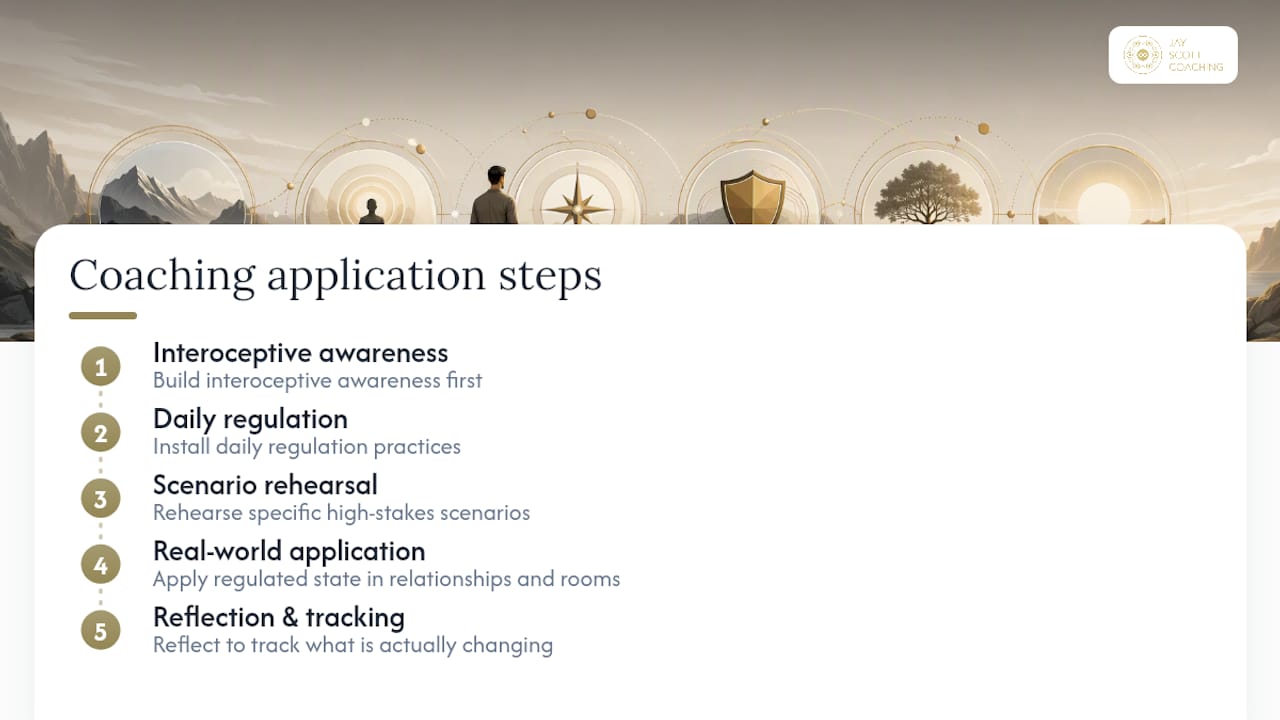
The method maps closely to the six-stage pathway above. Clients build interoceptive awareness first, then install daily regulation practices, then rehearse specific high-stakes scenarios, whether that is a hard conversation with a spouse or a make-or-break negotiation at work. From there, the work moves into applying that regulated state inside real relationships and real rooms, with reflection built in to track what is actually changing.
The results clients describe are consistent with what the research above predicts: steadier communication, clearer decision-making, and a felt sense of groundedness that outlasts the coaching session itself. You can read more about the approach on the why work with me page.
Why the Conventional Advice on Presence Misses the Point
Most leadership content still treats presence as a communication problem: better words, better slides, a stronger opening line. That advice is not wrong, exactly. It is just aimed at the wrong layer of the system.
The research is clear that presence is a physiological state before it is a verbal performance. A leader who scripts the perfect answer while his breath is shallow and his shoulders are locked will still read as anxious, because the body communicates faster and more honestly than the words riding on top of it. That is the gap conventional coaching rarely names.
If you take one thing from this pathway, make it stage one: awareness before technique. Most leaders skip straight to a breathing exercise or a posture tip without ever noticing their actual baseline, and then wonder why the practice does not stick. Presence built on genuine self-sensing outlasts presence built on performance, because it is not dependent on remembering to perform it.
— Jay
Ready to Train Presence Instead of Just Talking About It
This coaching approach is built for the exact gap this article describes: knowing what grounded presence looks like on paper is not the same as having a nervous system that holds it under real pressure. Where books and frameworks stop at explanation, some methods work directly with your physiology through structured, one-on-one coaching, building the regulation skills that make composure automatic instead of effortful.

This approach fits a specific reader: a man who recognizes the overthinking, the avoidance, the tightness that shows up before hard conversations, and who wants that pattern to actually change rather than just be better understood. Individual coaching sessions can work through your specific triggers and rehearse the high-stakes scenarios in your own life, whether that is a leadership moment at work or a hard conversation at home. If any part of this pathway sounds like the work you have been circling without starting, the individual coaching services page outlines what that looks like and how to apply.
Sources
- Embodied leadership in organizations: an integrative conceptual review
- Leadership Presence Pathway
- Embodied leadership: A perspective on reciprocal body movement (chapter)
- A dynamic approach to developing leadership presence (IMD technical note)