

Emotional safety at work is not a policy or a culture statement. It is a steady internal nervous-system state that lets you think clearly, speak plainly, and act decisively when the pressure spikes. Build it with brief regulation tactics in the moment, then reinforce it with structured coaching. Research on cognitive reappraisal and executive coaching backs both moves.
TL;DR:
- Resetting the nervous system during high-pressure moments with quick techniques like slow breathing and grounding can prevent reactive responses.
- Consistent daily practice of breathwork and somatic routines over months can shift baseline emotional regulation, reducing automatic activation in stressful situations.
- Coaching outcomes rely heavily on habitual reappraisal practices and pattern recognition rather than session volume, emphasizing ongoing skill reinforcement.
- The Unshakable Man Method™ trains the nervous system directly through somatic exercises, pattern mapping, and accountability, especially for men who have already tried cognitive fixes.
- Lasting change typically requires three to six months of disciplined practice to recognize early activation cues and develop automatic stoppage skills.
Table of Contents
- What Emotional Safety at Work Actually Means for High Performers
- Does Coaching Actually Change How You Perform Under Pressure?
- What Do You Do in the Moment When Pressure Hits?
- How the Unshakable Man Method™ Trains This Skill Directly
- How Do You Know If Coaching Is the Right Next Step?
- Where the Real Change Happens
- Work With Jay Scott Coaching Directly
- Sources
- FAQ
What Emotional Safety at Work Actually Means for High Performers
Most articles on this topic describe psychological safety: team norms that let employees speak up without fear of punishment. That is a different subject with a different audience. Here, emotional safety at work means something more personal. It's the felt sense of being grounded in your own body, even when the room gets tense.
Your nervous system runs on three broad states. Ventral vagal is calm, connected, and clear. Sympathetic is activated, urgent, and reactive. Dorsal is shut down, checked out, and numb. High-stakes moments, a board challenge, a tense conversation with your spouse, a missed number, push you toward sympathetic or dorsal before your thinking brain even registers the trigger.
This is why talk-only approaches often stall. Insight tells you what happened. It does not retrain the automatic physiological response that hijacks you the next time. You can understand your triggers completely and still snap at your team or go silent with your wife. Emotional safety at work is a physical skill first, an understanding second.
Does Coaching Actually Change How You Perform Under Pressure?
The evidence is stronger than most executives assume, and it is not built on soft claims.
An ecological momentary intervention using cognitive reappraisal reduced negative affect and improved job performance, with gains still present a month later. A separate 2025 study in the Journal of Occupational and Organizational Psychology found that reappraising the situation, not just the emotion, worked better, and the effect did not fade at the one-month follow-up. That distinction matters for how you practice: reframe what is happening, not just how you feel about it.
Coaching outcomes tell a similar story:
- A meta-analysis in Frontiers in Psychology found coaching produces its strongest effects on behavior and cognitive activities, with meaningful gains in self-efficacy and resilience.
- Habitual reappraisal correlates positively with leadership performance, while habitual suppression correlates negatively.
- The number of sessions did not consistently predict outcomes. Consistency of practice mattered more than volume.
What this means for you: coaching changes what you do, reliably, before it changes who you are. If you're waiting to feel like a different person before you expect different results, you are measuring the wrong thing.
What Do You Do in the Moment When Pressure Hits?
You need two kinds of tools: fast tactics for the emergency, and daily rituals that raise your baseline so the emergency happens less often.
Tier 1, use these within 30 seconds of noticing activation:
- Slow breathing. Five to six breaths per minute, with the exhale longer than the inhale. This shifts you toward parasympathetic activation faster than almost anything else you can do standing up.
- Bhramari humming. A low, sustained hum on the exhale. It stimulates the vagus nerve directly and works well in a bathroom before you walk back into a hard conversation.
- Sixty-second grounding. Feel your feet, name three things you can see, unclench your jaw. This interrupts the spiral before it takes over your next sentence.
Tier 2, seven to fifteen minutes, done daily, not just in a crisis:
A morning activation sequence, movement plus breath, sets your baseline tone before the day starts hitting you. An evening decompression routine, the same tools run in reverse, tells your system the day is over so it stops running the tape at 2 a.m.
The skill underneath both tiers is what we call the stoppage: you learn your personal activation signature, tight jaw, throat closing, breath speeding up, and you insert a deliberate pause before you speak or act. Practice it in low-stakes moments first. It will not show up reliably in a boardroom if you have never rehearsed it at the dinner table.
Pro Tip: Track your resting heart rate variability over six to eight weeks instead of day to day. A single number means little. A trend line moving in the right direction means your baseline is actually shifting.
How the Unshakable Man Method™ Trains This Skill Directly
Jay Scott Coaching built the Unshakable Man Method™ around a specific gap: most high-performing men have already tried the cognitive fixes, books, podcasts, therapy insight, and still find themselves reactive under real pressure. The method trains the nervous system directly instead of relying on understanding alone.
The work combines:
- Nervous-system training designed to help you stay grounded under real pressure, not just in a calm room.
- Pattern mapping to help you identify your personal activation signature.
- Somatic practice practiced in low-stakes situations until the stoppage becomes automatic in high stakes.
- Accountability to support consistent practice beyond insight alone.
This approach fits men who have already tried cognitive approaches but still find themselves reactive under pressure, overthinking decisions, avoiding hard conversations, or withdrawing from important relationships. Participants often experience steadier presence in high-pressure situations, clearer decision-making, and improved connection with loved ones. For a fuller picture of the patterns this addresses, see common challenges men face that individual coaching can solve.
How Do You Know If Coaching Is the Right Next Step?
Ask yourself four questions before you book anything: Have you already tried cognitive-only approaches and hit a ceiling? Can you commit real practice time, not just session time, each week? Is there urgency, a specific relationship or role at stake? And are you ready to treat this as training, not a one-time conversation?
Here's a realistic timeline based on what the coaching research shows:
- Month one: you learn the Tier 1 protocols and start recognizing your activation signature before it runs the show.
- Around three months: behavior shifts become visible to other people, fewer reactive moments, clearer calls under pressure.
- Six months and beyond: your baseline itself moves, and the people close to you notice the difference before you fully name it yourself.
In a consultation, ask how progress gets measured, what daily practice actually looks like, and what the first thirty days require of you. A program with no way to track behavioral change and no clear practice structure is a red flag, regardless of how good the pitch sounds.
Where the Real Change Happens
The stoppage is the whole game. Every client who makes lasting progress eventually stops trying to think their way out of activation and starts practicing the pause instead. That shift, from managing thoughts to managing physiology, is where confidence actually gets rebuilt.
One pattern shows up again and again: a leader comes in convinced his problem is a communication issue. Three months into consistent practice, he realizes the real issue was never what to say. It was that his body hit sympathetic activation before he ever opened his mouth, and the words that came out were damage control, not leadership. Once he could catch that signature early, the words changed on their own.
Specific outcomes and client stories vary, and Jay Scott Coaching can speak to the particulars during a consultation.
— Jay
Work With Jay Scott Coaching Directly
Reading about the stoppage is useful. Practicing it with someone who can spot your specific pattern, in real time, is what actually rewires it. Jay Scott Coaching offers a structured path built specifically for men who have already tried insight-only fixes and need embodied training instead.

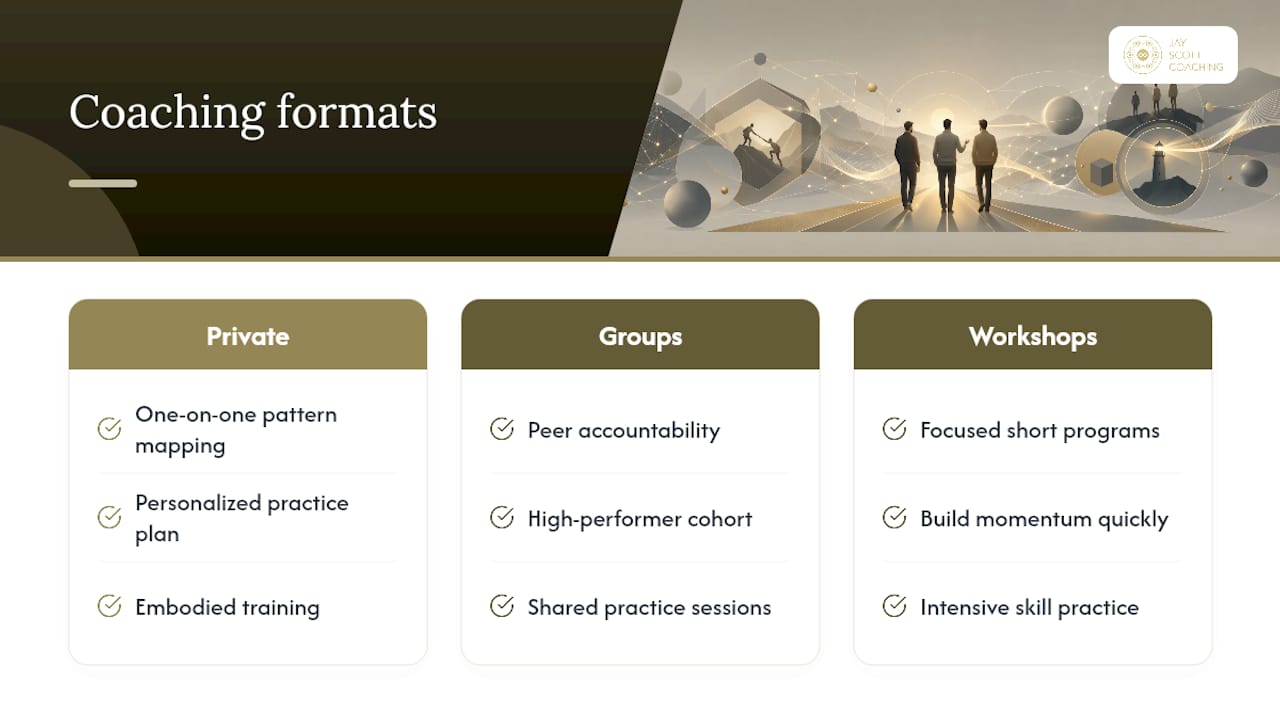
Three formats map to different needs. Private Coaching offers one-on-one pattern mapping and a personalized practice structure. Groups provide a setting with other high performers working on similar skills to support accountability. Workshops & Immersions provide focused programs designed to build momentum quickly. All three formats are described on the Private Coaching, Groups, Workshops & Immersions page.
A consultation call covers your current activation patterns, what has not worked yet, and which format fits your situation. If you are ready to stop managing symptoms and start training the actual skill, book a call through why work with me and get a direct read on where to start.
This article is general information, not a substitute for advice from a qualified doctor. Consult a qualified healthcare professional about your own circumstances before acting on anything here.
Sources
- Cognitive reappraisal emotion-regulation interventions in the workplace and their impact on job performance (ecological momentary intervention)
- Empirical research on habitual emotion regulation and leadership outcomes
- Meta-analysis of coaching effectiveness (Frontiers in Psychology, 2023)
- Cognitive reappraisal ecological momentary intervention in the workplace (Journal of Occupational and Organizational Psychology, 2025)
FAQ
What Is the Difference Between Emotional Safety and Psychological Safety?
Emotional safety, as used here, is your internal nervous-system state, whether you feel grounded enough to think and act clearly under pressure. Psychological safety refers to team-level norms about speaking up without fear of punishment. They are related but distinct, and this article focuses on the internal, individual skill.
How Long Does It Take to Feel More Regulated Under Pressure?
Most people notice their emergency protocols working within the first month of consistent practice. Behavioral shifts, fewer reactive moments and clearer decisions, tend to become visible after some months, based on patterns seen in executive coaching research.
Can Breathing Exercises Really Change How I Respond to Stress?
Slow breathing at five to six breaths per minute with a longer exhale activates the parasympathetic nervous system within minutes, and cognitive reappraisal paired with in-the-moment practice has shown job performance improvements that lasted at least a month. It works best as a repeated skill, not a one-time trick.
How Much Does Coaching With Jay Scott Coaching Cost?
Pricing for Private Coaching, Groups, and Workshops & Immersions is available directly through why work with me, since costs depend on the format and structure that fits your situation. A consultation call is the fastest way to get an exact answer.
Do I Need to Be in Crisis to Start This Kind of Coaching?
No. Most clients start while performing well on paper but noticing reactivity, anxiety, or disconnection under the surface. Early intervention, before a crisis forces the issue, tends to produce faster and steadier results.