

Emotional sobriety is the ability to feel your full range of emotions, including the hard ones, without letting them run your behavior. It matters because staying physically sober keeps you out of the bottle or the pill bottle, but it doesn't teach you what to do with anger, shame, or loneliness when they show up uninvited. Below, we'll walk through what emotional sobriety actually looks like, how it differs from abstinence, and the practical skills that build it day by day.
TL;DR:
- Building emotional sobriety involves developing the ability to name, tolerate, and accept feelings without reacting impulsively or relying on substances.
- It requires a deliberate process of practicing self-awareness, setting boundaries, and staying present despite discomfort, often supported by therapy or peer groups.
- Progress depends on consistent daily practices like affect labeling, grounding exercises, and tracking emotional triggers, with no fixed timetable for mastery.
- Overreliance on recovery rituals or affirmations can hinder emotional growth if feelings remain unprocessed or buried beneath superficial positivity.
- Long-term success is marked by steadier relationships, fewer reactive patterns, and increased resilience, not by achieving constant calm or perfection.
Table of Contents
- What Is Emotional Sobriety, Really?
- How Emotional Sobriety Differs From Physical Sobriety
- Why Emotional Sobriety Matters for Recovery and Daily Life
- What Emotional Sobriety Actually Looks Like Day to Day
- How to Build Emotional Sobriety: A Practical Toolkit
- How Long Does Emotional Sobriety Take to Develop?
- The Traps That Undermine Emotional Sobriety
- How Coaching Supports Nervous-System Work in Recovery
- Where to Go Deeper
- What the Research Actually Supports, and What It Doesn't
- Ready to Build This Skill With Support?
- Sources
What Is Emotional Sobriety, Really?
Emotional sobriety is emotional autonomy: the capacity to feel anger, grief, boredom, or fear without needing a substance, a compulsion, or an outburst to make the feeling go away. It's not about controlling your emotions like a thermostat. It's about staying present with them long enough that they pass through you instead of running the show.
Here's where most people get the definition wrong. They picture emotional sobriety as a permanent state of calm, some enlightened plateau where triggers stop landing. That's not what it is, and chasing that version sets you up to feel like a failure the first time you snap at your spouse or spiral over a work email. Psychology Today's analysis of emotional sobriety makes the point directly: the goal isn't constant happiness. It's the willingness to feel what's actually there, including the feelings nobody wants.
This idea isn't new. Bill Wilson, cofounder of Alcoholics Anonymous, wrote about it in a 1958 essay he called "The Next Frontier: Emotional Sobriety." Wilson had been sober for over two decades and still found himself gripped by depression and dissatisfaction. He concluded that physical abstinence had solved one problem and exposed another: an immature emotional life that hadn't caught up to his sober years. He framed the work ahead as learning humility, maturity, and the ability to "Twelfth Step" himself through emotional pain rather than demanding the world make him comfortable, a framing that still shapes how recovery literature talks about long-term recovery today.
In plain terms, emotional sobriety includes a few core capacities:
- Noticing a feeling as it arises instead of realizing it three hours later when you've already acted on it
- Tolerating discomfort long enough to choose a response instead of reacting on autopilot
- Accepting that some days will feel worse than others, without treating that as evidence you're failing at recovery
- Staying connected to people even when a feeling makes you want to withdraw or lash out
That last point trips people up in relationships. Emotional sobriety in relationships often looks less like harmony and more like staying in the room during a hard conversation instead of shutting down or storming off.
How Emotional Sobriety Differs From Physical Sobriety
Physical sobriety is abstinence: you stop drinking, using, or engaging in the compulsive behavior. Emotional sobriety is what you do with the feelings that used to get numbed out. They're related, but one doesn't automatically produce the other.
Cleveland Clinic's clinical overview of emotional sobriety treats physical sobriety as a foundation rather than an endpoint. The reasoning is straightforward: it's very hard to build tolerance for difficult emotions while a substance is still available to short circuit the feeling the moment it gets uncomfortable. Get the substance out of the loop, and the real emotional work usually becomes possible, sometimes for the first time in years.
That order of operations plays out in predictable scenes:
- Someone hits 90 days sober and feels more irritable, not less, because the numbing agent is gone and the irritation has nowhere to hide
- A person maintains years of abstinence but still explodes at their kids, because nobody ever taught them what to do with anger once alcohol wasn't handling it
- Someone white knuckles through cravings using willpower alone, without any parallel work on the anxiety driving the cravings in the first place
None of this means physical sobriety is easy or a lesser achievement. It means it's a prerequisite, not a finish line. The emotional work is a separate skill set that has to be built deliberately, usually with support.
Why Emotional Sobriety Matters for Recovery and Daily Life
Unregulated emotion is one of the most common paths back to relapse. When shame, loneliness, or anger builds with no outlet, the old coping mechanism, whatever it was, starts to look appealing again. Emotional sobriety interrupts that pathway by giving you other ways to metabolize the feeling before it turns into a decision you'll regret.
The functional gains extend well past relapse prevention. People who build emotional regulation skills tend to make clearer decisions under pressure, because they're not making choices from a flooded nervous system. Relationships improve, because a partner or friend can trust that a hard conversation won't end in stonewalling or a blowup. Work performance often steadies too, since fewer decisions get hijacked by an emotional reaction that has nothing to do with the task at hand.
SAMHSA frames recovery as an ongoing process, not a single achievement, and lists treatment and peer-support resources built around exactly this kind of skill building. That framing matters for coping with emotions long term: recovery isn't just staying away from a substance. It's building an entirely different relationship with distress.
A few concrete markers of what emotional sobriety changes in daily life:
- Fewer decisions made purely to escape discomfort (skipping the confrontation, numbing out with a screen, avoiding the phone call)
- More capacity to sit with a partner's frustration without immediately defending or deflecting
- A shorter gap between "something upset me" and "I understand why," instead of that gap stretching into days
- Less reliance on other people to regulate your mood for you
This is also a public health issue, not just a private one. Mental health conditions are widespread across the population, and emotion regulation skills are relevant to far more people than those in formal addiction recovery. The overlap between recovery work and general emotional resilience is larger than most people assume.
What Emotional Sobriety Actually Looks Like Day to Day
Emotional sobriety isn't a personality type. It's a set of observable habits, and you can watch yourself get better at them over time.
- Self-awareness and affect labeling. You can name what you're feeling with some precision, "this is resentment, not just anger," rather than a vague sense of being "off." Naming the emotion is the first move that creates distance from it.
- Distress tolerance. You can sit with an uncomfortable feeling for minutes, sometimes longer, without needing to fix it, escape it, or take it out on someone else.
- Acceptance and nonreactivity. You notice the urge to react instantly and let a few seconds pass before you decide whether to act on it. This is the heart of respond not react: the pause between stimulus and behavior.
- Healthy boundaries. You can say no, disagree, or set a limit without either collapsing into guilt or overcorrecting into aggression.
- Present-moment awareness. You catch yourself ruminating on the past or spinning out about the future, and you can bring attention back to what's actually happening right now.
- Resilience. A bad day, a setback, or a triggering conversation doesn't undo weeks of progress. You recover faster than you used to.
Emotional sobriety for men often runs into a specific obstacle here: many men were never taught affect labeling as kids, so the first skill on this list, simply naming the feeling, can be the hardest one to build. That's not a character flaw. It's a skill gap, and skill gaps close with practice.
Pro Tip: Keep a running list of ten emotion words beyond "fine," "good," and "stressed," things like "resentful," "restless," "flat," "wired," "tender." When something's off, scan the list before you decide how you feel. Precision does half the regulation work by itself.
None of these traits show up perfectly or permanently. You'll have a week where boundaries feel easy and a week where you cave on every single one. The trend line matters more than any individual day.
How to Build Emotional Sobriety: A Practical Toolkit
Emotional sobriety builds through repetition, not insight alone. You can understand exactly what's wrong with your reactivity and still react the same way next week if you haven't practiced a different response enough times for it to become automatic. Here's a prioritized way to build the skill.
Get the right kind of support
- Individual therapy helps most when the goal is understanding the origin of a pattern, why a certain comment from your partner sends you into a shutdown, for instance. A therapist trained in trauma or attachment work is often the right fit here.
- Group therapy or peer support groups help with a different problem: they show you that your reactions aren't as uniquely broken as they feel in isolation, and they give you a low-stakes place to practice being honest about a hard emotion out loud.
- 12-step or recovery-specific programs add structure and accountability, plus a built-in community that already speaks the language of emotional sobriety, since the term originated inside that literature.
None of these are mutually exclusive. Many people in solid recovery use two of the three at once, therapy for the deeper pattern work, a group for weekly accountability.
Train the actual skills
Mindfulness and affect labeling have real backing in the clinical literature for reducing reactivity and supporting better emotion regulation. Dialectical behavior therapy contributes a set of distress tolerance skills, techniques for getting through an intense feeling without making it worse, that translate well outside a clinical setting.
The clearest version of respond not react comes down to four steps:
- Pause. Notice the urge to react before you act on it, even if the pause is only two seconds long at first.
- Process. Name the feeling and ask what it's actually about. Anger at a slow driver is rarely just about the driver.
- Plan. Decide what response actually serves you, not just what would feel satisfying in the next ten seconds.
- Proceed. Act on the plan, not the impulse.
Affect labeling research backs the "process" step specifically: naming an emotion measurably lowers the intensity of the stress response in the moment, which is part of why this four step sequence works better than trying to white knuckle a reaction away.
Support the nervous system directly
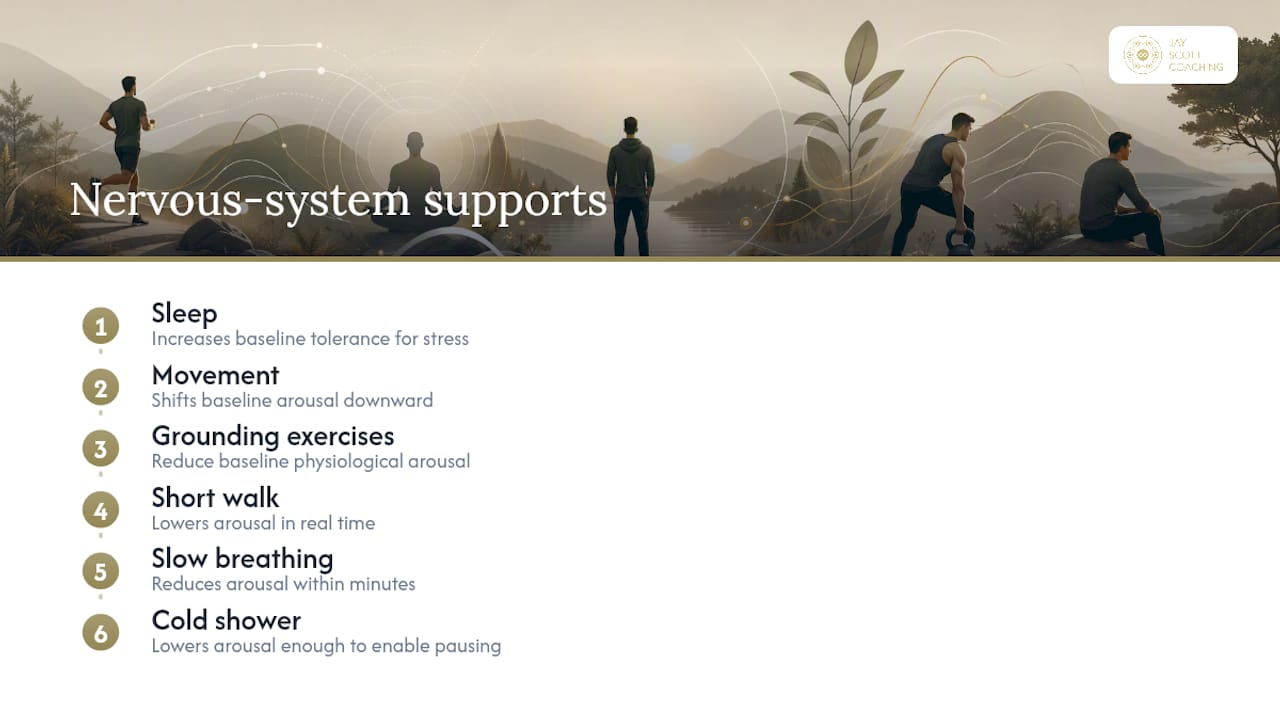
Sleep, movement, and grounding exercises aren't wellness fluff, they change your baseline capacity to tolerate stress before a trigger ever shows up. Someone running on four hours of sleep has a shorter emotional fuse no matter how much insight they've built. A short walk, a few minutes of slow breathing, or a cold shower can lower physiological arousal enough that the "pause" step above actually becomes possible in real time instead of theoretical.
Build accountability into your week
A sponsor, a coach, or a consistent peer group gives you somewhere to report back, which matters more than most people expect. Emotional sobriety is easy to fake to yourself and hard to fake to someone who checks in weekly. If you want a concrete starting point for the communication side of this, there are practical ways men can show emotion effectively that work well as a shared reference with a coach or a partner.
Pro Tip: Pick one micro-exercise and run it for two weeks before adding another. Trying to install five new habits at once is how most people abandon all five by week two.
Four micro-exercises worth trying this week:
- Before responding to a triggering text, count to ten and name the emotion silently before you type anything
- Once a day, say out loud (even alone in your car) what you're feeling, using one of the precise words from your emotion list
- When you notice rumination, name it, "I'm ruminating," and redirect attention to one physical sensation in the room
- At the end of each day, write one sentence naming the strongest emotion you felt and what triggered it, no analysis required, just the record
How Long Does Emotional Sobriety Take to Develop?
There's no fixed timeline, and anyone who promises you one is selling something. Cleveland Clinic's overview is direct about this: some people notice real gains within months, while for others it's a lifelong practice with no clean finish line. Both outcomes are normal.
Short-term progress tends to look like a longer pause before reacting, fewer decisions made purely to escape discomfort, and a faster recovery time after a bad moment. Long-term progress looks different: steadier relationships, fewer situations that used to be triggers still landing that way, and a general sense that your emotional floor has risen even on hard days.
A few markers worth tracking over time:
- How long the gap is between feeling triggered and choosing a response (shrinking this gap is real progress, even slowly)
- Whether the same situations keep triggering the same intensity of reaction, or whether that intensity is softening
- Whether your closest relationships feel more stable this year than last year
- Whether you're using outside support (a therapist, a group, a coach) consistently rather than only in a crisis
Track the trend, not the day. A single hard week doesn't erase six months of progress, and treating it that way is its own form of emotional perfectionism, the exact rigidity emotional sobriety is supposed to loosen.
The Traps That Undermine Emotional Sobriety
The biggest trap is spiritual bypass, using recovery language or ritual to avoid a feeling rather than process it. Someone who responds to genuine grief with "everything happens for a reason" before they've let themselves actually grieve isn't practicing acceptance. They're skipping a step and calling it wisdom.
Watch for these patterns:
- Reaching for a slogan or affirmation the instant a hard feeling shows up, instead of sitting with it first
- Treating meetings, journaling, or meditation as boxes to check rather than spaces where real feeling happens
- Insisting you're "at peace" with something you clearly haven't processed, especially if people close to you would disagree
- Expecting recovery to eventually produce constant calm, and feeling like a failure whenever it doesn't
Ritual itself isn't the problem. A meditation practice, a meeting schedule, a gratitude list, these are useful scaffolding. They become a problem only when they replace the feeling instead of holding space for it. The honest test is simple: after the ritual, did the feeling actually move, or did it just get relabeled and buried?
Pro Tip: If you notice you've described the same conflict or feeling as "resolved" three times without anything actually changing, that's usually a sign it isn't resolved. It's a sign you've found a good story about it.
If a feeling has been sitting unprocessed for months, or if the same reactive pattern keeps repeating despite real effort, that's the point to bring in a therapist or coach rather than trying to journal your way through it alone.
How Coaching Supports Nervous-System Work in Recovery
Therapy and support groups build insight and community. What often gets left out is direct nervous-system training, teaching the body itself to stay grounded when a trigger lands, rather than relying on cognitive strategy alone under pressure.
That's the piece this coaching focuses on. Work often includes pattern mapping, identifying the specific triggers and self-abandonment habits that show up in a person's relationships and career, paired with structured communication practice and nervous-system exercises designed to widen the gap between trigger and reaction. The aim isn't to think your way to calm. It's to train the body to stay regulated long enough that the thinking can happen at all.
For readers who've noticed how anxiety or overthinking shows up specifically in close relationships, a relationship-focused coaching approach tackles that overlap directly. And building general emotional intelligence alongside nervous-system work tends to compound both skill sets faster than either one alone.
Where to Go Deeper
For clinical grounding, start with Cleveland Clinic's overview of emotional sobriety and SAMHSA's recovery resources. For the historical roots of the term, read Bill Wilson's original essay, The Next Frontier: Emotional Sobriety. For related reading on emotional reactivity, this discussion of neurodiversity and emotional reaction is worth a look.
What the Research Actually Supports, and What It Doesn't
Most of what gets written about emotional sobriety overpromises the destination and underexplains the mechanism. The clinical and recovery literature is consistent on one point that popular advice keeps softening: there is no finish line, and pretending there is sets people up to feel like they've failed the moment a hard day arrives.
Where conventional advice falls shortest is the assumption that insight equals change. Understanding your triggers intellectually and actually pausing before you react to them are two different skills, built two different ways. The literature on affect labeling and distress tolerance backs a specific claim: repetition of small, concrete practices, naming a feeling, sitting with discomfort for sixty seconds, changes reactivity faster than another year of talking about your childhood in the abstract.
If you take one thing from this, prioritize the nervous system before the narrative. Understand your story eventually. Regulate your body first.
— Jay
Ready to Build This Skill With Support?
Everything above, the pause practice, the affect labeling, the daily grounding, works. It also works faster and sticks longer with someone tracking your patterns alongside you, which is exactly the gap Jay Scott Coaching's Unshakable Man Method was built to close for high-performing men whose overthinking and avoidance show up hardest under pressure.
Coaching makes the most sense once you've noticed a repeating pattern, the same fight with your partner, the same freeze in high-stakes conversations at work, and you've tried the solo practices above without the gap closing. That's the signal it's time for structured, one-on-one work rather than another book or podcast. This coaching often builds pattern mapping and nervous-system training directly into each engagement, so the pause between trigger and reaction gets trained deliberately instead of left to chance. If that sounds like where you are right now, start with a look at how the coaching works and book a consultation to talk through your specific pattern.
This article is general information, not a substitute for advice from a qualified doctor. Consult a qualified healthcare professional about your own circumstances before acting on anything here.
Sources
- Understanding Emotional Sobriety and How To Achieve It
- SAMHSA — Recovery resources
- NCBI article — emotion regulation literature
- The Next Frontier: Emotional Sobriety — Bill Wilson