
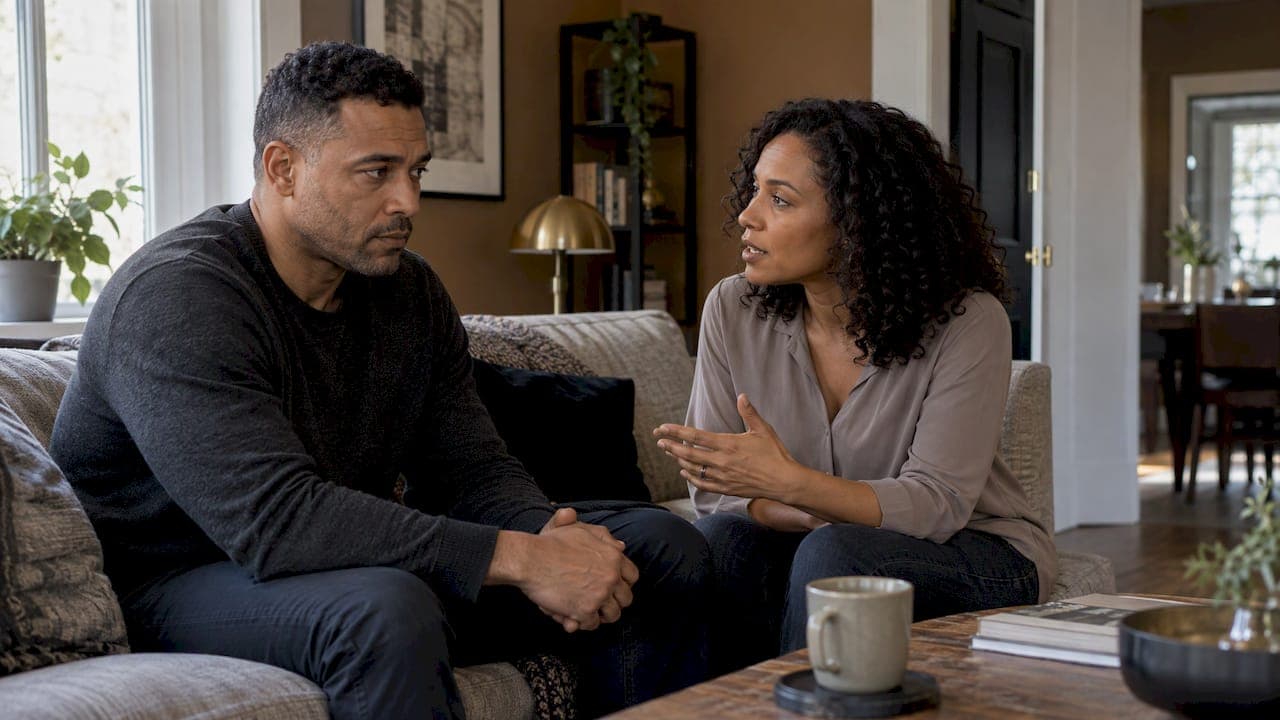
An emotional trigger is a moment when something your partner says or does sets off a reaction far bigger than the moment seems to deserve. Your chest tightens, your voice sharpens or you go silent, and later you wonder what happened. The way through is to notice the reaction in your body, slow it down, and then talk about what it touched in you without blaming anyone.
If you are a man who prides himself on staying composed, this can feel confusing. You handle pressure at work, yet one tone of voice at the kitchen table undoes you. Nothing is wrong with you. Your nervous system is doing what it learned to do. Below, we walk through what triggers are, what commonly sets them off, how to catch one early, and what to say afterward.
TL;DR
- A trigger is a sudden, intense reaction, often tied to past pain, stress or an unmet need, according to Cleveland Clinic.
- Your body usually warns you first: tight chest, fast heartbeat, clenched jaw, talking faster, or shutting down.
- When you are flooded, take a break of at least 20 minutes, use it to calm down rather than rehearse the argument, and then come back.
- Afterward, own your reaction, explain what it meant to you, and invite your partner's view.
- Patterns that keep repeating deserve support: coaching to build regulation skills, and a licensed therapist when pain runs deep.
Table of Contents
- What emotional triggers in a relationship really are
- Common triggers between partners
- How to catch a trigger before you react
- What to do in the moment
- Talking about it afterward
- Perspective: what we see in men who struggle with triggers
- Support that fits the pattern
- Work on your triggers with us
- A short practice for this week
- FAQ
- Sources
What emotional triggers in a relationship really are
Cleveland Clinic describes emotional triggers as situations, whether environmental, interpersonal, sensory or thought-based, that spark sudden, intense negative reactions, often linked to past trauma, pain or stress. The present moment touches something older, and your system responds to the old thing.
SimplePractice gives a simple example: a partner walks out without acknowledging you, and it lands as rejection because rejection once hurt deeply. The partner may have only been running late. The reaction is real either way.
That is why triggers feel unfair from both sides. You feel attacked. Your partner feels they said nothing wrong. Both experiences are true, and neither person is the villain.
Unmet needs sit underneath
The Family Institute notes that triggers often appear when a present event seems to recreate an unmet need, such as autonomy, control, predictability, being valued, feeling safe, fairness, or being seen and heard. That list is worth reading slowly. Most of us can find two or three that make us bristle.
For many high-performing men, the need underneath is to be respected and to be allowed to figure things out without being managed. When a partner's comment sounds like "you got that wrong," the need for respect flares, and the reaction follows.
Common triggers between partners
Some themes show up again and again. SimplePractice lists rejection, betrayal or lack of trust, threats to self-worth, feeling smothered or overly needed, and abandonment as common ones.
Behaviors matter too. A study of more than 100 participants reported by Psychology Today found that partners are upset by condescension, jealousy or possessiveness, neglect, rejection, unreliability, infidelity, inconsiderateness, moodiness, and sexual rejection. The same article lists the everyday topics couples fight about: communication, chores, decisions, money, habits, role expectations, screen time and time management.
Some triggers are sensory. Cleveland Clinic gives the example of a partner's raised voice setting off anger tied to being yelled at as a child. You are not reacting to your partner's volume alone. You are reacting to every time that volume meant trouble.
How triggers show up in men who hold it together
In our work with high-performing men, triggers rarely look like shouting. More often they look like:
- Going quiet, getting efficient, and moving on without really being present.
- Overthinking a comment for hours and then bringing up something unrelated.
- Agreeing to keep the peace, then feeling resentful.
- Over-explaining or defending before your partner has finished a sentence.
These are all ways of leaving yourself in the moment. We call it self-abandonment: you stop staying with what you feel and what you need, because staying feels unsafe. The trigger is the doorway. The habit of leaving is the pattern worth working on.
How to catch a trigger before you react
You cannot manage what you do not notice. The good news is that your body announces triggers early.
Utah State University Extension points to a sudden, intense reaction, plus physical signs such as a tight chest, a faster heartbeat, heavy breathing, shaking or tense muscles. It also names earlier signals: talking faster, sarcasm, the urge to prove your point, or shutting down.
Some people notice a triggered state first as difficulty thinking clearly. If you suddenly cannot find words, or your thoughts race, treat that as information, not failure.
A quick personal check
Try these questions when you are calm, not mid-argument:
- What was the last conversation where my reaction was bigger than the moment?
- What did I feel in my body just before it?
- What did I tell myself it meant ("she doesn't respect me," "I'm failing")?
- When did I first feel this way, long before this relationship?
The Extension guidance suggests exactly this kind of reflection: notice your likely pressure points before conflict, ask what activates you and what meaning you attach to it, and then tell your partner about the pattern without expecting them to tiptoe around you.
If your reactions also come with sensory overwhelm, mapping when it happens can help. A resource on mapping sensory overload episodes can help you spot what builds up before the spike.
What to do in the moment
This is the part most people want first. Here is a sequence drawn from the Utah State University guidance and Cleveland Clinic.
- Name it. Say to yourself what you feel, as precisely as you can: anger, anxiety, hurt, abandonment, frustration. Cleveland Clinic notes that labeling emotions can help regulate and calm them.
- Slow your body. Press your feet into the floor, unclench your jaw, drop your shoulders, open your hands, and breathe out longer than you breathe in. Then lower your voice and slow your speech, as the Extension guidance recommends.
- Pause before you say or do anything you may regret. Psychology Today's advice is to stop and reflect first.
- Take a real break if you are flooded. More on that next.
Why not just push the feeling down?
Because it does not work well. A 2013 experiment with 127 couples found that suppressing emotion raised cardiovascular arousal and negative feelings, while adopting a positive relationship mindset lowered them. The effects were stronger in people high in attachment anxiety. The same research suggests regulation is shared: one partner's suppression or mindset can change the other's physiology during conflict.
So staying calm is not the same as swallowing it. The goal is to let the wave pass through your body while you stay present. For many men, that is the unlearned skill, and suppressing feelings tends to strain relationships over time.
Taking a break that is not avoidance
Some men fear that stepping away looks like walking out. It does not have to. Utah State University Extension reports that John and Julie Gottman recommend at least 20 minutes for the brain and body to calm after flooding. The break is communicated as a pause, not abandonment, and followed by a return to the conversation.
Here is how that sounds in plain words:
"I'm getting overwhelmed and I want to handle this well. I need 20 minutes. I'll come back to this, I promise."
Then use the time to settle, not to build your case. Walk, read, breathe. Mentally replaying the argument keeps your body in the fight.
A structured pause and avoidance can look similar from the outside. The difference is the return. If you leave and never come back to the topic, that is avoidance. If you leave, calm down, and come back, that is regulation.

Talking about it afterward
Once you are both steady, the conversation that follows is where relationships actually change.
Psychology Today suggests you own the trigger rather than hand your partner responsibility for your reaction. Explain what happened inside you and what you thought it meant. Then invite your partner to describe their experience. Later, talk about what your partner can do to help and what you can do to see things differently and react more calmly.
A simple template:
- "When you said ___, my chest got tight."
- "What I told myself it meant was ___."
- "It reminds me of ___ from long before us."
- "What was that like for you?"
- "What would help next time? Here's what I'll try."
Notice what is missing: "you always" and "you made me." Owning your side does not mean taking all the blame. It means you are no longer waiting for your partner to fix your nervous system.
It works in the other direction as well. When your partner shares their own trigger, you can respond with compassion and recognize why their reaction made sense, without excusing hurtful behavior. Understanding each other's histories makes defensive or attacking behavior easier to read. Both of you are protecting something tender.
Perspective: what we see in men who struggle with triggers
We meet many men who are great at solving problems for everyone else. Then a trigger hits at home, and the toolkit that works at the office stops working. Logic does not calm a nervous system that believes it is under threat.
Here is what we believe. Insight alone rarely changes a pattern. You can understand exactly why you shut down and still shut down next Tuesday. What changes it is training your nervous system to stay grounded under pressure, so you can feel the charge and still choose your response. That is the core of the Unshakable Man Method™.
We also believe the real cost of triggers is not the argument. It is self-abandonment: the moment you leave yourself to keep the peace, avoid the discomfort, or win. Over time that chips away at confidence, and it leaves your partner talking to someone who is not fully there.
This is why our coaching focuses on emotional regulation and inner safety, on mapping your own patterns so you can see them coming, and on real accountability to act differently. Men who do this work tell us it changes how they speak, decide and connect, at home and at work.
Jay
Support that fits the pattern
Self-help gets you far. Some patterns need more.
Psychology Today suggests considering couples therapy when conflict has lasted more than six months, leaves long emotional after-effects, repeatedly damages connection, or follows a critical incident such as betrayal. It also fits when partners cannot bring underlying emotions to the surface, feel unheard, or stay resentful after fights.
The Society of Clinical Psychology describes Emotionally Focused Couples Therapy as an attachment-based approach that de-escalates a couple's negative cycle and builds more secure connection. It typically runs 8 to 20 sessions, though complexity can add more.
If your triggers connect to trauma, flashbacks, or any form of abuse, please work with a licensed mental health professional. If you ever feel unsafe, contact a qualified professional or local emergency services right away. Coaching can sit alongside that work, building day-to-day regulation skills and follow-through. It does not replace clinical care for trauma.
Work on your triggers with us
If you are tired of knowing what you should do and not doing it in the heat of the moment, that is the gap we work on. Our coaching helps high-performing men train their nervous systems to stay steady under pressure, map the patterns that run them, and take decisive action in their marriages and careers.
You can work with us one-on-one, in a group, or through workshops and immersions. Take a look at how we work together and apply when you feel ready.

You do not need to have it figured out. You only need to be willing to stop leaving yourself.
A short practice for this week
The next time you notice a spike, run this five-step loop:
- Notice the first body signal.
- Name the emotion in one word.
- Breathe out slowly and drop your shoulders.
- Say a sentence that asks for a pause if you need one.
- Revisit the topic later with the template above.
You will not do it perfectly. Nobody does. Each time you stay with yourself through the surge, the muscle gets stronger, and the next trigger loses a little of its grip.
FAQ
How do you not react when someone triggers you?
Catch the body signal first, such as a tight chest, a faster heartbeat or a clenched jaw. Name the emotion, lengthen your exhale, lower your voice and slow your speech. If you are flooded, ask for a break of at least 20 minutes and use it to calm down, not to rehearse the argument.
Are emotional triggers always about trauma?
Not always. Triggers are often linked to past pain or stress, but they can also come from unmet needs such as feeling respected, safe, heard or in control. If your reactions involve flashbacks or feel overwhelming, a licensed mental health professional is the right person to see.
What are the most common emotional triggers in relationships?
Rejection, feeling abandoned, betrayal or lack of trust, threats to self-worth, and feeling smothered come up often. Everyday behaviors like condescension, neglect, jealousy and being ignored can set them off as well. Your own list depends on your history.
How do I talk to my partner about my triggers?
Wait until you are both calm. Describe what happened inside you and what you thought it meant, without blaming, then ask how it was for your partner. Finish by agreeing on what each of you can do next time.
When should we get outside help?
Consider it if the same fight keeps returning for more than six months, if the aftermath lingers, or if trust has been broken. Therapy is also a good fit when one of you feels unheard or resentful after every conflict.
Sources
- Emotional triggers: Cleveland Clinic
- Emotional triggers in relationships: SimplePractice
- Do You Know Your Partner's Triggers? The Family Institute
- The 10 Most Common Sources of Conflict in Relationships: Psychology Today
- How to Deal With Trauma Triggers in a Relationship: Wellman Psychology
- When Emotions Take Over: Learning to P.A.U.S.E. Before You React: Utah State University Extension
- How to Handle Emotional Triggers: Psychology Today
- Emotion suppression and relationship mindset study: APA PsycNET
- Should We See a Couples Therapist? Psychology Today
- Emotionally Focused Couples Therapy: Society of Clinical Psychology