
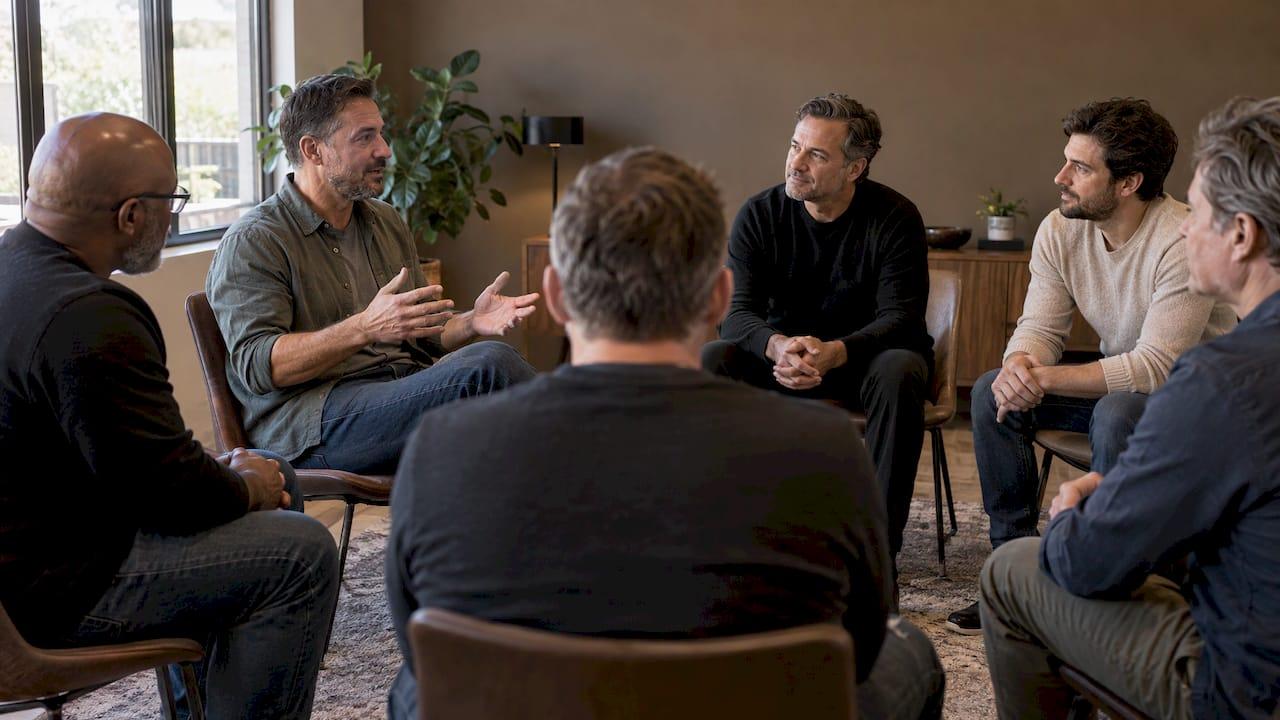
Choose one-on-one coaching when the thing you are working on is private, specific and tied to your own patterns: a marriage, a career decision, the way you shut down under pressure. Choose group coaching when you want accountability, perspective and proof that you are not the only capable man who goes quiet when it matters. Many men end up using both, and the order they use them in matters more than the label.
If you are a high performer, you probably solve problems for a living. You may also be tired, a little invisible, and unsure why the skills that work at the office stop working at home. This guide walks through how the two formats differ, what the research says, and how to match the format to what you are trying to change.
TL;DR
- One-on-one coaching gives you the coach's full attention, a plan built around your life, and complete privacy. It suits deep pattern work and high-stakes decisions.
- Group coaching gives you peers, shared accountability and several perspectives at once. It suits men who want to practice new behavior with others who understand.
- Research on both formats shows real gains. Individual coaching tends to win on personal satisfaction and goal attainment, while groups can deliver comparable results and stronger networks of support.
- The two formats work well together: groups can build momentum and one-on-one work can turn it into specific action.
- The best choice depends on your goal, your comfort with being seen, and how urgent the change feels, not on which format sounds more impressive.
Table of Contents
- The core difference in plain terms
- What one-on-one coaching gives you
- What group coaching gives you
- What the research says about results
- Matching the format to what you are trying to change
- Why the strongest path often combines both
- How to decide: five honest questions
- Our perspective
- Working with Jay Scott Coaching
- FAQ
- Sources
The core difference in plain terms
In one-on-one coaching, you and a coach work together, and nobody else is in the room. Sessions are built around your goals, your history and your calendar. The coach tracks the patterns that show up across weeks and points them out to you.
In group coaching, a coach works with several people at once. Each man brings his own goals, but the learning happens in a shared space where people listen, respond and reflect each other back. One practitioner summary describes the group coach's added job as managing group dynamics so the environment stays safe and supportive, which is a good way to think about what makes a group worth joining.
That is the whole structural difference. Everything else, cost, intensity, speed, comfort, follows from who is in the room.
What one-on-one coaching gives you
Undivided attention. Every minute is about you. If you spend ten minutes explaining a conflict with your wife or a board meeting where you froze, the other forty minutes are spent working on it.
Privacy. Some of what drives overthinking and avoidance is not something you want to say in front of other people yet. A private session lets you say it out loud for the first time without an audience.
Pattern mapping. A coach who sees you week after week can spot the loop: the trigger, the story you tell yourself, the way you go quiet or over-explain. That is hard to see alone, and harder in a crowd where airtime is shared. In our work, this is where session tools such as pattern visualization and a personal archive of your own breakthroughs earn their place.
Flexible pacing. If a hard week blows up your plan, the plan changes. Nobody else is waiting on you.
The research agrees on the personal side. A randomized field study of 84 participants compared individual coaching with group training for people who procrastinate. Both helped, but individual coaching produced higher satisfaction and stronger goal attainment, while the group format was better at spreading knowledge. A 2010 evaluation of leadership coaching found that people coached one-on-one placed significantly more value on personal, tailored help.
If you want to see what this looks like from the inside, we describe it in what men learn through one-on-one professional support.

What group coaching gives you
Proof you are not alone. A lot of capable men carry the quiet belief that they are the only one who feels this way. Sitting with other men who say the unsaid thing out loud can change that faster than any explanation from a coach.
Accountability from several directions. You are answerable to the coach and to peers. When a group of men expects you to report back on the hard conversation you promised to have, it gets harder to avoid it.
More than one point of view. A group offers a range of experiences and approaches, which is one of the main benefits Case Western Reserve's Richard Boyatzis identifies in his paper on peer coaching groups. He also argues groups can be especially useful when the need for change is immediate and intense, because during stress people feel their experience is normal and that they are not alone.
Practice in real time. Speaking up, asking for what you need and staying steady while others react are skills. A group lets you rehearse them with people, not just talk about them.
Belonging. In a study of peer coaching circles for early career researchers, participants reported a stronger sense of belonging, a support network and more access to advice while they navigated big career transitions.
Satisfaction is high too. At UT Southwestern, 94% of participants in a group coaching program were very or completely satisfied with the sessions, and 88% said they would recommend it to a colleague.
Curious what a session actually feels like? Here is what happens in a typical men's group coaching session.
What the research says about results
The honest summary is that both formats work, and the gap between them is smaller than most people assume.
A 2025 randomized trial in the Journal of General Internal Medicine followed 79 physicians through six one-hour virtual sessions. Burnout fell by 29.6% (absolute) in the small group arm and 13.4% in the one-on-one arm, while it rose 11.1% in the control group. The difference between the two coaching formats was not statistically significant, which means both beat doing nothing, and the authors concluded small group coaching may be a scalable approach.
| What you care about | One-on-one | Group |
|---|---|---|
| Personal and tailored attention | Strongest | Shared with the group |
| Privacy | Complete | Shared, within group agreements |
| Peer support and network | Built with your coach | Built with several peers |
| New ideas and perspectives | Coach's view of your patterns | Many viewpoints at once |
| Turning ideas into action | Strong | Strong with peer accountability |
| Urgency and shared stress | Focused and private | Normalizing, "swarm" support |
The 2010 leadership evaluation puts the split neatly: peer groups were seen as better for generating new ideas, while one-on-one coaching was seen as better for executing them. Treat that as a guide to sequence, not a ranking. Ideas without execution leave you where you started, and execution without fresh ideas can lock you into the same moves.
One caution about all of this research: much of it comes from workplace, academic or medical settings, not from men's personal development. It tells you the formats work. It cannot tell you which one will feel right for your situation, which is why the next sections focus on matching.
Matching the format to what you are trying to change
If you abandon yourself under pressure
Self-abandonment looks like agreeing when you disagree, going silent in the meeting, or saying yes and resenting it later. Underneath it is usually a nervous system that reads disagreement as danger. The Unshakable Man Method™ trains that system to stay grounded so you can act from clarity instead of fear.
One-on-one work is a strong start here because the pattern is yours specifically. Your triggers, your history and your habitual escape routes need a coach who can map them. Group work adds the part that is hard to practice alone: staying steady while another person reacts to you.
If you are an executive building emotional resilience
Your time is tight and your decisions are visible. One-on-one sessions let you bring a live situation, such as a tense negotiation, a team conflict or a decision you keep postponing, and work it before it happens. A group suits you if the isolation of leadership is part of the problem. Peers who carry similar weight can be a relief you did not realize you needed.
If you want to communicate better with your wife
Communication problems in a marriage often come from what happens in your body in the moment: you defend, withdraw or fix when you are being asked to listen. Private sessions let you unpack specific conversations without worrying about her privacy or yours. A group gives you a look at how other men handle the same moments, which often makes your own patterns easier to see. Our piece on men's personal growth coaching goes deeper on how this change shows up at home.
If anxiety shows up in your work and relationships
Anxiety that tightens your chest before a hard conversation is a good fit for nervous-system training in either format. A group can help you feel that anxiety is common among capable men. One-on-one work helps you build a personal toolkit for those moments. If your anxiety is severe, constant or affecting your sleep, health or safety, see a licensed mental health professional or your doctor as well. Coaching works on skills, capacity and action, and it sits alongside clinical care rather than replacing it.
If you need to make decisions faster
Indecision is usually fear of consequences wearing a logical costume. Individual coaching helps you name the real fear. Group accountability helps you commit by a date and report back. The Losch study's recommendation fits: individual coaching when your personal development goals are the priority, and group formats when you need systematic preparation at a lower cost.

Why the strongest path often combines both
The either-or framing is the least useful part of the question. The University of Kentucky built an integrated coaching program that uses group sessions to make coaches approachable so hesitant students go on to one-on-one appointments. About 92% of students in the Fall 2021 cohort who attended at least one coaching appointment were retained into spring.
That pattern maps well onto how men often work:
- Start in a group if you are hesitant, want to hear other men first or need to normalize what you are feeling.
- Add one-on-one sessions when you are ready to go into the specific patterns and decisions that are costing you the most.
- Return to a group to practice the new behavior under real social conditions and keep your accountability alive.
Or reverse it. Start privately, get clear on your patterns, then join a group to put them into practice. Neither order is wrong. What matters is that you are moving between understanding and action.
How to decide: five honest questions
- How private is the issue? If it involves a marriage crisis, a legal matter or something you have told no one, begin one-on-one.
- How isolated do you feel? If the loneliness is as heavy as the problem itself, a group addresses both at once.
- How urgent is the change? Intense, immediate pressure is where Boyatzis sees groups creating a supportive "swarm effect." A specific, high-stakes deadline is where focused individual work shines.
- What happens when nobody is watching? If you follow through when someone is expecting you to, group accountability is a strong tool. If you need to understand why you stall, individual sessions go further.
- What are you willing to share, and with whom? Honesty is the raw material of coaching. Choose the format where you can be most honest, then grow from there.
If you are still unsure, our guide to finding the right individual coaching for men covers what to look for in a coach before you commit.
Our perspective
We built our work around one idea: men do not stay stuck because they lack information. They stay stuck because, under pressure, the body decides it is unsafe to be honest, and so they abandon themselves. Insight alone does not change that. Training does.
That is why we offer both formats. Private coaching is where we map your patterns in detail, use tools and a personal archive to make them visible, and build the capacity to stay grounded when it counts. Groups are where that capacity gets tested and strengthened with other men who are doing the same work, with accountability that does not depend on willpower.
We do not think you have to pick a side. We think you should pick a starting point that feels honest, and let the work move you toward the format that your next step needs. Workshops and immersions are there for the times when you want to go further in a concentrated stretch.
Most of the men we work with are used to being the capable one. You are allowed to be supported while you do this. It is how internal muscles get stronger.
Jay
Working with Jay Scott Coaching
We offer private coaching, group coaching, and workshops and immersions, all built on the Unshakable Man Method™. You can read how each one works on our Private Coaching, Groups, Workshops & Immersions page, and begin through the application form or a consultation call, where we talk through your situation and which starting point fits.
If you are based in California, our overview of what to expect from individual coaching services in California shows what the first weeks look like.
FAQ
Is group coaching as effective as one-on-one coaching?
Both formats produce measurable improvement. In a 2025 randomized trial with physicians, small group and one-on-one coaching both reduced burnout, and the difference between them was not statistically significant. Individual coaching tends to score higher on personal tailoring and satisfaction, while groups add peer support and perspective.
Is one-on-one coaching better for anxiety and self-doubt?
It is a strong choice when your triggers are personal, because your coach can map your specific patterns and tailor each session. Groups help too, since hearing other capable men describe the same experience reduces the sense of being alone. If anxiety is severe or affecting your health, work with a licensed mental health professional or your doctor alongside coaching.
Can I do group coaching and one-on-one coaching together?
Yes, and the pairing is common. Groups build momentum, accountability and perspective, while private sessions focus on your patterns and decisions. Programs that combine the two, such as one university coaching model, use groups to lead people into individual work.
What will group coaching feel like if I am not used to opening up?
Most men feel nervous at first, and a good group is structured so that sharing happens gradually and respectfully. The coach manages the dynamics so the room stays safe. You can also begin with private sessions to build comfort first.
How do I start?
Begin with the application form or a consultation call on our work with me page. We will talk about what you are facing and help you choose the starting point that fits.
Sources
- Comparing the Effectiveness of Individual Coaching, Self-Coaching, and Group Training (PMC, 2016)
- Utilizing One-on-One Coaching and Peer Coaching Groups, TCLI Evaluation Report (2010)
- The Democratization of Coaching and Development Through Peer Coaching Groups (Case Western Reserve University, 2025)
- Expanding the Landscape of Opportunity: Professional Peer Coaching Circles (PMC, 2021)
- Group coaching for career development, UT Southwestern (PMC, 2025)
- Professional Coaching to Reduce Physician Burnout, Journal of General Internal Medicine (2025)
- Creating an Integrated Coaching Culture in Higher Education (PMC, 2024)
- Group Coaching vs. Individual Coaching: What's the Difference?