

Leadership presence is the learnable ability to stay grounded, communicate clearly, and align your words with your actions so people trust you and want to follow your lead. It is built, not born. Start today with a 60-second grounding pause, three slow breaths and a moment of silence, before your next important conversation. The sections ahead show you how to turn that single habit into a real, measurable skill.
TL;DR:
- Building leadership presence requires consistent practice of attention, self-regulation, communication, and alignment, tailored to specific settings and roles.
- Grounding techniques like breathing exercises and pauses significantly enhance internal steadiness, especially before high-pressure conversations or meetings.
- Focusing on one component at a time, such as gravitas or authenticity, yields more noticeable progress than trying to improve multiple traits simultaneously.
- Structured feedback from peers or coaches, combined with recording and reviewing performance, helps leaders accurately track progress and identify blind spots.
- Presence on video calls necessitates deliberate adjustments in mechanics, like camera eye contact and concise speaking, to effectively project trustworthiness and authority.
Table of Contents
- What Is Leadership Presence, and How Is It Different From Executive Presence?
- Why Leadership Presence Actually Matters at Work
- The Four Building Blocks: Gravitas, Communication, Composure, and Authenticity
- How Do You Actually Practice Building Presence?
- Building a Practice Routine That Actually Sticks
- How Do You Know If Your Presence Is Actually Improving?
- How Jay Scott Coaching Approaches Presence Through Nervous-System Work
- Does Leadership Presence Work the Same Way on Video Calls?
- How Should Leadership Presence Adapt Across Cultures?
- What Role Does Emotional Intelligence Play in Leadership Presence?
- How Do You Measure Whether Improved Presence Is Helping Your Team?
- What Leaders Get Wrong About Building Presence
- Books and articles can teach you the mechanics of presence, the pause, the posture, the pacing, but they can't catch your blind spots or hold you accountable when old patterns creep back under pressure. One-on-one and group coaching can help with this by focusing on nervous-system patterns underneath self-abandonment, overthinking, and avoidance that quietly undercut presence long before visible signs appear.
- Sources
- FAQ
What Is Leadership Presence, and How Is It Different From Executive Presence?
Leadership presence is the felt sense that someone is grounded, paying attention, and speaking from conviction rather than performance. It shows up as a steadiness in the room, a way of listening that makes people feel heard, and a consistency between what a person says and what they do. Executive presence, by contrast, is a narrower and more scrutinized version of the same trait, usually tied to visibility in front of senior leaders, boards, or clients. Executive presence is about how you're perceived under a spotlight; leadership presence is about how you show up day to day, spotlight or not.
Harvard Business Review's research on executive presence still organizes the concept around three familiar buckets: gravitas, communication, and appearance. What has changed is the addition of inclusiveness and a visible online presence as newer, expected dimensions of the same skill. That framework is useful, but it can make presence sound like a costume you put on for big moments. A more accurate model treats presence as four connected capacities that work together:
- Attention: the ability to be fully with the person or group in front of you, not half-listening while planning your response.
- Self-regulation: a settled nervous system that lets you respond to pressure instead of reacting to it.
- Communication: clear, well-paced language that carries conviction without needing volume.
- Alignment: consistency between your stated values and your actual behavior, especially when it's inconvenient.
Psychology Today's coverage of presence research makes a point worth sitting with: presence is most powerful when it comes from undivided attention. Being fully there, without a phone, an agenda, or a rehearsed line, is rare enough that it registers as leadership all by itself. That is also the encouraging part. If presence were a fixed trait, coaching would be pointless. Because it's a set of adjustable skills, deliberate practice moves the needle.
Why Leadership Presence Actually Matters at Work
Presence is not a soft skill you develop after the "real" leadership competencies. It is one of the load-bearing ones. HBS Online's research on effective leadership links stronger presence to more decisive action, tighter team alignment, and faster trust building, all of which show up directly in performance reviews and promotion conversations.
The trust gap is real. Gallup's long-running workplace research consistently finds that trust in leadership sits far lower than most executives assume, which means presence, the visible signal that a leader is grounded and consistent, does real work in closing that gap.
Consider three scenarios where presence changes the outcome, not just the optics. In a crisis update, a leader who pauses before answering a hard question buys the room a second to trust the answer that follows. In a negotiation, a steady voice and unhurried pacing signal that you are not desperate for the deal, which shifts leverage before a single number is discussed. In a stakeholder presentation, a leader who makes eye contact and finishes sentences without trailing off earns more follow-up questions and less silent skepticism.
None of these are about charisma. They're about whether the room believes what you say matches what you'll actually do. That belief compounds over time: teams led by people with strong presence tend to move faster because they spend less energy second-guessing direction, and they take more ownership because they trust the person setting it.
The Four Building Blocks: Gravitas, Communication, Composure, and Authenticity
Break leadership presence into its component parts and each one becomes something you can practice on purpose instead of hoping shows up under pressure.
Gravitas is weight without volume. It's the sense that when this person speaks, it's worth listening. Behaviorally, gravitas looks like finishing your sentences instead of trailing off, taking a beat before answering a hard question, and stating opinions as opinions rather than hedging every sentence into mush.
Communication is less about vocabulary and more about structure. Leaders with strong communication presence tend to open with the point, not the backstory, ask more questions than they answer in one-on-ones, and use silence deliberately rather than filling every gap with filler words.
Composure is nervous-system regulation made visible. It's the difference between a leader whose voice tightens and speeds up under pressure and one whose pacing barely shifts. Composure isn't the absence of stress; it's the ability to metabolize stress without broadcasting it to the room.
Authenticity is where modern presence frameworks diverge most from the old "fake it till you make it" advice. Harvard Business Review's updated framework explicitly adds inclusiveness and genuine connection as expected traits now, not optional ones. Authenticity means your presence looks roughly the same whether you're talking to your team or your board, because you're not performing two different characters.
These four traits apply differently depending on the setting:
- One-on-ones: attention and authenticity dominate; gravitas matters less than genuine listening.
- Team meetings: communication structure and composure carry the most weight, since everyone is watching how you handle disagreement.
- Public forums and board updates: gravitas and composure take center stage, because the room is scrutinizing consistency under pressure.
Pro Tip: Pick one component, not all four, to work on this month. Trying to fix gravitas, communication, composure, and authenticity simultaneously usually means none of them improve. Ask a trusted colleague which single trait, if it got stronger, would change how people experience you in meetings. Start there.
A quick self-check: after your next three meetings, ask yourself which of the four you leaned on and which one you avoided entirely. That gap usually points straight at your next focus area.
How Do You Actually Practice Building Presence?
Presence-building splits into three practice areas: nervous-system work, communication habits, and body and voice alignment. None of them require a personality transplant. They require repetition.
Nervous-system techniques
Forbes' reporting on leadership presence makes a case that should reshape how most people think about commanding a room: a grounded, quieter presence built through breath and pausing consistently outperforms loud projection. Volume signals urgency. Stillness signals control.
- Orientation. Before a high-stakes conversation, spend 10 seconds noticing three things you can see and one thing you can hear. This pulls your attention out of anticipatory anxiety and into the present room, which is the raw material of presence.
- Box breathing. Inhale for four counts, hold for four, exhale for four, hold for four. Two rounds, done quietly at your desk or in a bathroom stall before a meeting, measurably lowers physiological arousal.
- The 60-second grounding pause. Before any conversation you know will be charged, take one full minute of silence, breath, and a single question to yourself: what does this room actually need from me right now? This is the same practice mentioned in the opening of this piece, and it's worth repeating here because it's the single highest-leverage habit in this entire list.
Communication practices
Speaking less is a presence technique, not a personality trait. Leaders who talk the most in a meeting are frequently perceived as the least in control of it, because volume of words often reads as anxiety filling space. Structure your messages instead: lead with your conclusion, follow with your two or three supporting points, and stop. Resist the urge to pad the silence that follows.
Active listening deserves more than a nod and a follow-up question. It means reflecting back what you heard before responding, "So what you're saying is..." and asking one more question than feels natural. That extra question is usually the one that surfaces what the person actually meant.
Body and voice alignment
Posture, eye contact, and gesture size are not vanity metrics. They're the nonverbal channel that either confirms or undercuts what you're saying out loud. Keep your gestures within your torso's width rather than flailing outside it. Hold eye contact for a full sentence at a time rather than glancing away mid-thought. Drop your vocal pace by roughly 10 to 15 percent when you want to be taken seriously; most people speed up under pressure, which is exactly the wrong direction.
Pro Tip: Record yourself delivering a two-minute update on your phone, then watch it once with the sound off. You'll see every fidget, gesture, and posture shift you'd otherwise never notice, and it's the fastest feedback loop available to you for free.
The throughline across all three practice areas is alignment, not performance. A leader who nails the pause and the eye contact but doesn't follow through on commitments will eventually get read as hollow. Kellogg Insight's research on executive presence makes a related point worth internalizing: rather than chasing every trait on a list, pick a few signature strengths and practice them relentlessly in the contexts where they matter most. Consistency beats range.
Building a Practice Routine That Actually Sticks
Presence work fails most often not because the techniques are wrong but because they never get repeated enough to become automatic. A cadence solves that.
- Daily (2 to 10 minutes). Use the grounding pause before your highest-stakes interaction of the day, whether that's a difficult one-on-one or a client call. On lighter days, spend two minutes on box breathing before your first meeting simply to build the habit muscle.
- Weekly rehearsal. Pick one upcoming meeting or presentation and record yourself delivering the opening 90 seconds. Watch it back, note one specific adjustment, gesture size, pacing, filler words, and ask one trusted colleague for a single piece of feedback on how you came across.
- Monthly stretch assignments. Volunteer for one situation that makes you slightly uncomfortable: presenting to a group one level up, running a meeting you'd normally sit quietly in, or giving direct feedback you've been avoiding. IMD's research on developing leadership presence frames this kind of staged exposure, moving from anticipation through actual engagement and reinforcement, as a deliberate pathway rather than something that happens by accident.
These "heat" experiences work because presence, like most nervous-system skills, generalizes poorly from theory and generalizes well from repeated, slightly uncomfortable exposure. You don't build composure under pressure by reading about composure. You build it by practicing under manageable pressure often enough that your baseline shifts. The Final Tape Academy offers structured lessons on this kind of deliberate practice if you want a more formal rehearsal framework to follow.
One caution: don't confuse frequency with intensity. Five minutes of grounding practice daily beats one heroic hour-long session once a month, because presence is a nervous-system pattern, not a knowledge base. Patterns are built through repetition, not intensity.
How Do You Know If Your Presence Is Actually Improving?
Most people trying to build presence rely on how the room "felt," which is close to useless as a measurement. Feelings on the room's side and feelings on your side rarely match. Research on leadership presence and impact points to something uncomfortable: most leaders significantly overestimate their own self-awareness, which is exactly why a self-only assessment of presence tends to be wrong in one direction or another.
The fix is structured feedback, not vibes. Ask stakeholders questions aimed at impact rather than style:
- "When I disagreed with you last week, did it feel like I was dismissing you or engaging with you?"
- "What's one thing I do in meetings that makes you trust my direction less?"
- "Did my update in that stakeholder meeting change how confident you feel about the plan?"
The Center for Creative Leadership's competency research recommends 360-degree feedback instruments precisely because they surface the gap between self-perception and peer perception that individual reflection almost always misses. Pair that with your own recorded rehearsals and a simple rubric, rate your pacing, eye contact, and message clarity on a 1 to 5 scale weekly, and you get a data trail instead of a guess.
Coaching earns its cost when the feedback loop needs an outside eye that won't soften the truth to protect your feelings. Reports from coaching practitioners commonly describe meaningful, visible shifts in presence within three to six months of focused, structured work, not because coaching is magic, but because an outside observer catches blind spots faster than solo practice ever will.
How Jay Scott Coaching Approaches Presence Through Nervous-System Work
Most presence advice focuses on the outside: posture, pacing, word choice. The Unshakable Man Method™ starts somewhere else entirely, with the nervous system itself. Some coaching programs work with men to address self-abandonment, the pattern of overthinking, avoidance, and second-guessing that quietly erodes presence long before visible signs emerge.
These approaches target emotional regulation and a felt sense of inner safety, recognizing that a leader whose nervous system is dysregulated under pressure may struggle to sustain composure regardless of rehearsal. Common shifts include:
- Steadier decision-making under pressure, moving from overthinking to clear action
- Communication that conveys conviction without raising volume
- Stronger emotional connection in both career relationships and at home
Such coaching supplements self-practice techniques like grounding pauses and rehearsal by helping identify and change underlying personal patterns.
Does Leadership Presence Work the Same Way on Video Calls?
Presence doesn't disappear on a screen, but it does require different mechanics to land. A pause that reads as gravitas in person can read as a frozen connection on a video call, and eye contact that would anchor a room in person means something different when the "eyes" are a camera lens instead of a person's face.
Harvard Business Review's research on modern executive presence points to intentional calibration as the fix: looking at your camera rather than the gallery of faces, keeping turns concise so you're not the person who runs three minutes over in every meeting, and framing your video deliberately so you're not lit from below or cropped at the forehead.
A few adjustments matter more on video than in a conference room. Pauses need to be slightly shorter online, because dead air on a call reads as a technical glitch faster than it reads as thoughtful silence. Your first 10 seconds on camera matter disproportionately, since that's when people decide how much attention to give the rest of what you say. And background noise or a cluttered visual frame undercuts composure just as much as a shaky voice would.
The core skills transfer directly: structured messaging, active listening, and a settled nervous system read as trustworthy whether you're across a table or across a screen. What changes is the delivery mechanics, not the underlying trait. Leaders who treat video calls as a lesser version of "real" presence usually show up worse on them than leaders who treat the camera with the same intention they'd bring to a boardroom.
How Should Leadership Presence Adapt Across Cultures?
Presence norms are not universal, and treating one cultural style as the default version of "strong leadership" is a common and costly mistake. What reads as confident directness in one culture can read as abrasive or disrespectful in another; what reads as composed restraint in one context can read as disengaged or weak in a different one.
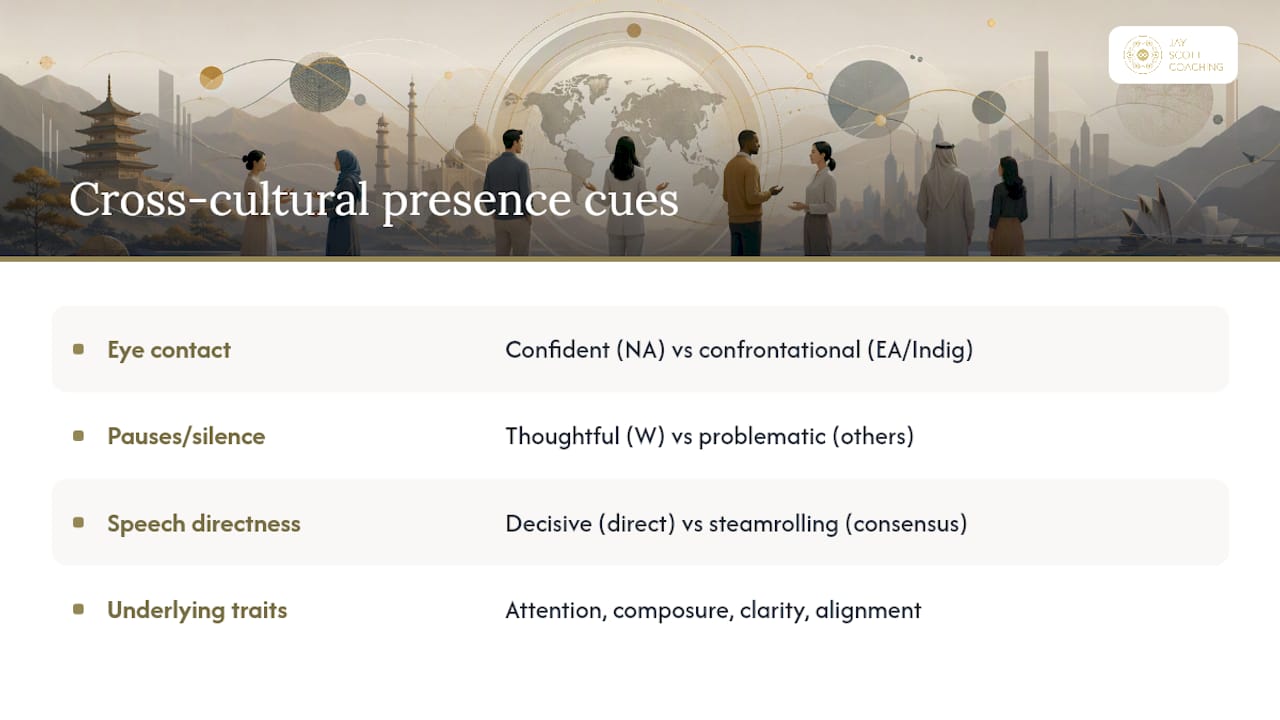
Direct eye contact, for example, signals confidence in much of North American business culture but can read as confrontational in some East Asian and Indigenous cultural contexts, where more indirect gaze during conversation signals respect. Pausing before answering a question reads as thoughtful gravitas in many Western business settings, but the tolerance for silence itself varies widely. Some cultures treat extended silence as comfortable and expected; others treat it as a sign something has gone wrong.
Volume and directness of speech carry similarly different weight. A leader who states opinions bluntly may be read as decisive in one team and as steamrolling colleagues in another, particularly on teams where consensus building carries more cultural weight than individual assertiveness.
None of this means presence is culturally arbitrary. The underlying components, attention, composure, communication clarity, and alignment between words and actions, translate across every culture examined in leadership research. What shifts is the specific behavior that signals each one. The practical move for leaders on diverse or global teams isn't to adopt one universal style. It's to ask directly: what does trust and respect look like on this particular team? Then calibrate your delivery, not your integrity, to match.
What Role Does Emotional Intelligence Play in Leadership Presence?
Emotional intelligence is the engine underneath most of the presence behaviors covered so far. Composure without emotional intelligence is just suppression, and suppression tends to leak out sideways, in irritability, disengagement, or a flat affect that reads as coldness rather than steadiness.
The connection runs through self-awareness first. A leader who can accurately name what they're feeling in a tense meeting, frustration, anxiety, defensiveness, has a real choice about how to respond. A leader who can't name it just reacts, and that reaction usually undercuts whatever presence they'd built up to that point.
Social awareness matters just as much. Reading a room accurately, noticing that a team has gone quiet not because they agree but because they're uncomfortable, is a presence skill disguised as an emotional intelligence skill. Leaders who miss that signal keep talking past the point where the room stopped listening.
The regulation piece ties directly back to the nervous-system techniques covered earlier. Emotional intelligence isn't just knowing what you feel; it's having enough internal steadiness that the feeling doesn't hijack your behavior. That's precisely what grounding pauses and breath work are designed to build. Presence and emotional intelligence aren't two separate skills that happen to correlate. Presence is largely what emotional intelligence looks like from the outside, under pressure, in front of other people.
How Do You Measure Whether Improved Presence Is Helping Your Team?
Individual presence gains matter most when they translate into team-level outcomes, and there are concrete signals worth tracking rather than guessing at.
Watch meeting dynamics first. Teams led by someone with strengthening presence typically show faster decision cycles, because less time gets spent re-litigating direction the leader has already communicated clearly. Track how often the same decision gets revisited within a week; a drop in that number is a real signal of clearer, more trusted communication.
Watch psychological safety indicators next. Presence built on genuine attention and composure tends to increase how often team members raise problems early rather than letting them surface as crises. A rise in early flagged issues, counterintuitively, often means presence is working, not that things are going worse.
Retention and engagement scores lag but eventually respond too. Teams that trust their leader's consistency between word and action report higher engagement in standard workplace surveys, and voluntary attrition on well-led teams tends to trend lower over sustained periods, though this shows up over quarters, not weeks.
The most direct method is still structured feedback rather than inference from metrics. Ask your team the same impact-focused questions covered in the assessment section above, but ask them about team-level experience rather than just your own behavior: "Do you feel clearer on priorities than you did three months ago?" That single question, tracked over time, often tells you more than any dashboard will.
What Leaders Get Wrong About Building Presence
The most common misstep is treating presence as a performance to switch on for big moments rather than a steadiness you carry all the time. I've seen the pattern repeat itself in coaching conversations: a leader nails the confident voice and eye contact in the boardroom, then goes home and can't have a calm conversation with a spouse about something minor. That gap is the tell. Real presence doesn't toggle on and off depending on who's watching. If it only shows up under a spotlight, it was never grounded to begin with, it was managed anxiety wearing a good outfit. The leaders who actually change are the ones willing to work on the nervous system underneath the performance, not just the performance itself.
— Jay
Books and articles can teach you the mechanics of presence, the pause, the posture, the pacing, but they can't catch your blind spots or hold you accountable when old patterns creep back under pressure. One-on-one and group coaching can help with this by focusing on nervous-system patterns underneath self-abandonment, overthinking, and avoidance that quietly undercut presence long before visible signs appear.

Coaching is the right fit if you've already tried the self-practice, the recordings, the grounding pauses, the rehearsal, and you're still hitting the same wall under real pressure. That's usually a sign the pattern lives deeper than a technique can reach alone. An initial consult typically starts with mapping where you lose steadiness and why, which is the same diagnostic work covered in choosing the right confidence coach for your specific situation. If you're ready to work on this directly, Jay Scott Coaching's individual coaching services are the next step worth taking.
Sources
The research behind this article draws from several credible sources worth reading directly if you want to go deeper on any single component of leadership presence.
Harvard Business Review's updated executive presence framework is the clearest modern breakdown of gravitas, communication, and appearance, with inclusiveness and online presence added as newer dimensions. HBS Online's research on effective leadership connects presence-adjacent competencies directly to measurable organizational outcomes. IMD's case study on developing leadership presence offers a staged model for sequencing practice, useful if you want a more structured rehearsal plan than the one outlined above.
For the nervous-system angle specifically, Forbes' reporting on presence versus volume and Psychology Today's piece on presence as attention both make the case that grounded stillness outperforms projected confidence, a theme worth revisiting anytime the pressure to perform starts to override the practice itself.
- Successful leaders cultivate the power of presence — Psychology Today
- The new rules of executive presence — Harvard Business Review
- How to become a more effective leader — HBS Online (PDF)
- Most important leadership competencies — Center for Creative Leadership (CCL)
FAQ
What Does It Mean to Have Leadership Presence?
It means being grounded and fully attentive enough that people trust your judgment and want to follow your direction, built through consistent composure, clear communication, and alignment between what you say and what you do rather than any single dramatic trait.
What Is Another Way to Say Leadership Presence?
Common alternatives include "executive presence," "gravitas," and "command presence," though executive presence usually refers more narrowly to visibility in front of senior stakeholders while leadership presence covers everyday interactions too.
Can Introverts Build Strong Leadership Presence?
Yes. Presence is built on attention, composure, and clear communication, none of which require extroversion, and quieter, grounded delivery is often more persuasive than loud projection.
How Long Does It Take to Notice a Real Change in Presence?
Practitioner reports and coaching programs commonly describe visible shifts within three to six months of consistent, focused practice paired with structured feedback.