

The fastest way to fix marriage communication when you're wired for performance is to train your nervous system before you train your words. Exercises like coherent breathing, micro-regulation, and paired breathing calm the sympathetic activation that makes you sound clipped, defensive, or absent with your wife. This work builds on polyvagal theory: safety in the body has to come before safety in the conversation.
TL;DR:
- Coherent breathing, micro-regulation, and paired breathing effectively reduce sympathetic nervous system activation, improving emotional regulation before engaging in communication.
- Daily practice of two to ten minutes and weekly partnered sessions build nervous system capacity, leading to faster recovery from tension within three to four weeks.
- Using short, time-bound pauses like "I need ninety seconds" signals regulation and prevents escalation during difficult conversations.
- Recurring issues like solution jumping, stonewalling, or performance-mode communication signal insufficient regulation rather than lack of skills.
- Consistent regulation training reduces reactive behaviors, enhances presence, and often eliminates the need for scripted responses over time.
Table of Contents
- What Are the Best Marriage Communication Exercises for High-Performing Men?
- How Do You Practice These Exercises Consistently?
- When Should You Use Each Exercise?
- How Do You Know When an Exercise Isn't Working?
- Why This Approach Works for High-Performing Men
- Check-In Questions and Scripts for Busy Husbands
- The Communication Pitfalls These Exercises Actually Fix
- What Changes When Men Practice This Consistently
- Customizing These Exercises to Your Personality
- The Nervous-System Angle Most Marriage Advice Misses
- Next Steps: How to Work With Jay Scott Coaching
- Sources
- FAQ
What Are the Best Marriage Communication Exercises for High-Performing Men?
Most communication advice hands you scripts and active listening tips as if the problem lives in your vocabulary. It doesn't. If your body is locked in a low-grade fight-or-flight state from a day of back-to-back decisions, no script survives contact with your wife's first hard sentence. The sympathetic nervous system narrows your attention and speeds your speech before you've even registered you're upset, which is why "communication skills" so often collapse into the exact behavior you were trying to avoid.
The six exercises below work the body first, in the order most executives find usable under real time pressure. Each one takes under two minutes and requires zero equipment.
-
Coherent breath (4:6 pattern). Inhale for four counts, exhalation for six, and keep your exhale slightly audible. Use it in the car before walking inside, or at your desk before a hard call home. Three cycles is enough to feel your shoulders drop.
-
10-second micro-regulation. Plant both feet, name one physical sensation out loud or silently ("my jaw is tight"), and take one slow breath. This interrupts the spiral before it becomes a tone of voice.
-
Paired breathing for repair. Sit knee to knee, breathe together, and let your exhale run slightly longer than your partner's. This mirrored pattern is a recognized co-regulation cue that signals safety without a word spoken.
-
Soft-prosody, open-posture script. Drop your voice half a register, unfold your arms, and open your torso toward her before you speak. Posture and tone are read by her nervous system before your sentence lands.
-
Pre-conversation ritual. Sixty to ninety seconds before any conversation you suspect will get hard: one hand on your chest, three breaths, one sentence of intention ("I want to stay present, not win this").
-
One-line repair script. After a rupture, practice saying, "That came out sharp. Let me try again," without qualifiers or excuses attached.
Pro Tip: Practice exercise six on a good day, not your first fight. A repair line rehearsed cold sounds robotic; a repair line rehearsed in calm becomes a reflex under stress.
How Do You Practice These Exercises Consistently?
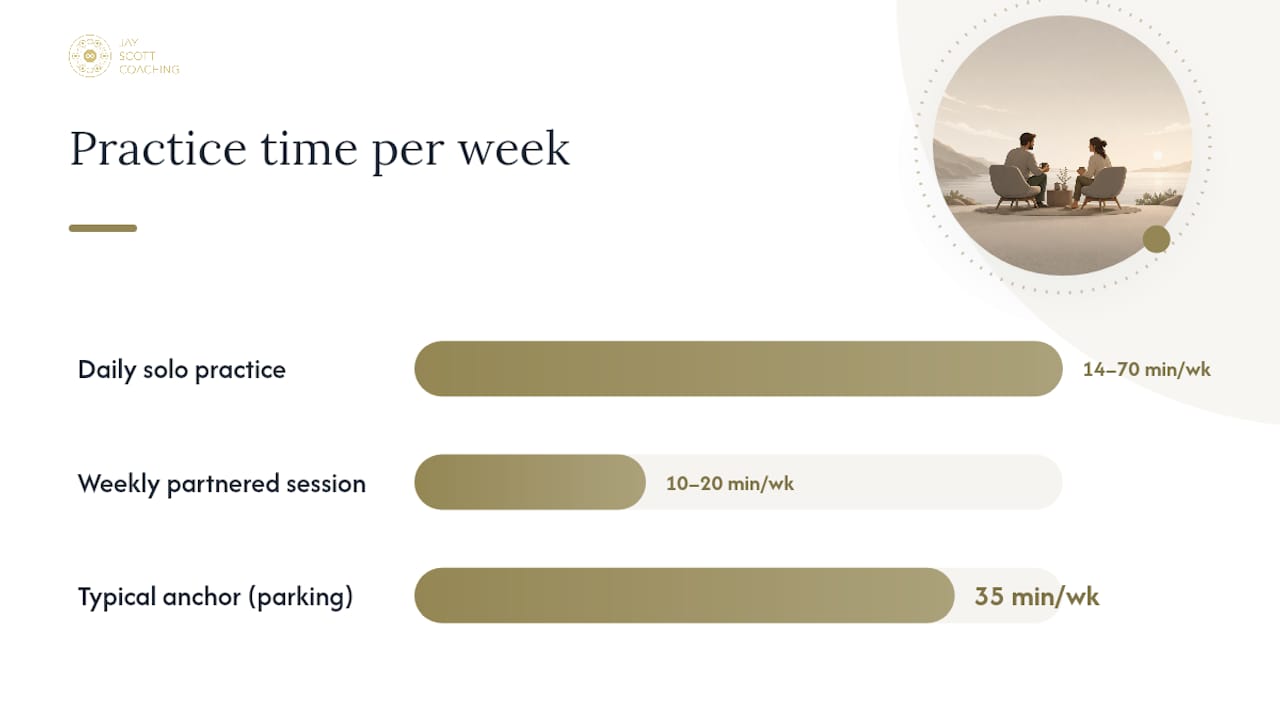
Consistency beats intensity here. A newsletter focused on high-performer nervous system capacity recommends two to ten minutes of daily solo practice plus one ten-to-twenty-minute partnered session weekly. That's the entire commitment. Most men see a shift in how quickly they recover from a tense exchange within three to four weeks of daily practice, not overnight.
Build the routine around three checkpoints:
- Daily micro-practice. Two to ten minutes, same time each day (many men use the first five minutes after parking the car). This is solo work, not a couples exercise.
- Pre-conversation ritual. Before any planned hard conversation, run the sixty-to-ninety-second anchor and state one sentence of intention out loud or in your head.
- In-conversation reset. When you feel the conversation escalating, say plainly: "I need ninety seconds." Then breathe, name your internal state silently, and re-engage. Silence without a reason reads as stonewalling; a stated pause reads as regulation.
The phrase matters more than it seems. "I need ninety seconds" is concrete and time-bound. "I need space" or walking out without a word tends to spike her alarm system rather than calm the room, because it offers no signal of when or whether you're coming back.
Pro Tip: If daily solo practice feels awkward, anchor it to something you already do. Coherent breathing during your morning coffee or before checking email builds the habit without adding a task to your list.
Solo practice builds baseline capacity. Paired practice, done once a week when things are calm, builds the actual skill of regulating together. If you find yourself needing the in-conversation reset more than two or three times a week, that's a signal to bring the pattern into coached sessions rather than keep troubleshooting it alone.
When Should You Use Each Exercise?
Timing determines whether an exercise helps or just feels like another task on the list. A few rules of thumb:
- Use coherent breathing and the pre-conversation ritual before any conversation you know carries risk (finances, in-laws, a recurring conflict topic).
- Use paired breathing after a rupture, specifically for repair, not as a daily default.
- Use the 10-second micro-regulation during the moment things start to heat up, especially when you notice your own tone shifting.
A workable weekly rhythm involves several short daily sessions plus one partnered session weekly, totaling a moderate amount of practice time each week. As your capacity builds, extend the paired sessions gradually rather than adding new techniques. A coaching model integrating polyvagal theory treats this graduated approach as central to lasting change: safety and trust build in layers, not leaps.
How Do You Know When an Exercise Isn't Working?
Dysregulation has a physical signature, and learning to spot it early is more useful than any script. Watch for rapid or clipped speech, shallow breathing high in the chest, a tightening jaw, gaze aversion, or a sudden freeze where you go blank mid sentence.
When you catch one of these signs mid-conversation:
- Pause out loud rather than going silent.
- Name the state plainly: "I'm getting flooded."
- Request a specific, time-limited break: "Give me ninety seconds," not an open-ended exit.
- Offer a brief safety cue before you step away, like a hand on her arm or a direct "I'll be right back."
- Reconvene at a stated time, not "later."
One podcast focused on marriage and nervous-system conflict frames most recurring marital conflict as two dysregulated nervous systems colliding, not a vocabulary problem. Listening skills alone rarely resolve it. If the same flashpoint keeps recurring despite consistent practice, or if either of you regularly can't complete the ninety-second reset without further escalation, that pattern is a strong signal to bring in coaching or couples therapy rather than keep running the same exercise solo.
Why This Approach Works for High-Performing Men
Executives are trained to solve problems with more effort and better technique. That instinct is exactly what fails in a marriage, because presence isn't a technique. The Unshakable Man Method™ treats self-abandonment, overthinking, and shutdown as nervous-system patterns first, not character flaws or communication gaps to be talked through.
Clients report the shift shows up first as presence: staying in the room during a hard conversation instead of checking out or overexplaining. Communication gets clearer once the body stops treating the marriage like a threat to manage.
A man who can regulate his own nervous system in real time doesn't need a perfect script. He needs the capacity to stay present when the conversation gets hard, and that capacity is trainable.
Coaching accelerates this because a trained eye catches the pattern you can't see in yourself, and structured accountability turns a good intention into a repeatable practice.
Check-In Questions and Scripts for Busy Husbands
A weekly check-in works better than daily debriefs for most executives, because it fits an already full calendar and lowers the stakes of any single conversation. Fifteen minutes, same time each week, with a simple structure beats an open-ended "how are we doing?"
Try these check-in questions:
- "What's one moment this week you felt closest to me?"
- "Was there a moment I felt distant or checked out? What did that look like from your side?"
- "What's one thing you need more of from me next week?"
For scripts, brevity beats eloquence. When you're flooded mid-conversation: "I'm feeling flooded. Give me ninety seconds, and I'll come back." When you've reacted sharply: "That came out sharp. Let me try that again." When she's sharing something emotional and your instinct is to fix it: "I hear you. I want to help, but tell me more first."
That last one matters more than it looks. High-performing men tend to jump to solutions during emotional disclosures because problem solving is the skill that got them promoted. A better move is what's sometimes called two-step listening: acknowledge the emotion first, wait roughly ten seconds, and only offer practical help once she's actually asked for it.
The Communication Pitfalls These Exercises Actually Fix
Three patterns show up over and over in marriages between high-performing men and their partners, and each has a specific fix rather than a general one.
The first is solution jumping: turning her emotional disclosure into a problem to be solved before she's finished talking. It reads as dismissive even when the intent is caring. Two-step listening (acknowledge, pause ten seconds, then offer help) interrupts this directly.
The second is stonewalling dressed up as composure. Going quiet under pressure can look like staying calm, but it often reads to her as checking out or punishing her with silence. The fix isn't forcing yourself to keep talking. It's naming the pause: "I need ninety seconds," followed by an actual return to the conversation.
The third is performance-mode communication: deploying textbook active-listening phrases while your body stays braced and your tone stays flat. One relationship-focused piece on communication and marriage makes the point directly: communication skills can become a performance that sits on top of an unregulated body, and partners tend to sense the mismatch even when the words are technically correct. Coherent breathing and soft-prosody cues close that gap because they change what your body is actually signaling, not just what your mouth is saying.
What Changes When Men Practice This Consistently
The most common early win isn't a breakthrough conversation. It's recovery speed. Men who practice daily micro-regulation for a few weeks typically report that a tense exchange that used to derail an entire evening now resolves in twenty or thirty minutes instead.
A second common shift: fewer unplanned exits from hard conversations. Instead of going quiet and walking off, a man says "I need ninety seconds," takes the break, and comes back. That single habit change often does more for a marriage's overall temperature than any single deep conversation.
Executives under chronic professional stress often carry that sympathetic activation home without realizing it, which makes ordinary marital friction feel disproportionately threatening. As daily practice builds parasympathetic flexibility, that friction stops registering as a five-alarm event. Wives frequently notice this before the men do: less defensiveness, longer fuse, more willingness to stay in the room.
The paired weekly practice tends to produce the deepest change, because it's the one place regulation becomes something the couple does together rather than something one partner manages alone.
Customizing These Exercises to Your Personality
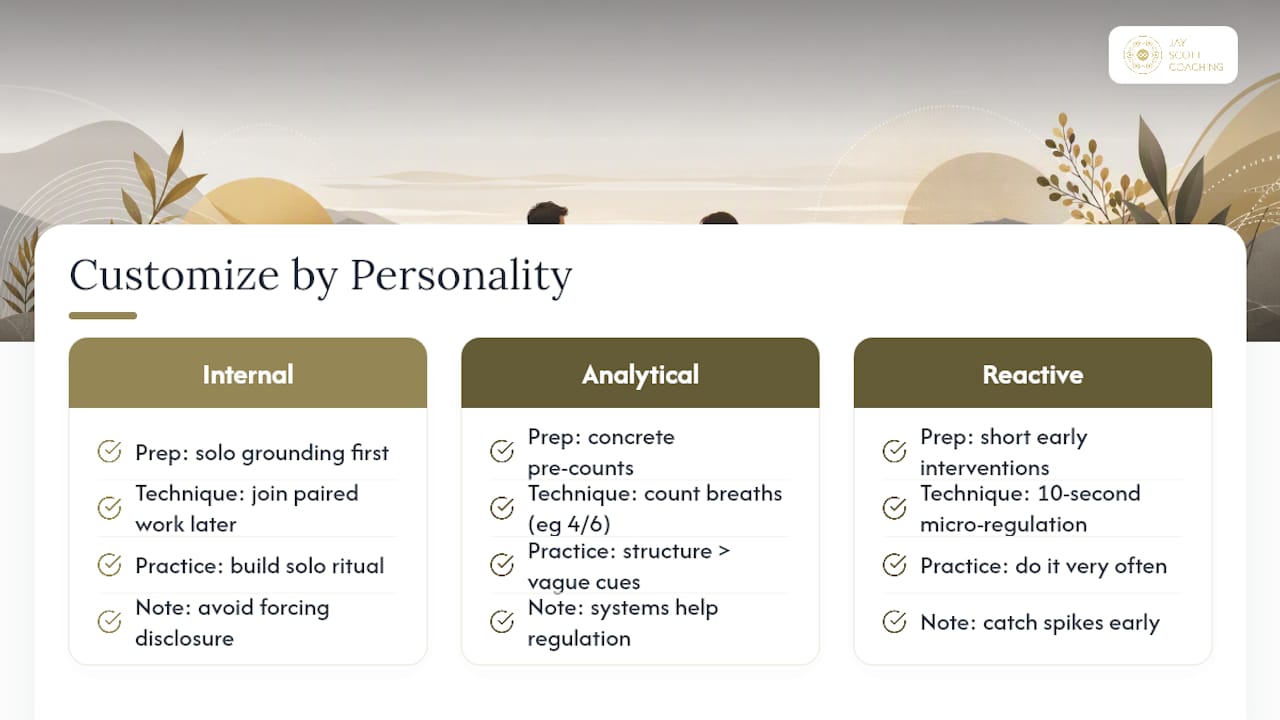
A man who processes internally needs more solo grounding time before he's ready for paired work; someone more externally expressive may skip straight to paired breathing because talking through the sensation as it happens is how he regulates. Neither approach is wrong, but forcing a highly internal processor into immediate verbal disclosure usually backfires into shutdown.
If you're naturally analytical, anchor the pre-conversation ritual to a concrete count (four in, six out, three cycles) rather than a vague "calm down" instruction. Structure tends to land better than open-ended mindfulness language for men who think in systems.
If you're naturally more reactive or quick to escalate, prioritize the 10-second micro-regulation and practice it far more often than the weekly cadence suggests. Catching the spike early matters more than any other single skill for this profile.
If your wife is the more verbally expressive partner and you tend toward brevity, the soft-prosody and open-posture cue matters more for you than word choice does. She may be reading your tone and body language for safety signals long before she's parsing your sentence.
None of this requires diagnosing yourself precisely. Start with the exercise that feels least natural, since that's usually the one addressing your actual gap, and adjust frequency based on what your week honestly allows.
The Nervous-System Angle Most Marriage Advice Misses
Most communication advice aimed at men treats marriage friction as a skills deficit: learn to listen better, learn to say the right thing, learn the formula. That advice isn't wrong so much as incomplete. It assumes the body is a neutral vehicle for the words, when the body is usually the actual problem.
The gap between what conventional communication tips promise and what actually changes a marriage is regulation capacity, not vocabulary. A man who can recite active-listening phrases while internally braced for conflict isn't communicating better; he's performing communication while his nervous system tells his wife something different. That's why so many smart, articulate executives feel baffled that their marriage still struggles despite reading the right books.
What the research and the pattern of client outcomes both point to is sequence: regulate first, then communicate. Skip the regulation step and even good scripts land flat. The reader's actual priority should be building a boring, repeatable daily practice before adding a single new communication technique. Capacity has to exist before skill can express it.
— Jay
Next Steps: How to Work With Jay Scott Coaching
Reading about nervous-system regulation gets you insight. Working through it with structure and accountability is what actually changes how you show up at home. Jay Scott Coaching is built specifically for men who already have the discipline to execute at work and need the same rigor applied to the body and the marriage, not more information to read alone.

Private Coaching, Groups, and Workshops & Immersions are available, each built around the Unshakable Man Method™ to train nervous-system regulation directly rather than relying on insight or talk therapy alone. If the exercises above feel like the right direction but you want a trained eye on your specific patterns, visit the why work with me page to see how the coaching works and apply for a consultation. For additional groundwork on communication before you start, the guide to overcoming communication barriers in relationships is a solid next read.
Sources
- Integrating polyvagal theory into the 5E Coaching Model — IJMCE (2026)
- Integrating coaching leadership style with polyvagal theory — MDPI (2025)
- Sympathetic nervous system (fight-or-flight) — Cleveland Clinic
FAQ
What Are the Most Effective Marriage Communication Exercises?
Coherent breathing, ten-second micro-regulation, and paired breathing are the most effective starting points because they change your physiological state before you speak. They work by lowering sympathetic activation, which is what typically derails communication under pressure in the first place.
How Often Should Couples Practice These Exercises?
Most men benefit from two to ten minutes of daily solo practice plus one weekly paired session of ten to twenty minutes, based on guidance for high-performers building nervous-system capacity. Consistency across weeks matters more than the length of any single session.
What Should I Say When I Feel Overwhelmed Mid-Conversation?
Say plainly, "I'm feeling flooded. I need ninety seconds," and then actually take the break and return. A stated, time-bound pause reads as regulation to your partner, while silent withdrawal without explanation usually reads as stonewalling.
When Should I Consider Coaching Instead of Practicing Alone?
If the same conflict pattern recurs despite consistent daily and weekly practice, or if in-conversation resets aren't reducing escalation, that's a signal to bring in structured support. A coaching method called the Unshakable Man Method™ is designed for exactly this stage, and pricing and program details are available on the why work with me page.
Do These Exercises Work for Men Who Aren't Naturally Verbal?
Yes. The exercises are built around breath, posture, and brief phrases rather than long verbal processing, which makes them accessible to men who regulate more internally. Starting with solo grounding before moving to paired practice tends to work best for this communication style.