

Nervous system dysregulation happens when your autonomic nervous system loses its ability to shift smoothly between activation and rest, leaving you stuck in either constant alert or complete shutdown. The fastest way to interrupt it in the moment is a physiological sigh, a double inhale through the nose followed by a long exhale, paired with a few minutes of movement. If symptoms feel sudden or severe, treat that as a signal to seek medical evaluation right away, not a routine to fix at home.
TL;DR:
- Chronic stress, trauma, or overwork recalibrates the HPA axis, leading to persistent nervous system overactivation that affects heart rate variability, sleep, and digestion.
- Symptoms of dysregulation include ongoing hyperarousal such as anxiety and insomnia, as well as hypoarousal like emotional numbness and low energy, especially when these last for weeks or months.
- Immediate regulation methods like physiological sighs and facial cooling can reduce activation within minutes, while lasting change from trauma or long-term dysregulation may take months of consistent practice.
- Lifestyle factors such as balanced nutrition, active recovery, and social connection are essential in maintaining regulation and preventing future dysregulation episodes.
- Professional coaching, combined with daily regulation routines, accelerates healing and helps high performers regain nervous system flexibility more effectively than solo effort.
Table of Contents
- What Nervous System Dysregulation Actually Means
- What Does Dysregulation Feel Like Day to Day?
- Why Does Nervous System Dysregulation Develop?
- Which Techniques Actually Calm the Nervous System?
- How Long Does Nervous System Recovery Take?
- When Should You See a Doctor for Nervous System Symptoms?
- What Happens in the Body During Dysregulation?
- Is This Dysregulation, Anxiety, or PTSD?
- How Do Diet, Exercise, and Relationships Affect Regulation?
- Can You Prevent Nervous System Dysregulation Before It Starts?
- A Coach's View on Training the Nervous System
- Ready to Retrain Your Nervous System With Support?
- Sources
- FAQ
What Nervous System Dysregulation Actually Means
Your autonomic nervous system runs on two branches that are supposed to trade off like a well-run relay. The sympathetic branch handles fight or flight, spiking your heart rate and sharpening focus when something demands attention. The parasympathetic branch handles rest and digest, the state where digestion, sleep, and repair actually happen. When one branch stays dominant for too long, the HPA axis that governs your stress hormone response starts running on a hair trigger, and your body loses the flexibility to move between states on demand.
That loss of flexibility is the real problem, not stress itself. A well-regulated system can spike under pressure and drop back down within minutes. A dysregulated one stays elevated for hours, or worse, goes numb instead of recovering. You can watch this play out through a few objective markers:
- Heart rate variability (HRV): low or flatlined HRV often signals a system stuck in sympathetic drive.
- Resting heart rate: a creeping baseline, even at rest, points to chronic overactivation.
- Sleep quality: frequent waking or shallow sleep reflects a parasympathetic system that never fully engages.
What Does Dysregulation Feel Like Day to Day?
Dysregulation shows up in two opposite directions, and most people swing between both without realizing they're connected. Hyperarousal looks like a racing heart, insomnia, a jaw that won't unclench, and a baseline hypervigilance that scans every room for a threat that isn't there. Hypoarousal is quieter and easier to miss: emotional numbness, low energy that no amount of coffee touches, a foggy sense of disconnection from your own life, and a pull toward withdrawal.
Watch for these patterns together, since they often show up as a cluster rather than a single symptom:
- Anxiety or a racing heart with no clear trigger
- Trouble falling or staying asleep despite exhaustion
- Brain fog, indecision, or impulsive snap decisions
- Numbness, low motivation, or a sense of watching your life from outside it
- Strained relationships from unpredictable reactivity or emotional shutdown
The distinction that matters is persistence. Everyone gets keyed up before a big presentation. Dysregulation is when that keyed up feeling, or its numb opposite, lingers for weeks or months without a clear off switch.
Why Does Nervous System Dysregulation Develop?
Chronic low-grade stress is the most common driver, especially for people who treat exhaustion as a badge of honor. Years of overwork without real recovery train your sympathetic system to treat "on" as the default setting, and hustle culture rarely builds in the downtime that would reverse it.
Early life adversity and trauma raise the baseline sensitivity of your stress response for decades afterward. Research on the HPA axis shows that early adversity, chronic stress, immune activation, and traumatic brain injury all reshape how reactive your stress machinery becomes, making future stressors feel bigger than they are. A few specific contributors show up repeatedly:
- Sustained overwork with no scheduled recovery
- Childhood adversity or unresolved trauma
- Traumatic brain injury
- Chronic immune activation or ongoing health conditions
Each of these recalibrates your HPA axis and sympathetic responsiveness, so the same trigger produces a bigger, longer reaction than it once did.
Which Techniques Actually Calm the Nervous System?
Not every regulation technique deserves equal airtime. Some work in seconds, others need daily repetition to matter, and the order you reach for them changes based on how activated you are right now.
- Physiological sigh. Take a double inhale through the nose, a short second pull of air on top of the first, then release a long, slow exhale through the mouth. Stanford's Huberman Lab identifies this as the fastest known way to downregulate in real time, working in roughly 30 seconds.
- Paced breathing and vagal stimulation. Slow exhales, longer than your inhales, along with humming or gargling, stimulate the vagus nerve and tend to raise HRV over repeated sessions.
- Movement that completes the stress cycle. A short walk, shaking out your limbs, or a few minutes of intentional exertion helps metabolize stress hormones your body produced but never used. Passive rest, scrolling your phone, watching television, does not accomplish the same thing, since neither behavior actually restores the nervous system the way active discharge does.
- Progressive muscle relaxation and body scans. Deliberately tensing and releasing muscle groups gives your nervous system a clear signal that the threat has passed.
- Sleep hygiene and transition rituals. Consistent mealtimes, a wind down routine before bed, and a hard stop on screens act as daily cues that tell your body it's safe to downshift.
- Facial cooling. Splashing cold water on your face or holding a cold pack briefly has pilot-level evidence for lowering cortisol spikes and nudging HRV upward, though the studies backing it are small.
- HRV and resting heart rate tracking. A wearable that tracks these numbers over weeks gives you objective feedback on whether your regulation habits are actually working, instead of guessing.
Pro Tip: Don't chase the single "best" technique. Clinicians researching these tools consistently find that consistency of practice matters more than which specific method you choose. Pick two or three and repeat them daily.
How Long Does Nervous System Recovery Take?
Some relief is immediate. A physiological sigh, a splash of cold water, or two minutes of movement can shift your state within minutes. Short-term changes, better sleep, fewer reactive blowups, tend to show up within days to a few weeks once you're running these rituals consistently.
Deeper change takes longer. If your dysregulation traces back to trauma or years of HPA-axis overactivation, expect months of sustained practice, and likely professional support, before the shift feels durable. Track progress with concrete markers: HRV trendlines moving upward, fewer nights spent waking at 3 a.m., and a subjective sense of recovery that holds steady rather than crashing by Wednesday.
When Should You See a Doctor for Nervous System Symptoms?
Some symptoms are not a self-regulation project. Sudden neurological changes, chest pain, or suicidal thoughts require immediate medical attention, not a breathing exercise.
For persistent but non-emergency symptoms, start with your primary care doctor to rule out cardiac, endocrine, or neurological causes that can mimic dysregulation. Cleveland Clinic notes that dysregulation can overlap with or mask underlying medical conditions, which is exactly why a baseline workup matters before you assume it's "just stress."
From there, ask your doctor about referrals when needed:
- Psychiatry, if mood symptoms or anxiety are severe or persistent
- Neurology, if cognitive symptoms or a history of TBI is involved
- Trauma-informed therapy, if early adversity is a likely root cause
- Specialized TBI clinics, for head injury related symptoms
Medical care and daily regulation practices aren't competing options. They work together, one addresses underlying pathology, the other retrains the pattern day to day.
What Happens in the Body During Dysregulation?
Dysregulation is a mismatch problem at its core: your nervous system keeps signaling danger long after the actual threat has passed. The HPA axis, your hypothalamus, pituitary gland, and adrenal glands working as a chain, releases cortisol and adrenaline in response to a perceived threat. In a well-regulated system, that response spikes, does its job, and shuts back off within minutes.
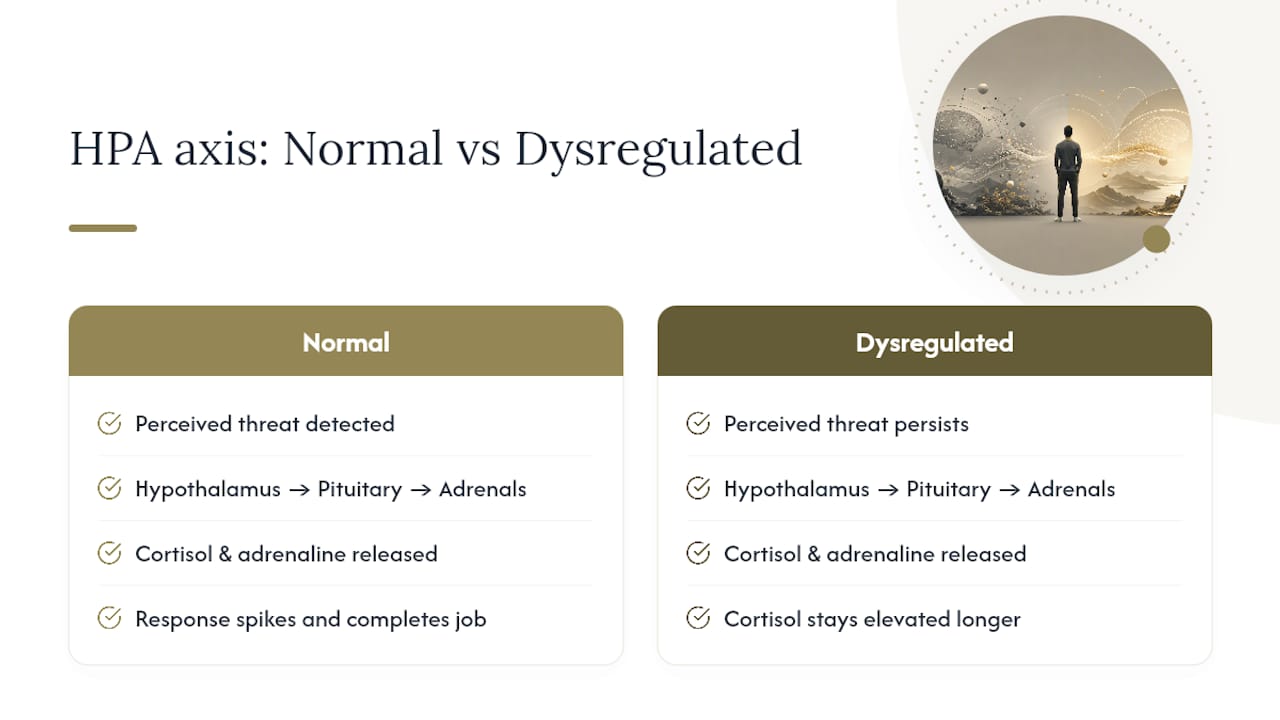
In a dysregulated system, the shutoff mechanism gets sluggish. Cortisol stays elevated longer than it should, which keeps your heart rate and blood pressure higher than baseline and interferes with digestion, since your body treats digesting a meal as a lower priority than surviving a threat that no longer exists. Sleep architecture suffers too, since deep restorative sleep depends on parasympathetic dominance, and a system stuck in sympathetic mode never fully hands over control at night.
Over time, this constant low-grade activation reflects a mismatch between perceived threat and actual safety, and it shows up across nearly every system in your body: energy production, sleep, digestion, mood regulation, and immune function all take a hit when the nervous system never gets the "all clear" signal. Left unaddressed, chronic activation contributes to elevated blood pressure, weakened immune response, disrupted metabolic function, and a mood baseline that trends toward anxiety or flatness. Restoring the nervous system's flexibility, its ability to move between activation and rest on demand, is the actual clinical goal, not eliminating stress altogether.
Is This Dysregulation, Anxiety, or PTSD?
These conditions overlap, but they're not identical, and the distinction matters for how you treat them. Nervous system dysregulation is a physiological state, an autonomic imbalance that can exist on its own or underlie other diagnoses. Anxiety disorders involve dysregulation, but they're also defined by specific thought patterns: persistent worry, catastrophic thinking, and anticipatory dread that go beyond what the nervous system alone explains.
PTSD is more specific still. It involves dysregulation triggered by identifiable traumatic events, paired with intrusive memories, avoidance behaviors, and hypervigilance tied to reminders of that trauma. Someone can be nervous system dysregulated from years of overwork with no trauma history at all, while someone with PTSD has dysregulation rooted in a specific injury to their sense of safety.
The practical takeaway: emotional dysregulation shows up across a range of diagnoses, including ADHD, PTSD, and borderline personality disorder, which is why treating the nervous system directly, rather than only treating the diagnostic label, tends to produce the most consistent results. Skills training paired with addressing the underlying cause outperforms either approach alone. If your symptoms center on specific traumatic memories or intense fear responses tied to reminders of past events, that points toward PTSD and warrants trauma-informed care specifically, not just general stress management. If your symptoms are more diffuse, tied to chronic overload rather than a specific event, general regulation work is a reasonable starting point.
How Do Diet, Exercise, and Relationships Affect Regulation?
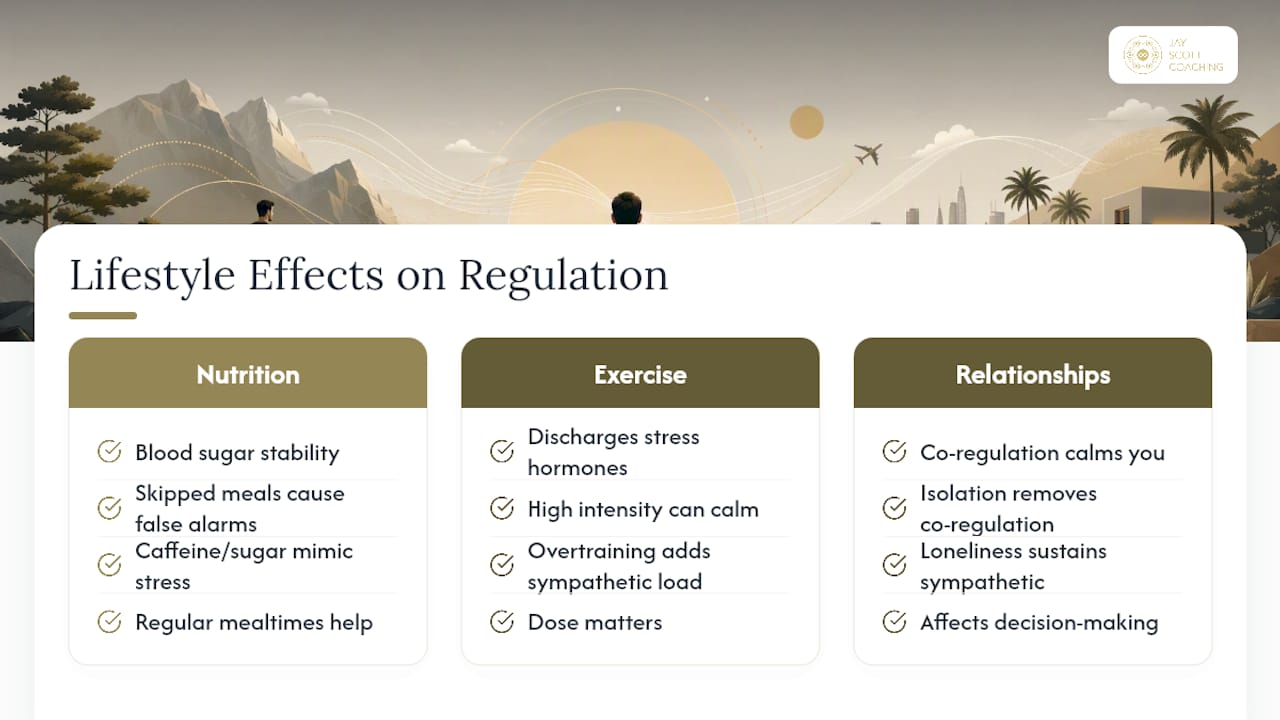
Your nervous system doesn't operate in isolation from the rest of your life, and three lifestyle factors carry outsized influence: nutrition, exercise, and social connection.
Blood sugar swings from skipped meals or heavy reliance on caffeine and sugar mimic the same physiological signals as a stress response, spiking cortisol and adrenaline in ways that make an already dysregulated system harder to settle. Steady mealtimes and stable blood sugar reduce one entire category of false alarms your body has to process.
Exercise plays a dual role. Intense exertion helps discharge stress hormones your body produced during the day, which is why a hard workout often leaves you calmer rather than more wound up. But exercise without recovery, training through exhaustion, chasing every personal record, adds another layer of sympathetic load on top of whatever stress you're already carrying. The dose matters as much as the activity.
Social connection may be the most underrated lever of all. Co-regulation, the process of calming down in the presence of another safe, regulated person, is a built-in feature of the nervous system, not a soft add-on. Isolation removes that mechanism entirely, which is part of why chronic loneliness correlates with sustained sympathetic activation. If you're managing dysregulation while also noticing it affecting your decision-making around money or impulse control, that overlap is worth naming honestly. Some readers find it useful to look at how nervous-system triggers shape impulsive spending, since the same reactivity that spikes your heart rate can just as easily spike your credit card.
Can You Prevent Nervous System Dysregulation Before It Starts?
Prevention beats recovery, and it costs less time than most people assume. The core principle is building recovery into your schedule before you need it, rather than waiting for a crash to force the issue.
A few preventive habits carry outsized weight. Protecting sleep as non-negotiable, rather than the first thing sacrificed to a busy week, keeps your parasympathetic system engaged on a predictable cycle. Building in short recovery windows during the workday, even five minutes between meetings, prevents the slow accumulation of unresolved sympathetic activation that eventually tips into full dysregulation. Maintaining social ties, especially during high-stress periods when isolation feels easier, keeps your co-regulation mechanism available when you need it most.
For high performers specifically, the biggest risk isn't a single acute stressor. It's the compounding effect of skipping recovery for months on end, treating each missed reset as a minor exception until dysregulation becomes the default operating state. Building daily rituals around safety and recovery works better as a preventive strategy than trying to overhaul your nervous system after years of neglect. The goal is a system flexible enough to handle stress and then actually let go of it.
A Coach's View on Training the Nervous System
Most men I talk to don't lack information about breathing techniques or sleep hygiene. They lack a structure that makes those practices stick under real pressure. The Unshakable Man Method™ exists because knowing what to do and actually doing it during a high-stakes moment are two different skills, and the gap between them is where self-abandonment lives.
Coaching accelerates this in a way solo practice rarely does, because pattern interruption requires someone catching the pattern in real time, not after the fact. Structured accountability, honest pattern-mapping across your history, and a coach who can name the moment you're about to override your own instincts again, that combination compresses years of trial and error into a shorter runway. None of this replaces medical care for urgent symptoms. It's a complement to it, built for the ongoing work of staying regulated once the immediate crisis has passed.
— Jay
Ready to Retrain Your Nervous System With Support?
Reading about regulation techniques gets you information. Working through them with structured accountability is what actually changes how you respond under pressure. This isn't a course you consume passively. It's a coaching relationship built specifically for high-performing men who are tired of overthinking their way through decisions that used to feel obvious.

Whether you're drawn to one-on-one coaching or a group format, the path starts with an application or consult call to map out where your patterns are running the show. People typically describe the shift as moving from constant internal noise to a grounded clarity that shows up in their leadership, their relationships, and how they carry themselves under pressure. If that sounds like the gap you're standing in right now, start with why this approach fits, or head to the main program overview to see how the Unshakable Man Method™ works from the inside.
This article is general information, not a substitute for advice from a qualified doctor. Consult a qualified healthcare professional about your own circumstances before acting on anything here.
Sources
- Stuck in survival mode: How to regulate your nervous system – Lifestyle Medicine (Stanford)
- Nervous System Dysregulation, According to Dr. Block | Healthline
- Review on HPA-axis and stress-related vulnerability (PMC6181794)
- Oversensitive and overreactive: what is nervous system dysregulation and how can it be resolved? | The Guardian
FAQ
How Do You Help a Dysregulated Nervous System?
Start with a physiological sigh, a double inhale followed by a long exhale, which downregulates activation in about 30 seconds. Pair that with short movement, consistent sleep rituals, and paced breathing over the following days to build lasting change rather than a one-time fix.
What Are the Symptoms of a Dysregulated Nervous System?
Symptoms split into two patterns: hyperarousal, including anxiety, racing heart, and insomnia, and hypoarousal, including numbness, low energy, and withdrawal. Persistence over weeks or months, rather than a single stressful day, is what separates dysregulation from normal stress.
How Long Does It Take to Regulate Your Nervous System?
Immediate tools like breathing and facial cooling work within minutes, while better sleep and fewer reactive episodes typically show up within days to a few weeks of consistent practice. Trauma-related or long-standing HPA-axis changes usually require months of sustained routines, sometimes alongside professional care.
How Can I Heal My Nervous System?
Healing combines daily parasympathetic anchors, physiological sighs, movement, progressive muscle relaxation, sleep hygiene, with medical evaluation when symptoms are severe or persistent. For those seeking structured accountability rather than solo trial and error, coaching built around nervous system training can accelerate the process considerably.