

A physiological sigh is a double inhale through the nose followed by one long, slow exhale through the mouth. It works by quickly resetting your breathing rate and nervous system arousal, and you can feel it take effect in under a minute. Stanford Medicine research backs this up, showing measurable drops in stress and breathing rate from just a few minutes of daily practice.
TL;DR:
- The physiological sigh can be most effective when performed in calm, upright postures to facilitate proper inhalation and exhalation.
- Taking the second inhale as a quick, sharp top-off sip, rather than a full breath, is crucial for triggering the calming response.
- Practicing five minutes of cyclic sighing daily, as in the Stanford trial, can significantly reduce resting breathing rates and improve mood over time.
- The technique primarily activates the parasympathetic nervous system through prolonged exhalation, helping to slow heart rate and reduce anxiety.
- Individuals with respiratory conditions such as COPD or recent lung surgery should consult a doctor before adopting this breathwork to avoid complications.
Table of Contents
- How Do You Do a Physiological Sigh?
- Why Does the Physiological Sigh Work?
- What Does the Research Say About Physiological Sighs?
- How Many Physiological Sighs Should You Do?
- What Are Common Mistakes With the Physiological Sigh?
- When Should You Avoid the Physiological Sigh?
- How Does Breathwork Fit Into Real Nervous System Training?
- A Different Path to Lasting Calm Under Pressure
- Sources
- FAQ
How Do You Do a Physiological Sigh?
Find a posture where your shoulders can actually drop. You don't need to lie down or close your eyes. Sitting at your desk before a hard conversation works fine. Standing in a hallway outside a meeting works too.
Once you're settled, follow three steps:
- Inhale through your nose until your lungs feel comfortably full, not maxed out.
- Take a second, smaller inhale right on top of the first, a quick "sip" of air that tops off your lungs completely.
- Exhale slowly through your mouth, making this breath out noticeably longer than both inhales combined.
One cycle can shift how you feel almost immediately. For an acute spike (walking into a tense room, catching a wave of panic before you speak), one to three cycles is usually enough. If you're building this into a daily habit rather than using it as an emergency brake, Physio-Pedia's cyclic sighing guidance and the Stanford trial both point to roughly five minutes of continuous practice.
Breathe normally between cycles if you're doing more than one. And stop if you feel lightheaded. That's your body telling you to ease off, not push through.
Pro Tip: *The second inhale trips up almost everyone the first time. It should be a short, sharp sip, not a full second breath.
Why Does the Physiological Sigh Work?
The mechanism starts in a cluster of neurons most people have never heard of: the preBötzinger complex, a breathing control center in your brain stem. Research using neuroscience methods has identified specific neuron populations there, including cells known as NMB and GRP neurons, that fire specifically to generate sighs rather than ordinary breaths. A PMC review of this circuitry defines a true sigh as a breath moving more than twice the air of a normal one, which is exactly what the double inhale accomplishes.
That larger volume of air does two things at once. It reopens tiny collapsed air sacs in your lungs called alveoli, improving how efficiently you exchange oxygen and carbon dioxide. And it sets up the second half of the mechanism, the part that actually calms you down: a long, controlled exhale.
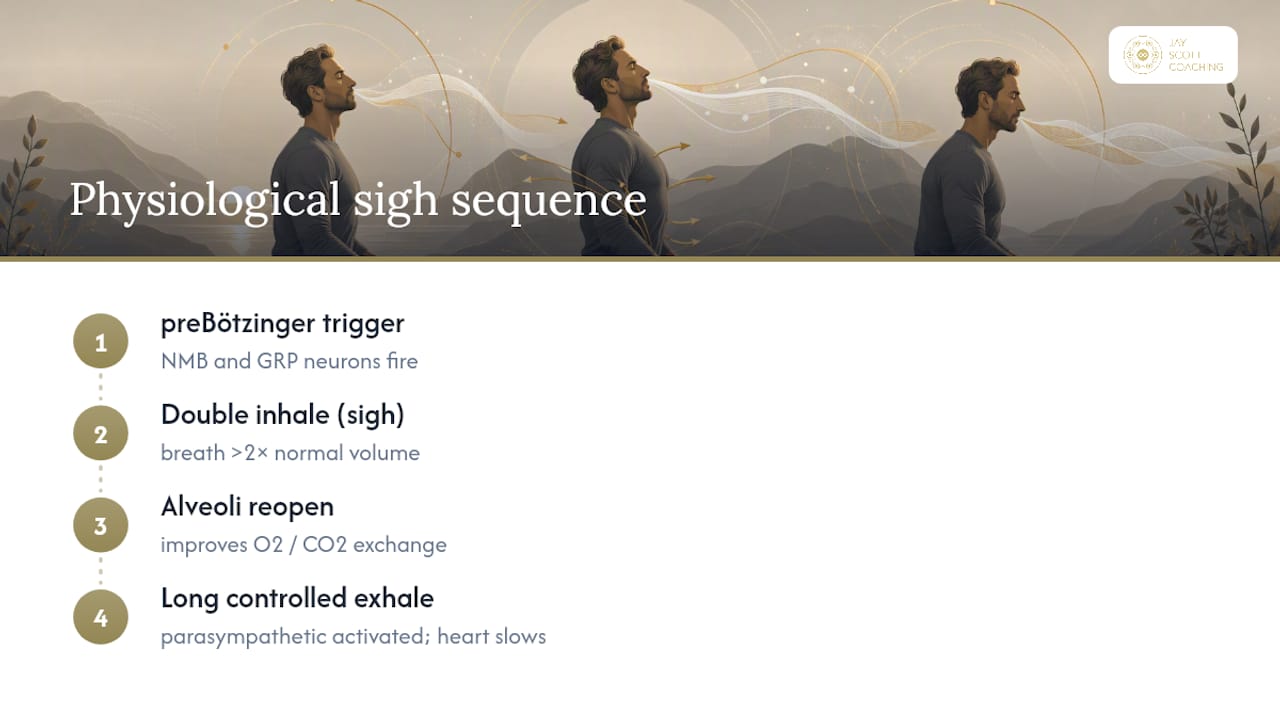
Exhaling activates your parasympathetic nervous system, the branch responsible for slowing your heart rate and telling your body the threat has passed. Stanford's David Spiegel has described breathing as sitting "on the edge of conscious control," which is exactly why deliberately extending your exhale can override an anxious, shallow breathing pattern almost as fast as it started. The result you feel is a slower breathing rate and a body that has stopped bracing.
What Does the Research Say About Physiological Sighs?
The strongest evidence comes from a Stanford Medicine randomized controlled trial involving 111 healthy volunteers. Participants who practiced cyclic sighing for five minutes a day over one month showed a bigger boost in positive mood and a larger drop in resting respiratory rate than groups doing other breathing exercises or mindfulness meditation.
- Cyclic sighing outperformed box breathing and meditation on mood improvement in the Stanford trial.
- Resting breathing rate dropped more in the sighing group than in comparison groups.
- Neuroscience findings on the preBötzinger complex give a physical explanation for why the technique works, not just a correlation.
- Most trial participants were healthy adults, so the findings don't automatically extend to people with diagnosed anxiety disorders or respiratory disease.
That last point matters. The evidence is genuinely strong for otherwise healthy adults managing everyday stress, but it's a supplement to care, not a replacement, for anyone managing a clinical condition. The practical takeaway holds either way: you get a fast effect within one cycle, and Stanford's data suggests the benefits compound with daily repetition.
How Many Physiological Sighs Should You Do?
Dosage depends on what you're solving for. Acute stress calls for a quick hit; building resilience calls for a habit.
- In the moment: one to three cycles is typically enough to feel your body settle within about a minute.
- As a daily practice: aim for around five minutes, matching the protocol used in the Stanford trial.
- Good moments to use it: right before a presentation, when you notice your breathing has gone shallow, or mid-argument when you feel yourself about to react instead of respond.
- Not a standalone fix: if you're managing panic disorder or a chronic respiratory condition, treat this as a supporting tool alongside professional care, not the primary treatment.
What Are Common Mistakes With the Physiological Sigh?
Most people make the same two errors, both of which quietly cancel out the effect.
- Taking the second inhale as another full breath instead of a small top-off sip.
- Rushing the exhale instead of stretching it out, which skips the parasympathetic activation that makes the technique work.
- Trying it for the first time during a real crisis, which makes it harder to focus on form.
- Ignoring lightheadedness instead of pausing and letting your breathing return to normal.
Pro Tip: Count silently to four, five, or six on the exhale, and let your lips soften into a slight "whoosh" shape as the air leaves. That extra half second of length is where most of the calming effect lives, more than in the inhale itself.
If you have a respiratory limitation, don't force a big first inhale. Take a smaller breath in, then lean into a longer, gentler exhale instead. Practicing during calm moments, not just crises, is what makes this automatic when you actually need it.
When Should You Avoid the Physiological Sigh?
For most healthy adults, this technique carries very low risk. It's breathing, adjusted deliberately. Still, a few guardrails matter.
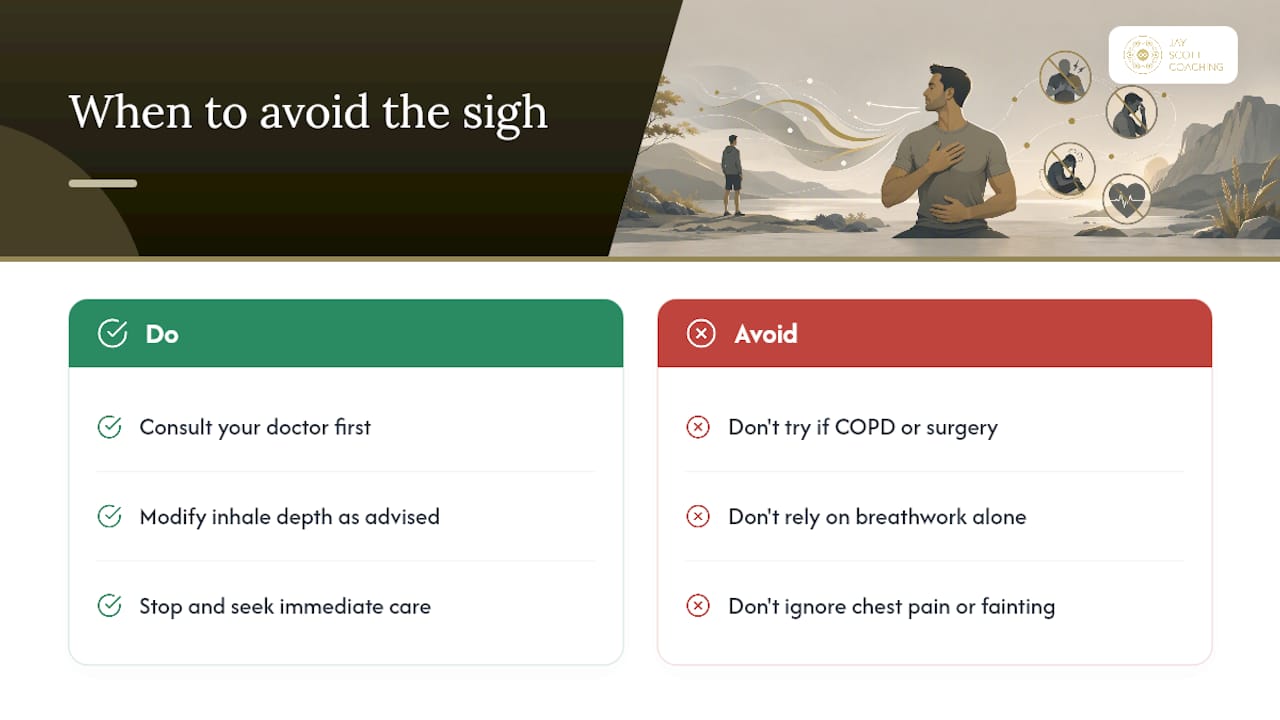
If you have COPD, recent chest or lung surgery, or another significant respiratory condition, talk to your doctor before adopting a new breathing pattern, and modify the depth of your inhale accordingly. Stop immediately and seek medical attention for chest pain, fainting, or dizziness that doesn't clear within a few normal breaths. And if breathlessness or panic symptoms are persistent rather than occasional, that's a signal to get a medical or mental health evaluation rather than relying on breathwork alone.
How Does Breathwork Fit Into Real Nervous System Training?
The physiological sigh is a genuinely effective tool. It's also a single tool, and most men I work with have tried a dozen breathing techniques before we ever start coaching together. The technique calms your body for a few minutes. It doesn't touch the pattern that put you in a stress spiral in the first place.
The Unshakable Man Method™ uses breathwork like this as an anchor point, not the whole strategy. A sigh buys you thirty seconds of clarity. What you do with those thirty seconds, whether you name what you're feeling, set a boundary, or take the decisive action you've been avoiding, is where lasting change actually happens.
— Jay
A Different Path to Lasting Calm Under Pressure
A physiological sigh gets you through the next five minutes. Coaching programs can help train your nervous system so pressure stops running the show in your career, your relationships, and the decisions you've been avoiding.

Breathing techniques are genuinely useful, and so is understanding practical stress management techniques beyond breath alone. But a single tool can only regulate you in the moment. Certain coaching methods go further: pattern mapping, accountability, and direct coaching that trains your nervous system to stay grounded before the spiral starts, not just after. These approaches are designed for men who are tired of managing symptoms and ready to change the underlying pattern, whether that shows up in decision paralysis, avoidance, or the quiet self-abandonment that erodes confidence over time. It's also the same composure skillset that matters in high-stakes evaluation settings, the kind covered in performance-under-pressure assessment prep.
If you're ready to see what durable regulation actually looks like, read why working with Jay Scott Coaching is different from another breathing app or one-off technique, and apply for a consultation call.
Sources
- 'Cyclic sighing' can help breathe away anxiety — Stanford Medicine
- Sigh generation in preBötzinger complex — PMC
- Cyclic sighing — Physio-Pedia
This article is general information, not a substitute for advice from a qualified doctor. Consult a qualified healthcare professional about your own circumstances before acting on anything here.
FAQ
Does the Physiological Sigh Actually Work?
Yes. A Stanford Medicine randomized controlled trial found that daily cyclic sighing improved mood and lowered resting respiratory rate more than comparison breathing techniques.
How Many Physiological Sighs Should You Do?
For an acute stress spike, one to three cycles is usually enough to feel your body settle within about a minute. For ongoing benefits, daily practice lasting several minutes aligns with the approach used in the Stanford research.
How Do You Do the Physiological Sigh?
Inhale deeply through your nose, take a second short "sip" inhale to top off your lungs, then exhale slowly through your mouth for longer than both inhales combined.
Can Anxiety Cause Shallow Breathing?
Yes, anxiety typically triggers rapid, shallow breathing centered in the chest, which reinforces the body's stress response. Techniques that emphasize a long exhale, like the physiological sigh, work in the opposite direction by activating your parasympathetic nervous system.