

Self-abandonment is the habit of ignoring, silencing, or overriding your own needs in the moment they arise, usually to keep peace, avoid conflict, or stay likable. It is not a one-time mistake but a repeated pattern, and it can be healed. The route out is not more willpower or insight. It's rebuilding self-trust through small, consistent practices, boundary by boundary, promise by promise.
TL;DR:
- Self-abandonment occurs when individuals repeatedly choose to override their needs to manage guilt, fear, or shame, often starting from childhood invalidation.
- Signs include automatic agreement without self-checking, chronic apologizing, self-numbing, and suppressing needs until resentment builds.
- Changing this pattern requires real-time awareness, micro-promises, boundary scripts, and daily self-compassion, rather than relying solely on insight.
- Self-abandonment is reinforced by societal pressures in workplaces, family roles, and social media, making cultural awareness essential for recovery.
- Professional therapy or coaching may be necessary when the pattern is rooted in trauma or causes significant distress, as self-practice alone may not suffice.
Table of Contents
- What Is Self-Abandonment, Exactly?
- Why Does Self-Abandonment Develop in the First Place?
- What Are the Signs of Self-Abandonment?
- How to Stop Self-Abandonment and Rebuild Self-Trust
- When Does Self-Abandonment Need Professional Help?
- Is All Self-Sacrifice a Form of Self-Abandonment?
- How Do Culture and Society Encourage Self-Abandonment?
- Where Else Does Self-Abandonment Show Up?
- How Does Self-Abandonment Shape Decisions and Growth?
- The Coaching Lens: How Jay Scott Coaching Approaches Self-Abandonment
- Sources
What Is Self-Abandonment, Exactly?
You already do this more often than you think. Self-abandonment happens when you know what you need, want, or feel, and you choose against it anyway, usually to manage someone else's reaction. NAMI describes it as deciding, in real time, not to meet your own needs. It's a live decision, made under pressure, over and over.
Two scenes make it concrete:
- You're exhausted after a long week, a friend asks for a favor that eats your Saturday, and you say yes before you've even checked in with your own body.
- Your partner says something that stings, and instead of naming it, you swallow the feeling and change the subject to keep the evening smooth.
Neither moment looks dramatic from the outside. That's exactly what makes the pattern hard to catch. PositivePsychology's framework points to two quick questions you can run in the moment:
- What am I actually making this decision for? Relief from guilt, fear of disappointing someone, or genuine desire to help?
- If I were the only person on earth, would I still choose this? If the honest answer is no, you're likely abandoning yourself to manage someone else's feelings.
Why Does Self-Abandonment Develop in the First Place?
Nobody wakes up one day and decides to stop trusting themselves. The pattern is built, usually starting in childhood, through thousands of small repetitions.
Kids who grow up with caregivers who dismissed their feelings, punished their "no," or rewarded compliance learn a simple lesson early: your internal signals are less important than everyone else's comfort. PositivePsychology links self-abandonment to exactly this kind of caregiver invalidation, where a child's authentic reactions get overridden so often that suppressing them becomes automatic.
That automaticity is the part people underestimate. This isn't a character flaw or a lack of discipline. It's a conditioned nervous-system response, the same category of adaptation as flinching at a loud noise.
A telling detail: Psychotherapy Networker's clinical work with self-abandoning clients focuses less on insight ("Ah, I see why I do this") and more on repeated experiential practice, because understanding the pattern rarely dismantles it on its own.
What keeps the pattern running:
- Fear of conflict or rejection if you assert a need
- Shame attached to wanting things at all
- Chronic self-doubt that makes your own judgment feel unreliable
- A learned belief that your worth depends on being agreeable
The nervous system adapted to keep you safe once, as discussed in Rejection Sensitive Dysphoria: What People With ADHD Need to Know. It just never got the update that the threat is gone.
What Are the Signs of Self-Abandonment?
Self-abandonment rarely announces itself. It shows up as a hundred small moments that, stacked together, quietly erode your relationship with yourself. Here's what to watch for.
- The auto-yes. You agree to requests before you've actually consulted your own capacity, time, or desire.
- Chronic over-apologizing. You say sorry for taking up space, having a preference, or simply existing inconveniently.
- Self-numbing. Scrolling, overeating, overworking, or drinking to avoid sitting with a feeling you haven't let yourself name.
- A harsh internal narrator. Your inner voice criticizes your needs as selfish or excessive before you've even acted on them.
- Lost preferences. You genuinely don't know what restaurant you'd pick, what movie you'd choose, or what you want out of a weekend.
- Minimizing your own hurt. "It wasn't a big deal" becomes your default response to things that actually stung.
- Over-accommodating in relationships. Psychology Today describes this as a chameleon-like adaptation, where you quietly reshape your wants around a partner's to avoid disconnection.
- Suppressing needs until resentment builds. You stay quiet so long that when you finally speak, it comes out as anger instead of a request.
Ask yourself: how often do you change your answer, your tone, or your plans the moment someone else looks disappointed? This tendency is commonly more frequent than people realize, and it's the clearest signal of where self-abandonment is currently active in your life.
How to Stop Self-Abandonment and Rebuild Self-Trust
Insight rarely fixes this on its own. What actually shifts the pattern is repetition, the same way you'd retrain a flinch. Here's a practical sequence.
-
Build real-time awareness first. Before you can change a response, you have to catch it happening. A 10-second body scan, noticing tension in your jaw, chest, or stomach right before you say yes to something, works better than trying to think your way out of the habit. Pair it with one pause question: "Am I choosing this, or avoiding a reaction?"
-
Start with micro-promises. Self-trust is built the same way trust with anyone else is built: through kept commitments. Pick something small, like a 10-minute walk or five minutes of quiet before checking your phone in the morning, and keep it for a week. Rick Hanson's work on self-trust frames this as generating direct evidence, not just belief, that you follow through on yourself.
-
Practice boundary scripts on low-stakes situations. Don't start with the hardest conversation in your life. Start with a waiter, a scheduling request, or a group text. Try: "That doesn't work for me, but thanks for asking," or "I need to think about it before I answer." Reciting the boundary is easier once it lives in your mouth rather than only in your head. A guide on helping men build healthier boundaries breaks this down into more scripts you can borrow directly.
-
Use mindfulness and self-compassion to tolerate the discomfort. Choosing yourself will feel uncomfortable at first, and that discomfort is not a sign you did something wrong. Mindful to becoming genuinely familiar with your own body and mind, which only happens through repeated, nonjudgmental attention, not through avoiding the discomfort altogether.
-
Run a 30-day structure. Give the practice a container instead of leaving it vague:
- Daily: one body scan before a decision, one kept micro-promise, one honest "no" or "not yet."
- Weekly: a five-minute review. What did you choose for yourself this week? Where did you cave? What pattern repeated?
Pro Tip: Keep a running list titled "Promises I Kept to Myself." Read it back after two weeks. Most people are shocked at how much evidence they've already built and how quickly the "I can't trust myself" story starts to crack.
For readers who identify strongly as people-pleasers, a piece on moving from people-pleaser to authentic self walks through this shift in more depth.
When Does Self-Abandonment Need Professional Help?
Self-directed practice goes a long way, but it isn't always enough on its own, and it isn't meant to replace clinical care when the pattern runs deep.
- CBT-informed work helps identify the automatic thoughts ("If I say no, they'll leave") that fuel the behavior and tests them against reality.
- Trauma-informed therapy is often necessary when the self-abandonment traces back to childhood invalidation or relational trauma, since the nervous system's threat response needs direct, guided work to recalibrate.
- Mindfulness-based approaches build the same present-moment awareness described above, with professional support for people who find it hard to access alone.
- Psychotherapy Networker's clinical approach reframes boundary-setting as an act of self-care rather than selfishness, which is often the exact belief keeping someone stuck.
Coaching can complement this work by giving you repeated, real-time rehearsal for staying grounded under pressure, which is different from processing the origin of the pattern.
Seek licensed help directly, and prioritize it over self-guided practice, if you notice sustained depression, thoughts of suicide, or symptoms tied to significant trauma. Progress from either path is rarely linear. Expect weeks of practice before boundary-setting feels less like a fight and more like a habit.
Is All Self-Sacrifice a Form of Self-Abandonment?
No, and confusing the two causes real harm. Healthy self-sacrifice is a conscious choice, made from a place of stability, where you weigh your own needs and decide, freely, to prioritize someone else's for a specific reason. You stay up late with a sick kid because you value their care more than your sleep that night. You know what you gave up, and you don't resent it afterward.

Self-abandonment looks similar on the surface but works differently underneath. It's automatic, not chosen. It happens because saying no feels dangerous, not because you weighed the trade-off and picked it deliberately. And it almost always comes with a hidden cost: resentment, exhaustion, or a slow erosion of your own preferences that you can't quite name.
The test is simple. Ask whether you'd make the same choice if there were zero risk of disapproval, guilt, or conflict attached to choosing otherwise. If yes, that's likely healthy sacrifice. If the honest answer is that fear is doing the choosing, that's self-abandonment wearing sacrifice as a disguise.
This distinction matters because well-meaning people often defend their self-abandoning patterns as generosity or loyalty. Reframing boundary-setting as an act of care, rather than a rejection of others, is one of the more effective shifts clinical work makes here.
How Do Culture and Society Encourage Self-Abandonment?
Self-abandonment isn't purely a personal or family-level pattern. Culture reinforces it constantly, often in ways that get praised rather than questioned.
Workplace culture rewards constant availability and treats boundary-setting as a lack of commitment. Many men, in particular, are raised on a script that equates emotional needs with weakness, which makes silencing feelings look like strength instead of what it actually is: a rehearsed suppression. Family and community systems often assign specific roles, the fixer, the peacekeeper, the reliable one, that quietly require ongoing self-sacrifice to maintain.
Social media adds another layer, rewarding curated agreeableness and punishing visible conflict or need. None of this is new, but it's more constant and more visible now, and it normalizes ignoring your own limits as simply what a good employee, partner, or friend does.
Recognizing these pressures doesn't excuse the pattern, but it does explain why so many capable, otherwise self-aware people struggle with the same habit. The fix still has to happen at the individual level, one kept promise at a time, but it helps to know you're swimming against a cultural current, not just a personal flaw.
Where Else Does Self-Abandonment Show Up?
Relationships get most of the attention, but self-abandonment shows up just as often in places that have nothing to do with a partner or family member.
Career choices are a common site. Taking a job for the salary or the title, while ignoring a clear internal signal that the work doesn't fit your values, is self-abandonment applied to your professional life. So is staying in a role for years past the point you knew it was wrong, because leaving would disappoint someone or disrupt a plan you'd already announced.
Health and body signals get overridden constantly too. Ignoring pain, exhaustion, or hunger cues to push through a schedule, or dismissing your own need for rest because productivity feels like the only acceptable output, is the same pattern in a different outfit.
Values get abandoned quietly as well. Going along with a group decision that conflicts with something you actually believe, staying silent when a joke or comment crosses a line you'd normally hold, or compromising on a personal standard because objecting feels like more trouble than it's worth. All of it draws from the same well: overriding your own signal because someone else's comfort, approval, or convenience took priority in that moment.
How Does Self-Abandonment Shape Decisions and Growth?
Every self-abandoning choice trains your brain to distrust its own signals a little more. That's the real cost, and it compounds.
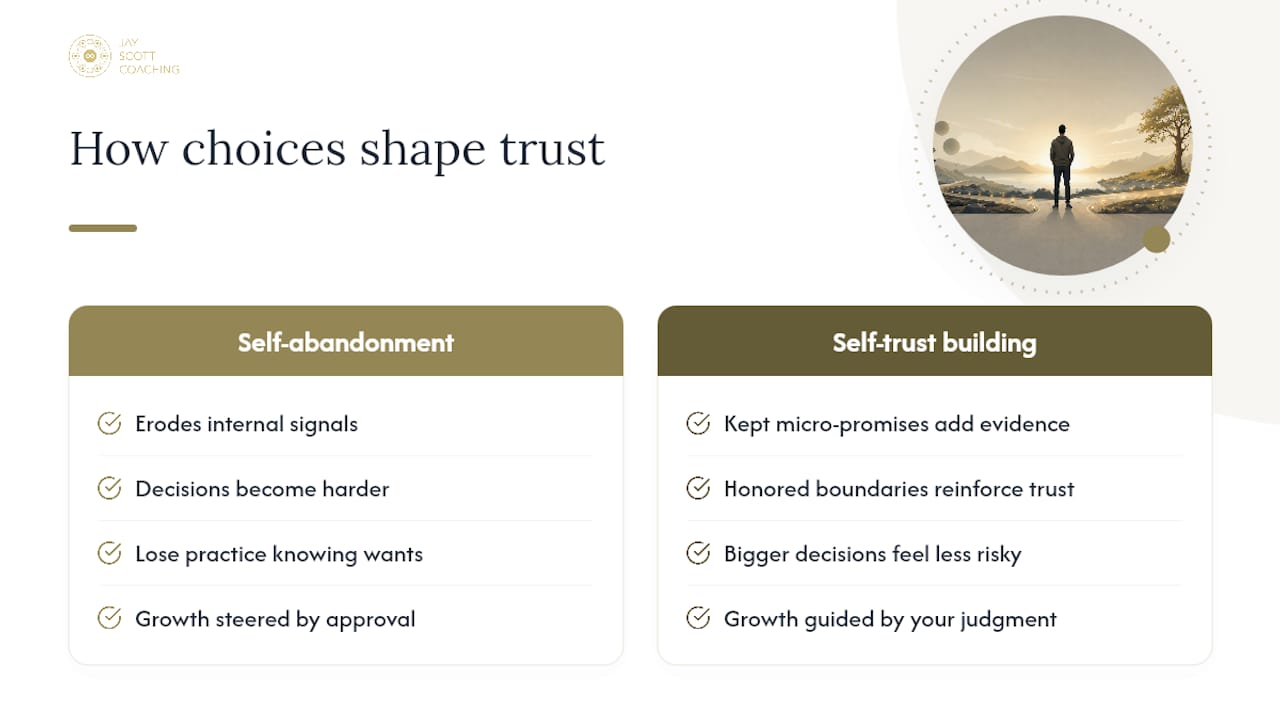
Decision-making gets harder, not easier, the longer the pattern runs. If you've spent years overriding your preferences to manage other people's reactions, you lose practice at knowing what you actually want. Simple choices, what to order, which job offer to take, whether to end a relationship, start to feel disproportionately hard, because you no longer have a reliable internal reference point to check against.
Personal growth stalls for a related reason. Growth requires taking risks based on your own judgment: starting something new, setting a boundary, pursuing a goal that isn't universally approved of. Self-abandonment keeps you oriented toward external approval instead, which means your growth gets steered by what looks acceptable to others rather than by what you actually want to build.
The reversal works the same way in the opposite direction. Every kept micro-promise, every honored boundary, adds a small deposit of evidence that your judgment is trustworthy. That evidence is what eventually makes bigger decisions, career changes, relationship boundaries, long-term goals, feel less like a gamble and more like something you're actually equipped to navigate.
The Coaching Lens: How Jay Scott Coaching Approaches Self-Abandonment
Most self-abandonment advice stops at insight: understand the pattern, journal about it, maybe talk it through once. That's rarely enough for men whose self-abandonment shows up as overthinking, avoidance, or going quiet under pressure at exactly the moments that matter most in their careers and relationships.
A coaching method approaches it differently. Instead of only analyzing the pattern, it trains the nervous system directly, building repeated, in-the-moment experiences where a man practices staying grounded and choosing himself under real pressure, not hypothetical pressure. Over time, that repetition is what shifts automatic appeasement into deliberate, confident response, the same principle Rick Hanson describes as generating direct proof you can rely on yourself.
Coaching works best as a direct path when the core issue is behavioral: overthinking decisions, avoiding hard conversations, or defaulting to silence under stress. When the pattern is rooted in significant trauma or comes with depression or anxiety that interferes with daily functioning, therapy should lead, with coaching layered in afterward for real-world rehearsal. Coaching can help men navigating exactly this gap between insight and action, in careers, marriages, and the quieter moments in between.
— Jay
Sources
- Are You a Chronic Self-Abandoner? — NAMI Blog
- Treating self-abandonment — Psychotherapy Networker
- Self-Abandonment: What It Is & How to Heal — PositivePsychology
- Mindful
- Trust yourself — Rick Hanson
This article is general information, not a substitute for advice from a qualified doctor. Consult a qualified healthcare professional about your own circumstances before acting on anything here.