

If you keep watching good relationships fall apart in the same predictable way, you're likely repeating a self-protective pattern, not failing at love. That pattern is learnable and changeable. Start today by naming one behavior you repeat when things get close, and add a three-second pause before you act on it. The rest of this guide walks through why the pattern exists and how to interrupt it for good.
TL;DR:
- Repeating defensive behaviors, withdrawal, or testing in multiple relationships indicate a learned sabotage pattern linked to trust, communication, and attachment issues.
- These patterns are driven by past attachment experiences, shame, fears of failure or identity loss, and automatic nervous system responses, not lack of willpower.
- Common triggers include major relationship milestones or small moments of perceived threat, with recognition of physical and mental cues necessary to interrupt sabotage early.
- Building awareness, naming patterns, using a somatic pause, and sharing your work with partners can help break the cycle gradually rather than through perfectionism.
- Professional support, such as therapy or coaching, is recommended if sabotage persists despite self-help efforts or involves repeated harm or trauma.
Table of Contents
- What Is Relationship Self-Sabotage, and Why Does It Matter?
- Common Self-Sabotaging Behaviors and Red Flags
- Psychological Drivers: Attachment, Shame, and the Nervous System
- How Avoidant, Anxious, and Disorganized Attachment Styles Sabotage Relationships
- Triggers and Relationship Milestones That Commonly Activate Sabotage
- How to Stop Self-Sabotaging: Step-by-Step Practices That Work
- When to Seek Professional Help for Relationship Self-Sabotage
- The Long-Term Cost of Letting Self-Sabotage Run Unchecked
- What Self-Sabotage Actually Looks Like in Real Relationships
- How Self-Sabotage Distorts Communication in Relationships
- Does Self-Sabotage Look Different in Friendships Than in Romantic Relationships?
- Steps to Rebuild Trust and Repair a Relationship After Self-Sabotage
- Jay's Practitioner Perspective: What Coaching Reveals About Sabotage and Repair
- If You Want Guided Help: Jay Scott Coaching
- Sources
What Is Relationship Self-Sabotage, and Why Does It Matter?
Relationship self-sabotage is a pattern of behavior that undermines closeness you actually want, usually without you fully realizing it's happening in the moment. Researchers who built the Relationship Sabotage Scale, a validated 12-item tool tested with a large sample, found the pattern clusters around three measurable factors: defensiveness, difficulty trusting a partner, and a lack of relationship skills. That structure held up when researchers ran it through further validity testing, confirming the same three constructs across diverse samples.
Not every relationship problem is sabotage. Genuine incompatibility, differing values, or a partner who consistently disrespects you are legitimate reasons to step back. The tell is timing and repetition. If the same defensive move, the same withdrawal, or the same picked fight shows up right when things are going well, across different partners, that's the signature of a pattern rather than a mismatch.
Sabotage rarely looks like sabotage from the inside. It looks like protecting yourself from a threat that already happened, once, a long time ago.
Recognizing the pattern matters because it shifts the question from "What's wrong with this relationship?" to "What's this old wiring trying to protect me from?" That single reframe is often the difference between another breakup and the first real repair.
Common Self-Sabotaging Behaviors and Red Flags
Sabotage rarely announces itself. It shows up disguised as caution, standards, or "just being honest." Here are the behaviors that show up most often in the research and in coaching rooms:
- Testing your partner. Picking fights or creating small crises to see if they'll stay, then feeling relieved and suspicious when they do.
- Withdrawing right after closeness. Going quiet, busy, or distant within days of a vulnerable conversation or a great weekend together.
- Picking fights over minor issues. Turning a dish left in the sink into a referendum on the whole relationship.
- People-pleasing to the point of resentment. Saying yes constantly, then quietly punishing your partner for needs you never voiced.
- Perfectionism aimed at the relationship or the partner. Fixating on a flaw as proof this isn't "the one," right as intimacy deepens.
- Excessive jealousy or surveillance. Checking phones, questioning motives, and treating normal social contact as evidence of betrayal.
- Infidelity as a detonation device. Using an affair, physical or emotional, to blow up something that felt like it was getting too real.
If you recognize two or three of these across multiple relationships rather than just one, treat it as an established pattern, not a bad-luck streak. The Relationship Sabotage Scale research found these behaviors cluster together statistically, which means someone who withdraws after intimacy is also more likely to struggle with trust and communication skills in other areas. The pattern travels as a set, not a single habit.
Psychological Drivers: Attachment, Shame, and the Nervous System
Sabotage isn't a willpower problem. It's a protection strategy your nervous system learned somewhere, and it's doing exactly what it was built to do.
Four forces tend to drive it:
- Attachment wiring. Early relationships with caregivers taught your nervous system what closeness predicts, safety or disappointment, and it still runs that prediction on your partner today, per Cleveland Clinic's overview of attachment theory.
- Shame. Clinicians describe shame as the hidden engine behind sabotage. It's the felt sense of "if they really see me, they'll leave," so you create the leaving yourself, on your terms, before they get the chance.
- Fear of success or identity conflict. A good relationship can threaten an old identity ("I'm the one who's always alone" or "I don't deserve this"), and the mind will manufacture reasons to return to the familiar version of yourself.
- Nervous-system logic. Your body doesn't distinguish between "this relationship might end" and "this is a physical threat." It reacts with the same fight, flight, or freeze response, which explains why sabotage often feels involuntary in the moment.
Shame is worth dwelling on for a second, because it explains why journaling alone rarely fixes this. Shame is a relational injury. It doesn't respond well to being reasoned with in isolation. It responds to repeated experiences of safety, either with a therapist, a coach, or a partner who stays calm and present when you expect them to leave. That's the mechanism behind lasting change, not insight alone.
How Avoidant, Anxious, and Disorganized Attachment Styles Sabotage Relationships
Attachment style doesn't just predict how you bond. It predicts exactly how you'll sabotage when things get real, according to the Cleveland Clinic's clinical review of attachment patterns. Here's how each style tends to show up:
- Avoidant attachment creates distance the moment intimacy rises. You'll notice a sudden need for space, a busier schedule, or a critical thought about your partner right after a vulnerable exchange. The fix starts small: stay in the room for five extra minutes past your urge to leave.
- Anxious attachment tests and escalates to get reassurance. You might send a string of messages, pick a fight, or accuse your partner of pulling away before you have real evidence. The fix is naming the need directly ("I want reassurance right now") instead of engineering a crisis to get it.
- Disorganized (fearful-avoidant) attachment produces push-pull chaos and covert undermining. You want closeness and fear it in the same breath, so you might pursue intensely, then sabotage just as intensely, sometimes without conscious awareness of the switch. This style often benefits most from slow, structured behavioral experiments inside a relationship that feels genuinely safe.
None of these are character flaws. They're adaptive strategies that made sense once and now misfire in a relationship that doesn't actually match the old threat.
Triggers and Relationship Milestones That Commonly Activate Sabotage
Sabotage rarely fires at random. It tends to spike at specific milestones: saying "I love you" for the first time, moving in together, getting engaged, a partner's promotion or job loss, or the announcement of a pregnancy. Each of these raises the emotional stakes, and your nervous system reads higher stakes as higher risk.
Smaller moments count too. A flat tone of voice, an unanswered text sitting for an hour, or a perceived slight at dinner can trigger the same defensive sequence as a major milestone, just at lower volume.
A quick detection checklist helps you catch activation before it turns into action: notice if your chest tightens, if your mind starts building a case against your partner, or if you suddenly want to create distance right after a good moment together. Catching it there, before the fight or the withdrawal, is where real change happens.
Pro Tip: Keep a running note on your phone titled "Triggers." Log the date, the moment, and the urge you felt. After a month, patterns that felt random will look obvious.
How to Stop Self-Sabotaging: Step-by-Step Practices That Work
Interrupting sabotage isn't about becoming a different person overnight. It's about building a short list of repeatable moves you can use the next time the old pattern fires.
- Name the pattern and separate it from your identity. Give it a label, the tester, the withdrawer, the fault-finder, the pleaser, so it becomes a behavior you're doing rather than a truth about who you are. Clinicians who study relationship sabotage note that naming the pattern this way makes it feel like a choice you can interrupt rather than a fixed trait.
- Use a somatic pause before you react. When you feel the urge to pick a fight, withdraw, or test your partner, stop and scan your body for three to five seconds. Notice where the tension sits, chest, jaw, stomach. This brief interrupt is one of the most reliable tools clinicians recommend for breaking a reactive sequence before it becomes an action.
- Tell your partner what you're working on. A short script works better than a long explanation: "I have a pattern where I pull away when things get close. I'm working on it. If you notice me doing it, you can name it and I'll try to stay." This turns your partner into an ally instead of an unwitting target.
- Run small behavioral experiments in vulnerability. Instead of a dramatic leap into full openness, share one honest thing you'd normally hide, a fear, a preference, an insecurity, and observe what actually happens instead of what your nervous system predicted would happen.
- Build daily practices that catch the pattern early. A short trigger log, a nightly journaling prompt ("What did I want to say today that I didn't?"), and specific, small relationship goals ("I will bring up one honest concern this week instead of three passive-aggressive comments") all compound over time.
Communication tends to be the weakest link in this whole process, mostly because sabotage and honest conversation rarely coexist. If defensiveness or withdrawal shows up the moment things get tense, working directly on communication skills built for men navigating exactly this pattern closes the gap faster than insight alone. And if the sabotage has already caused damage, whether that's a blowup fight or a longer stretch of distance, knowing how to repair a relationship after conflict gives you concrete language instead of vague apologies.
Pro Tip: Pick one exercise from this list, not all five, and run it for two weeks before adding another. Trying to overhaul every pattern at once is itself a form of perfectionism, and perfectionism is often part of the sabotage.
When to Seek Professional Help for Relationship Self-Sabotage
Self-help tools go a long way, but some situations call for structured support rather than solo effort.
- Entrenched patterns that survive repeated attempts to change them signal that the root cause needs more than a journaling prompt.
- Substance use tangled into the sabotage cycle needs its own dedicated treatment track before relationship work can stick.
- Repeated harm to a partner, whether emotional or physical, requires professional intervention immediately, not a self-directed fix.
On the treatment side, cognitive behavioral therapy, Internal Family Systems work, attachment-based couple therapy, and somatic approaches all show up consistently in clinical guidance for self-sabotage and relationship difficulty. Coaching sits in a different lane. It tends to focus on skills, decision-making, and nervous-system regulation in daily life rather than diagnosing or treating clinical conditions, which makes it a strong complement to therapy rather than a replacement when deeper trauma or diagnosable conditions are present.
The Long-Term Cost of Letting Self-Sabotage Run Unchecked
Left alone, sabotage doesn't stay the same size. It compounds. Each relationship it ends or damages reinforces the belief that drove the sabotage in the first place, "closeness isn't safe," "I always get left," "I'm not built for this." That belief then makes the next relationship's sabotage easier to trigger and harder to catch, because the evidence pile looks bigger every time.
There's a practical cost too, beyond the emotional one. People who repeat unaddressed sabotage patterns often report a narrowing sense of what relationships are even for, settling into either isolation or a string of short, guarded connections that never deepen. Trust, once treated as risky, gets rationed out in smaller and smaller amounts until a partner rarely gets the full version of the person they're with.
The reverse is also true, and this is the part that matters most. Every cycle interrupted, every pause taken instead of the old reflex, weakens the pattern's grip a little. Nervous systems that learned danger can relearn safety. It happens slower than anyone wants, but the trajectory bends the other direction once the pattern is named and worked on consistently rather than white-knuckled through willpower alone. The relationships that survive sabotage and come out stronger aren't the ones where sabotage never happened. They're the ones where it got caught early enough, and often enough, to stop compounding.
What Self-Sabotage Actually Looks Like in Real Relationships
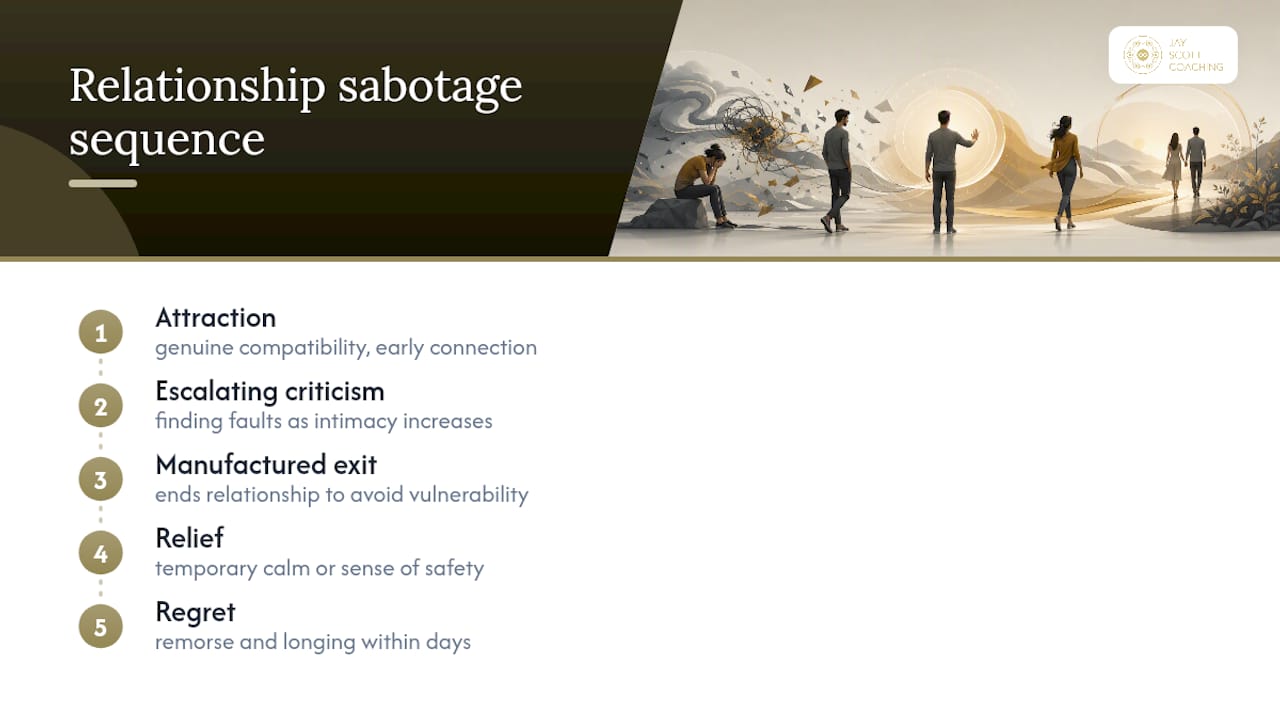
Consider a composite pattern coaches see often: a man in his late thirties dates someone genuinely compatible, and within six weeks of things going well, he starts finding fault. Her laugh is suddenly "too loud." Her career ambition, which he was attracted to, becomes "she's always working." He picks a fight over a canceled plan that would have barely registered a month earlier. By week eight, he's convinced himself the relationship "isn't right" and ends it, only to feel a familiar relief followed by regret within days.
That sequence, attraction, escalating criticism, a manufactured exit, relief, then regret, is one of the clearest sabotage signatures there is. The fault-finding wasn't really about her laugh or her hours. It was the nervous system flagging that intimacy had crossed a threshold it read as dangerous, and manufacturing an exit before real vulnerability could deepen further.
A different composite pattern shows up in longer relationships: a woman who's been with her partner for three years starts a pattern of unprovoked jealousy every time he gets a promotion or new opportunity. The pattern isn't really about trust in him. It tracks almost exactly with moments when the relationship's stakes rise, when losing him would suddenly cost more than it used to.
Neither of these people would describe themselves as saboteurs. Both would describe themselves as someone with high standards, or someone who's just naturally a little anxious. That's precisely why naming the pattern matters. It rarely announces itself with a label. It shows up wearing the costume of a reasonable concern.
How Self-Sabotage Distorts Communication in Relationships
Sabotage and honest communication cannot coexist for long, because sabotage depends on a certain amount of indirectness to survive. If you said outright, "I'm scared you're going to leave, so I'm going to create a fight to test that," the fight would lose its power. Instead, the pattern operates through distortion: passive-aggressive comments standing in for direct requests, silence standing in for unexpressed hurt, criticism standing in for fear.
This shows up in a few predictable ways. Defensiveness turns ordinary feedback into a perceived attack, so a partner's simple request ("Can you text me when you'll be late?") gets received as "You think I'm irresponsible." Withdrawal replaces a hard conversation with silence, leaving a partner to guess what happened. Testing behavior replaces a direct question ("Do you still want to be with me?") with an indirect provocation designed to force an answer without ever having to ask.
The Relationship Sabotage Scale's core factors, defensiveness, trust difficulty, and lack of relationship skills, are really a map of communication breakdown. Someone weak in relationship skills often literally doesn't have the vocabulary to say "I'm scared" instead of picking a fight. Building that vocabulary, one direct sentence at a time, is often more effective than any amount of insight into why the pattern started. Straightforward communication skills for overcoming these barriers tend to shrink the gap between what you feel and what you actually say faster than years of quiet self-analysis.
Does Self-Sabotage Look Different in Friendships Than in Romantic Relationships?
Self-sabotage shows up in platonic relationships too, but the stakes and the mechanics shift in a few key ways. Romantic relationships involve a level of physical and emotional vulnerability, and often cohabitation, financial entanglement, or long-term commitment, that raises the perceived threat much higher than most friendships carry. That's part of why romantic sabotage tends to be more intense and more visible: the nervous system treats the higher stakes as a bigger danger signal.
Friendships tend to trigger sabotage more subtly, often through gradual withdrawal rather than dramatic blowups. Someone might slowly stop initiating contact with a close friend right as the friendship deepens into something more significant, like being asked to be a best man or a maid of honor, without ever consciously deciding to pull away. There's rarely a single triggering fight in friendship sabotage the way there often is in romantic relationships, because friendships usually lack the built-in checkpoints, moving in, engagement, and so on, that force a moment of reckoning.
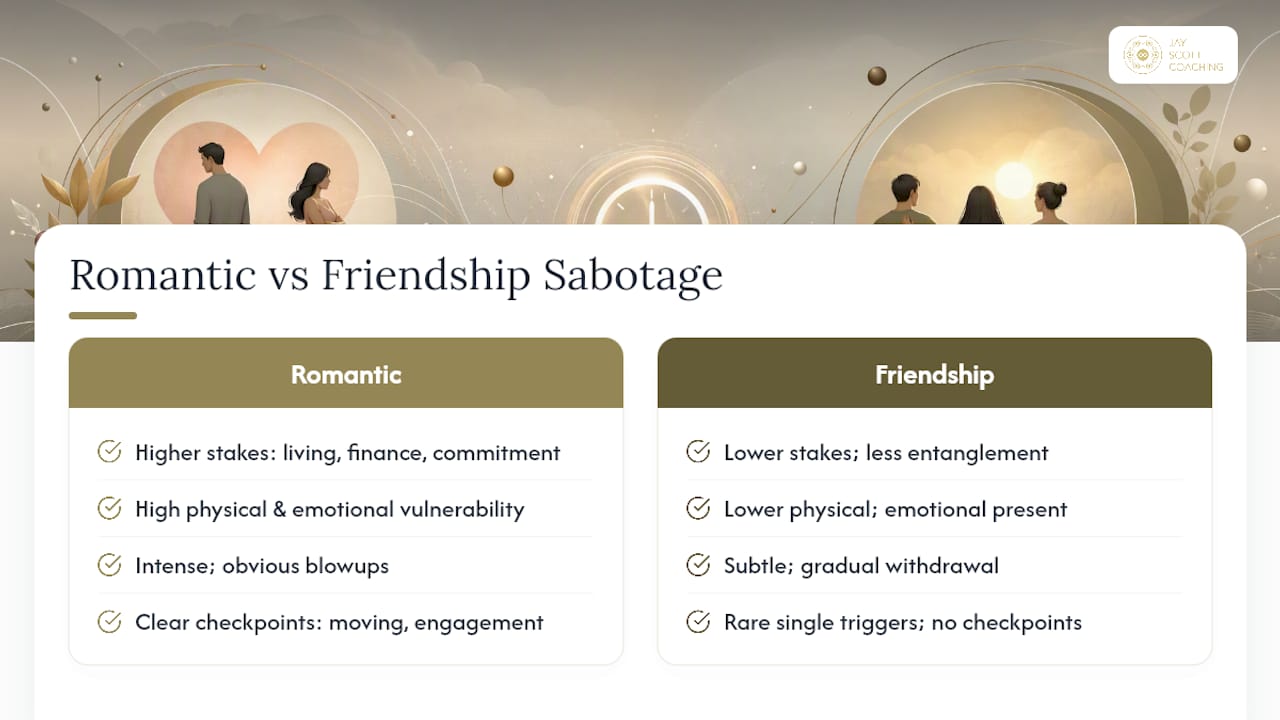
The overlap matters more than the difference, though. The same core drivers, fear of being truly seen, discomfort with dependency, a nervous system primed for disappointment, run underneath both. Someone who withdraws from romantic partners right after intimacy deepens will often notice, once they start paying attention, that they do the same thing with close friends, just more slowly and with less obvious wreckage. That's frequently the first real evidence that the pattern is systemic rather than specific to one difficult partner.
Steps to Rebuild Trust and Repair a Relationship After Self-Sabotage
Repair starts with acknowledgment that's specific rather than general. "I'm sorry I've been distant" lands very differently than "I've been pulling away when things feel too close, and I know that's confusing and hurtful. I'm working on catching it earlier." Specificity signals you actually understand the pattern rather than just feeling bad about its effects.
From there, a few moves tend to rebuild trust faster than time alone:
- Consistency over grand gestures. Small, repeated follow-through, showing up when you said you would, staying present through a minor conflict instead of vanishing, rebuilds trust more reliably than one big romantic apology.
- Inviting your partner into the pattern, not just the apology. Ask them what they noticed, and actually listen without getting defensive. Their observations are often more accurate than your own in the moment.
- Rebuilding slowly rather than rushing back to full closeness. Trust that was damaged by sabotage often needs to be re-earned in stages, not restored instantly through a single good conversation.
- Setting a boundary or check-in ritual together. Something as simple as a weekly ten-minute conversation about how connected each of you has felt recently can catch the next cycle before it escalates.
If the relationship has weathered real damage, working through strengthening a relationship with structured guidance gives both partners a shared framework instead of leaving repair to guesswork and good intentions alone.
Jay's Practitioner Perspective: What Coaching Reveals About Sabotage and Repair
In coaching conversations with high-performing men, the same pattern surfaces again and again: a guy who's decisive and composed at work goes quiet, defensive, or avoidant the moment his relationship asks for real emotional presence. That's not a character flaw. It's self-abandonment wearing a competent disguise, and it costs these men far more at home than it ever does at the office.
The work that actually shifts it isn't more analysis. It's teaching the nervous system, through the Unshakable Man Method™, that staying grounded under emotional pressure is possible. That regulation is what turns overthinking into clear decisions and turns avoidance into honest, direct expression with the people who matter most. Treat sabotage as a pattern you're training out, not a verdict on your character. That distinction alone changes how the whole process feels.
— Jay
If You Want Guided Help: Jay Scott Coaching
Reading about the pattern is one thing. Interrupting it under real pressure, in the actual moment your nervous system wants to withdraw or pick a fight, is another, and that's where structured coaching earns its place. A coaching program can work with men using methods designed to train nervous-system regulation so old patterns like withdrawal, defensiveness, and overthinking stop running the relationship.

Coaching programs may include one-on-one and group sessions, pattern mapping to identify sabotage patterns, and direct, actionable practice rather than open-ended talk therapy. It's built to complement clinical treatment, not replace it. If deeper trauma, entrenched mental health conditions, or diagnosable clinical issues are part of the picture, therapy remains the right first step alongside coaching. For men ready to stop overthinking their way out of good relationships and start showing up with real clarity, the next step is visiting Jay Scott Coaching to apply and book a consultation call.
Sources
The research and clinical frameworks behind this guide come from a mix of peer-reviewed work and trusted clinician resources:
- The relationship sabotage scale: an evaluation of factor analyses and construct validity (PMC)
- Researchonline
- Attachment theory and attachment styles (Cleveland Clinic)
- Self-sabotage (Medical News Today)
If a relationship involves ongoing harm or abuse, contact the National Domestic Violence Hotline for confidential support.
This article is general information, not a substitute for advice from a qualified doctor. Consult a qualified healthcare professional about your own circumstances before acting on anything here.