

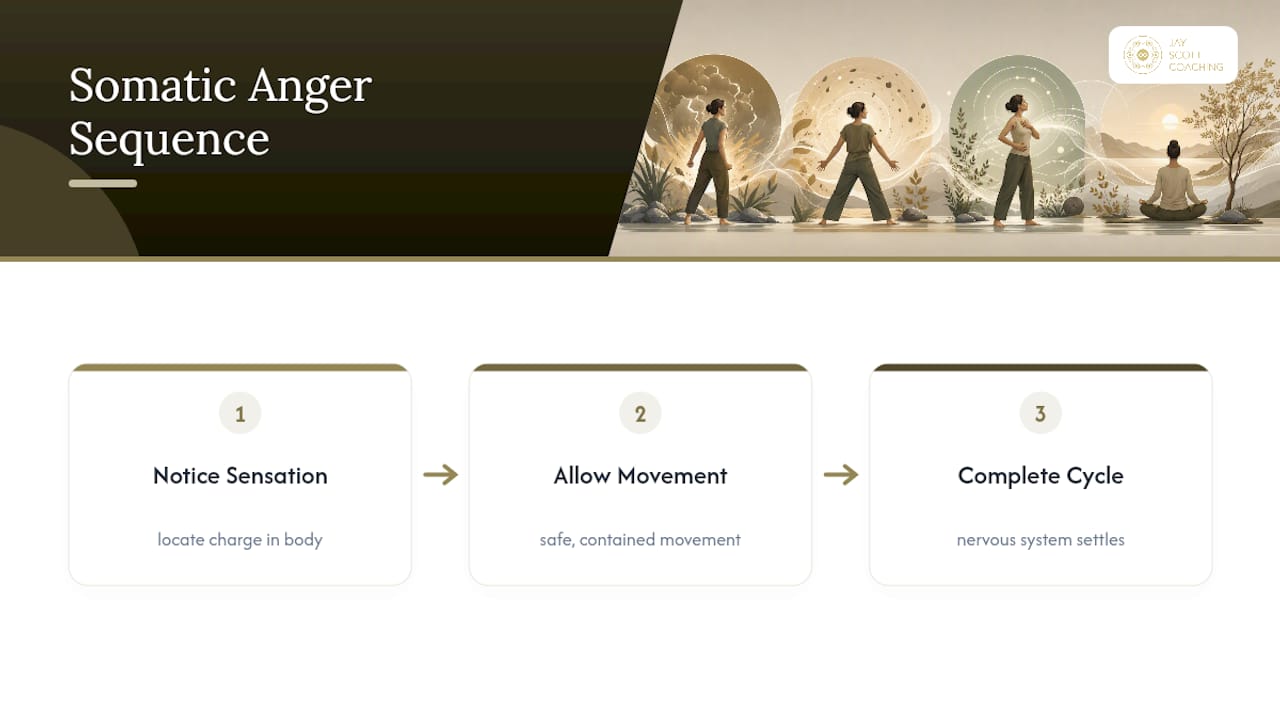
Somatic anger release means working with sensation, not just thought, to let anger finish its job in your body instead of getting stuck there. The payoff is real: your nervous system completes the activation cycle and settles instead of staying braced. This approach fits anyone who feels anger as tightness, heat, or a clenched jaw more than as a clear thought. If anger regularly turns into violence, threats, or thoughts of harming yourself or others, work with a licensed professional before trying these exercises alone.
TL;DR:
- Repeated application of somatic anger release can help lower baseline reactivity and improve emotional regulation over time, especially for less severe anger issues.
- Using containment techniques like short, timed exercises and pairing movement with regulated breathing reduces the risk of over-activation or relapse into reactive patterns.
- The most effective practice involves explicitly naming the emotion, locating the sensation, following the impulse with contained movement, and then grounding with slow exhalations.
- Professional coaching enhances self-practice by providing pacing, pattern recognition, and safeguards to prevent escalation, especially for those with recurring or severe anger.
- Addressing underlying physical signs such as jaw clenching, chest tightness, or heat, with specific exercises, can prevent ongoing tension from turning into destructive outbursts.
Table of Contents
- What Is Somatic Anger Release and Does It Work?
- Practical Somatic Exercises to Try Right Now
- Where Does Anger Live in the Body?
- A Simple 4-Step Somatic Anger-Release Routine
- When Somatic Anger Work Needs Professional Support
- How Guided Coaching Strengthens Somatic Anger Work
- Fitting Somatic Release Into a Bigger Practice
- Long-Term Benefits and Real Risks to Watch For
- What Somatic Anger Work Looks Like in Practice
- Where Somatic Anger Release Goes Wrong
- How Jay Scott Coaching Supports Lasting Change
- Sources
- FAQ
What Is Somatic Anger Release and Does It Work?
Somatic anger release is a body-first approach to processing anger. Instead of talking your way through what made you mad, you locate the physical charge, the tight chest, the clenched fists, the heat climbing your neck, and give it a safe, contained way to move.
This isn't the same as venting. Venting (yelling, punching a wall, slamming doors) often amplifies anger rather than resolving it. Somatic work does something different: it treats anger as unfinished physiological business. Your body is geared up for a fight-or-flight response that never got to complete, and it's still holding the tension from that unfinished loop.
Peer-reviewed research on body-focused interventions backs this up. A review of somatic and nervous-system regulation approaches links body-based work to measurable reductions in agitation and better affect regulation over time. That's a meaningfully different claim than "punching a pillow feels good." It's about training your nervous system to recognize when a threat response can stand down.
The standard clinical term for this broader category is emotional release therapy, sometimes grouped under trauma-informed anger work or somatic healing methods. Whatever label a given practitioner uses, the mechanism is the same: sensation, movement, and completion, in that order.
Practical Somatic Exercises to Try Right Now
These are contained, low-risk moves you can do alone in a room with a door you can close. None of them require special equipment.
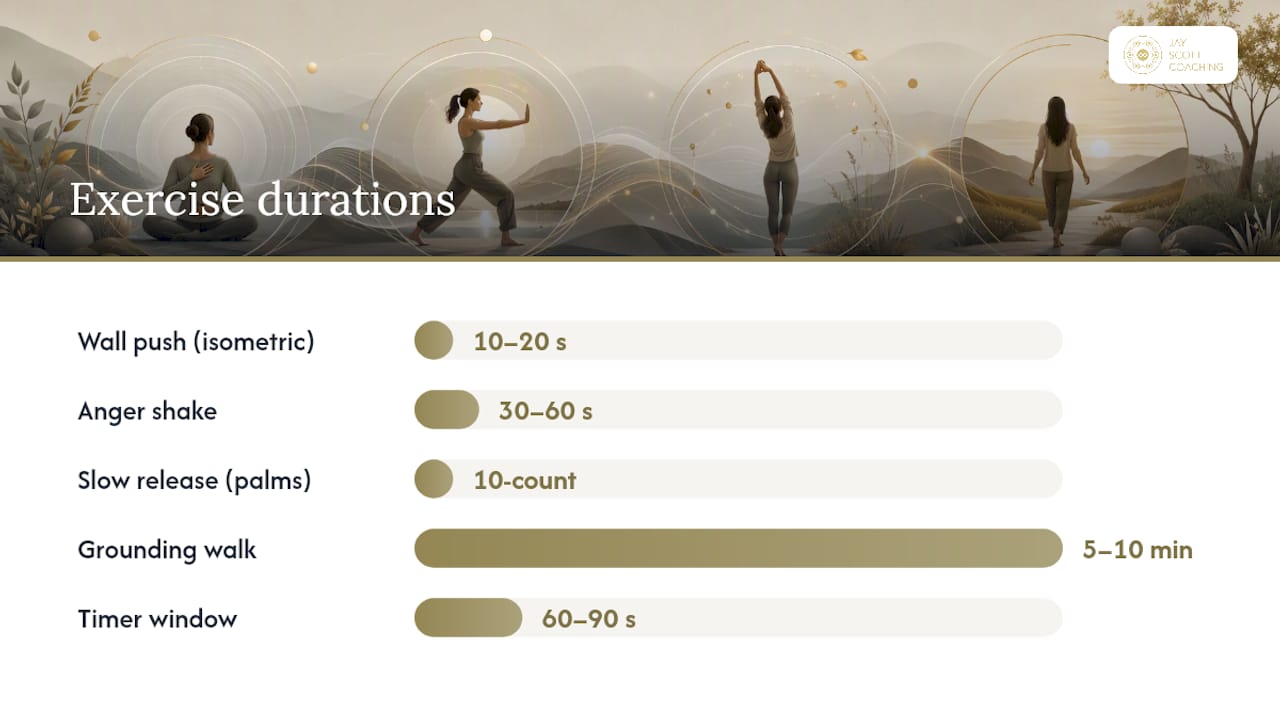
- Wall push (isometric press): Stand arm's length from a wall, place both palms flat against it, and push as hard as you can for 10 to 20 seconds, like you're trying to move the wall. Release slowly and notice what changes in your shoulders and jaw. This isometric hold gives your nervous system a defined task to discharge into, rather than an open-ended outlet that can spiral.
- Anger shake: Stand with knees soft and let your hands, arms, and shoulders tremble or shake loosely for 30 to 60 seconds. Animals do this naturally after a stress event. Humans mostly suppress it.
- Palms into wall, slow release: Similar to the wall push, but instead of releasing quickly, pull your hands away over a full 10 count, paying attention to the sensation as pressure drops.
- Grounding walk: Walk at a brisk pace for five to ten minutes, focusing attention on your feet contacting the ground and the rhythm of your breath. This works especially well when the shake or press feels like too much too fast.
- Contained vocal or physical expression: Punching a pillow, growling into a towel, or making low vocal sounds can help, but only in a private space, at a volume and intensity that stays controlled. If it starts escalating rather than settling, stop.
A clinical roundup of somatic techniques recommends pairing any of these with paced breathing on the back half, since the exhale is what tells your nervous system the threat has passed.
Pro Tip: Set a timer for 60 to 90 seconds before you start any expressive exercise. Short, bounded windows work better than open-ended venting, and they keep you from accidentally escalating instead of settling.
Where Does Anger Live in the Body?
Anger rarely announces itself as a thought first. It shows up as a locked jaw, a tight chest, a flushed neck, or hands that want to clench into fists. Clinical materials on anger consistently point to the same physical markers: a faster heartbeat, tense muscles, and shallow breathing, all signs your body has already shifted into a threat response before your conscious mind catches up.
This is where the "move through" versus "move out" distinction matters. Moving out means discharging the energy performatively, punching something, yelling, slamming a door, without much awareness of what's happening in your body while you do it. Moving through means staying curious about the sensation itself: Where exactly is the heat? Is the clenching in your jaw or your fists? Does it pulse or stay constant?
That distinction isn't semantic. Experts increasingly frame anger as a messenger worth listening to, not a problem to suppress or blast away. Naming what you feel and staying curious about it, rather than fighting it or performing it, changes how your nervous system processes the signal.
- Jaw tightness or teeth grinding
- Chest tightness or a racing heartbeat
- Heat rising through the neck or face
- Hands or shoulders clenching without conscious decision
Activation, completion, and settling is the natural arc. Somatic practice just gives your body permission to finish that arc instead of freezing halfway through it.
A Simple 4-Step Somatic Anger-Release Routine
This routine draws on the same stepwise logic clinicians use, sometimes called the Change Triangle, that guides people to experience anger fully enough that its energy can dissipate rather than staying lodged in the body.
- Name it and set a safety intention. Say to yourself, out loud if you're alone, "I am angry, and I'm going to work with this safely." Naming lowers the emotional charge almost immediately.
- Scan and locate the sensation. Where is it concentrated? Chest, jaw, hands? How intense is it on a scale of 1 to 10?
- Follow the impulse, contained. If your hands want to clench, try the wall push. If your body wants to shake, let it shake for 30 seconds. Watch for the shift, usually a slight cooling, a deeper breath, or loosened shoulders, that signals the charge is de-escalating rather than building.
- Regulate and integrate. Take five slow exhales, longer than your inhales. Put a hand on your chest or stomach. Jot down one line about what triggered you and what you noticed in your body.
This four-step shape (name, sense, follow, regulate) mirrors the containment-first approach that practitioners recommend precisely because open-ended discharge without a regulation step tends to leave people activated rather than settled. Practitioners who work with somatic release regularly suggest keeping initial sessions to roughly five to fifteen minutes, then spending an equal stretch of time on the regulation step. Repeated long sessions without proper down-regulation can leave some people more reactive, not less.
When Somatic Anger Work Needs Professional Support
Self-guided somatic practice works well for everyday frustration, the kind that shows up after a hard meeting or a fight with a partner. It's not a substitute for professional care when anger has become a pattern with real consequences.
- Frequent outbursts involving violence, threats, or property destruction
- Anger that shows up alongside substance use
- Thoughts of harming yourself or someone else
- Anger that's damaging your job, marriage, or friendships repeatedly
Clinical guidance on anger is direct on this point: when anger affects your relationships, work, or safety, that's the threshold for a professional evaluation, not another self-help technique.
If activation escalates mid-practice, faster heartbeat, racing thoughts, panic, stop the exercise, plant your feet, and slow your exhale. Having a trusted person on call, or a pre-agreed stop signal if you're practicing with someone else, meaningfully lowers the risk of things spiraling. Set up your space beforehand: a private room, nothing breakable within reach, and a plan for what you'll do in the ten minutes after you finish.
How Guided Coaching Strengthens Somatic Anger Work
Self-practice gets you far. It has limits. Working alone, it's easy to either under-do the release (staying performative, never touching the real sensation) or over-do it (turning a contained exercise into another form of venting).
This is where guided coaching adds something self-practice can't replicate on its own: pacing, containment, and pattern recognition across time. A coach trained in nervous-system work can spot the difference between a client who's genuinely completing a stress cycle and one who's rehearsing the same reactive loop under a different name.
A coaching method can be built specifically around this gap. It can train the nervous system to stay grounded under pressure, addressing the self-abandonment pattern where some men override their own signals through overthinking or avoidance instead of acting from a grounded place.
The goal isn't to suppress anger or perform its release for an audience. It's to help a man recognize activation early, stay present with it, and choose his response instead of being run by it.
Guided work like this maps recurring patterns across weeks and months, something a single solo exercise can't do on its own.
Fitting Somatic Release Into a Bigger Practice
Somatic anger release works best as one piece of a broader emotional-regulation habit, not a standalone fix you reach for only in crisis moments. Pairing it with daily grounding practices, five minutes of paced breathing each morning, a short body scan before bed, keeps your nervous system's baseline lower, so anger has less distance to travel before it becomes a full activation.
It also complements talk-based approaches rather than replacing them. If you're already in therapy, mention the somatic exercises you're using. A therapist trained in trauma-informed anger work can help you connect a physical release (the wall push, the shake) to the underlying pattern driving it, whether that's an old relational wound or a learned habit from childhood.
Faith-based and pastoral frameworks sometimes tackle this from a different angle, treating anger itself as meaningful information rather than a failure of character. One useful resource on anger as a form of honest lament makes the case that naming anger, even anger directed at God or at circumstances beyond your control, is healthier than suppressing it indefinitely.
The daily habit that ties it together is simple: a short check-in scale (rate your tension 1 to 10 a few times a day), a go-to contained exercise for when the number climbs, and a regulation step you don't skip. Consistency here matters more than intensity. A 90-second wall push done regularly outperforms an occasional, dramatic release session that leaves you more wound up than when you started.
Long-Term Benefits and Real Risks to Watch For
Practiced consistently, somatic anger release tends to lower your baseline reactivity. People who stick with it often report catching anger earlier, before it hits a boiling point, and having more choice in how they respond once they notice it. Over months, that shift can change how conflict plays out in relationships and at work: less explosive, more direct.
The nervous-system logic behind this holds up under scrutiny. Body-focused regulation work is linked in clinical literature to durable improvements in affect regulation, not just momentary relief. That's a meaningful distinction from techniques that only provide short-term venting.
The risks are real but manageable. Doing expressive somatic work (shaking, pressing, vocalizing) without a regulation step afterward can leave you more activated, not less, especially if sessions run long or happen in isolation without support. There's also a smaller but genuine risk for people with a trauma history: intense body sensation can occasionally trigger flashback-like states rather than release. That's precisely why containment (short sessions, a support person on call, a clear stop signal) matters as much as the exercise itself.
Used with those guardrails, somatic practice is a low-cost, accessible complement to talk therapy or coaching, not a replacement for either when anger has become a serious, recurring problem.
What Somatic Anger Work Looks Like in Practice
Consider a man who notices his jaw locking every time a coworker interrupts him in meetings. Instead of stewing through the rest of the day or snapping at his family that evening, he steps into a stairwell, does a 20 second wall push, and follows it with three slow exhales. The tightness in his jaw drops noticeably. He walks back into his afternoon without the residue he used to carry home.
Or a husband who feels a familiar heat rise during an argument with his wife. Rather than raising his voice, he names it silently, "I'm angry right now", excuses himself for two minutes, does the anger shake in the bathroom, then returns to the conversation with enough regulation to actually listen. The disagreement still happens. It doesn't turn into the blowup it used to.
These aren't dramatic transformations. That's the point. Somatic release, done consistently, tends to show up as smaller, quieter wins: a pause where there used to be an explosion, a returned conversation instead of a slammed door. The pattern shows up repeatedly in men who learn to express emotion through regulated, direct channels instead of suppression or outburst. Over time, those small moments compound into a different way of moving through conflict altogether, one where anger informs a decision instead of hijacking it.
Where Somatic Anger Release Goes Wrong
The most common mistake is forcing a release instead of following the sensation. Pressing harder or shaking longer than your body wants doesn't speed up settling. It usually just adds more charge. The second mistake is skipping regulation entirely. A shake or press without slow breathing and grounding afterward leaves you activated, not resolved. Keep sessions short, check in with a 1 to 10 scale, and always end on the exhale, not the exercise.
— Jay
How Jay Scott Coaching Supports Lasting Change
Coaching can give men something most solo somatic practice can't: a trained eye that spots the difference between real completion and another reactive loop wearing a new mask. A coaching method might combine nervous-system training with direct pattern mapping, one-on-one and in group formats, so a coach tracks triggers across weeks, not just in a single session.

A first step usually starts with an honest look at where self-abandonment shows up, the overthinking, the avoidance, the moments you swallow what you actually need to say, followed by a grounded, practical pace toward change. No dramatic overhaul required on day one. If the wall push and the four-step routine above felt useful but you sense a deeper pattern underneath, see why men choose to work with Jay and what a first conversation actually covers.
Sources
The clinical framing here draws on NPR's coverage of anger processing, MedlinePlus, and the Cleveland Clinic's anger management guidance, alongside practitioner-written exercise guides for continued practice.
- 4 steps to calm anger and process it : Shots - Health News : NPR
- Get help with anger - MedlinePlus
- PMC review article
FAQ
What Happens During a Somatic Release?
Your body moves through a physical sensation (heat, tension, trembling) tied to stored activation, then settles as breath slows and muscles release, often within a few minutes when the exercise is followed by grounding.
How Do I Release Repressed Anger?
Start by locating where anger sits in your body, then use a contained physical outlet like a wall push or a shake, followed by slow exhales; if repressed anger surfaces intensely or repeatedly, work with a therapist or coach trained in nervous-system regulation.
How Do You Trigger a Somatic Release?
Naming the emotion out loud and scanning for physical sensation often triggers the body's own release response; pairing that with movement, pressing, shaking, or walking, gives the sensation somewhere safe to go.
Where Is Repressed Anger Stored in the Body?
Anger commonly concentrates in the jaw, chest, shoulders, and hands, showing up as clenching, tightness, or heat, though the exact pattern varies from person to person.
Is Somatic Anger Release Safe to Try Alone?
For everyday frustration, yes, especially with short, contained exercises and a regulation step afterward; if anger involves violence, substance use, or thoughts of self-harm, seek professional support instead of practicing alone.