

Somatic coaching is a body-centered developmental approach that trains nervous-system regulation to turn insight into behavior that actually sticks. It's built for people who already understand their patterns intellectually but keep repeating them anyway. Some coaching practices apply this model through methods designed to help high-performing men trade overthinking and avoidance for grounded, decisive leadership.
TL;DR:
- Somatic coaching focuses on training the nervous system to improve regulation and behavior change, especially in high-pressure situations.
- Key practices include body scans, breathwork, pendulation, and titration, often guided by a trained coach who ensures safety and capacity.
- This approach leads to quicker, more durable shifts in emotional regulation, decision-making, and relational presence, typically within weeks.
- It differs from somatic therapy, which is clinical and diagnoses mental health conditions, whereas coaching supports personal development goals.
- Effective programs demand substantial training hours, trauma-informed content, supervised practice, and clear scope, with early signs of progress including better stress management and presence.
Table of Contents
- What Is Somatic Coaching, Really?
- Core Principles Every Somatic Coach Should Practice
- What Do Somatic Practices Actually Look Like?
- What Results Should You Actually Expect?
- Somatic Coaching vs. Somatic Therapy: Which One Do You Need?
- How Do You Vet a Somatic Coaching Program?
- What Happens in an Actual Session?
- What Does the Research Actually Support?
- When Does Somatic Coaching Actually Move the Needle?
- Ready to Train Your Nervous System, Not Just Your Mindset?
- Where to Learn More About Somatic Approaches
- Sources
- FAQ
What Is Somatic Coaching, Really?
Most personal growth work starts and ends in your head. You talk, you analyze, you get an insight, and then Monday morning arrives and you do the exact same thing you swore you'd stop doing. Somatic coaching exists because that gap between "I understand this" and "I actually behave differently" is where most self-improvement quietly fails.
The word "soma" refers to the living body as experienced from the inside, not the body as an object you look at in a mirror. Somatic coaching treats the body and mind as one integrated system rather than two separate departments where the brain gives orders and the body just follows along. This is sometimes called body-centered coaching or the bodymind approach, and it rests on a simple but underappreciated idea: your nervous system, not just your beliefs, decides how you show up under pressure.
Here's the mechanical piece that most self-help content skips. When you face a stressful conversation, a career risk, or a moment that demands honesty, your autonomic nervous system activates first, often before conscious thought catches up. That activation shows up as a tight chest, shallow breath, clenched jaw, or the urge to check your phone instead of finishing the sentence you started. If a coach only works with your thoughts, they're negotiating with the passenger while the driver never got the memo.
Somatic coaching works differently by engaging the body directly:
- It tracks physical activation (racing heart, shallow breath, tension) in real time, not just after the fact.
- It uses body awareness to help the nervous system shift from a stressed state toward a calmer, more regulated one.
- It treats settling the body as a prerequisite for clear thinking, not a nice add-on afterward.
- It builds new patterns through repeated embodied experience rather than repeated explanation.
The Co-Active Training Institute frames it directly: the body is an active participant in change, not a passive container for whatever the mind decides. Their argument is that embodied methods engage the autonomic nervous system and support the kind of parasympathetic states, the "rest and digest" mode, that make learning stick. That matters because a nervous system stuck in fight-or-flight has a hard time absorbing anything new. You can hand someone the best advice in the world, but if their body is bracing for a threat, that advice bounces off.
This is also why cognitive insight alone so often underperforms. Knowing you should speak up in a meeting and being able to speak up in the moment are governed by different systems. One lives in your prefrontal cortex. The other lives in your nervous system's stress response, which reacts faster than conscious reasoning and doesn't care how many books you've read on assertiveness. Somatic coaching closes that gap by training the body to stay regulated when it matters, so the insight you already have finally has somewhere to land.
Core Principles Every Somatic Coach Should Practice
Not every coach who mentions "the body" is practicing somatic coaching with any rigor. A handful of core principles separate credible practitioners from people who bolted a breathing exercise onto a standard coaching session.
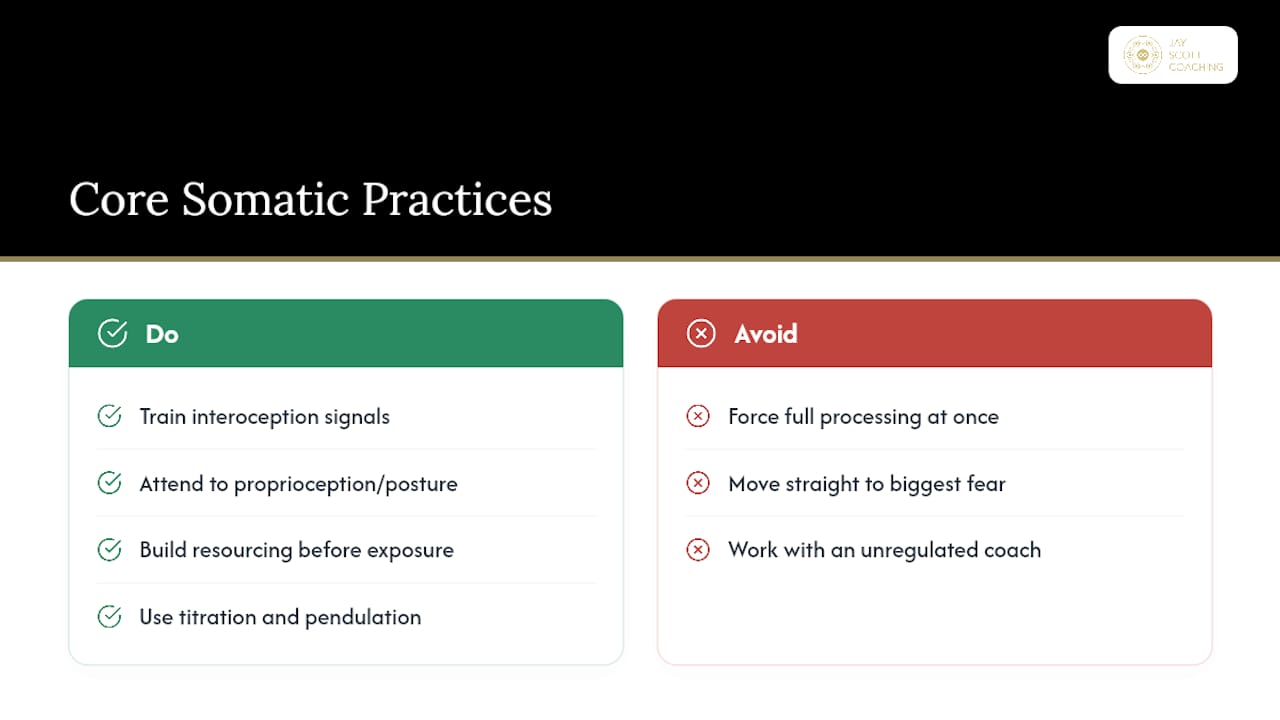
Interoception is the felt sense of what's happening inside your body: tightness, warmth, a pit in your stomach, a lump in the throat. Somatic coaches train clients to notice these signals rather than override them, because interoception is often the earliest warning system for stress long before it becomes a thought.
Proprioception is your sense of where your body is in space, posture, and movement. A coach might notice that a client collapses their chest when discussing a difficult topic, or braces their shoulders before a hard truth. That physical pattern often precedes the emotional avoidance it's tied to.
Resourcing means identifying and strengthening access to a felt sense of safety, whether that's a steady breath, a grounded stance, or a specific memory that produces calm. Coaches build resourcing capacity before asking a client to approach anything activating, the same way you wouldn't ask someone to lift a heavy weight without a warm-up.
Pendulation is the deliberate movement between activation and settling. Rather than sitting in distress until it resolves, a client touches a difficult sensation briefly, then returns to a resourced state, then goes back again. This oscillation, borrowed from trauma-informed coaching frameworks, builds tolerance gradually instead of flooding the system.
Titration keeps that process small and manageable. Instead of processing an entire charged experience at once, a coach helps a client approach it in doses their nervous system can actually integrate. Titration exists specifically to prevent overwhelm, and it's one of the clearest markers of a practitioner who understands nervous-system capacity rather than pushing for dramatic breakthroughs.
Discharge refers to the body's natural release of built-up activation, sometimes through trembling, a deep exhale, or spontaneous movement, once a defensive response completes rather than staying stuck mid-cycle.
Beyond technique, the coach's own presence matters more than most training programs admit. A dysregulated coach cannot regulate a client. Interpersonal neurobiology research on mirror-neuron dynamics suggests a coach's own groundedness shapes a client's nervous-system state simply through proximity and attunement. This is why experienced somatic coaches spend real time on their own regulation before they ever work with clients.
Pro Tip: If a coach moves straight to your biggest fear or your most painful memory in session one, that's a red flag, not a sign of depth. Skilled somatic work builds resourcing and titration skills first, the same way you wouldn't sprint before your legs know how to walk.
Safety and working within capacity aren't soft add-ons here, they're the method. Practitioners intentionally avoid pushing clients past what their system can regulate, because flooding someone with unprocessed activation can retraumatize rather than heal.
What Do Somatic Practices Actually Look Like?
Reading about pendulation and titration is one thing. Knowing what to actually do is another. Here's how the core somatic practices translate into something you can recognize, and in some cases try, in real life.
-
Body scan. Sit or stand quietly and mentally move attention from your feet up through your head, noticing tension, temperature, or numbness without trying to fix anything. This is the entry point for interoception, and it takes two to five minutes.
-
Breathwork. Extending your exhale longer than your inhale, for example a four-count in and a six-count out, activates the vagus nerve and nudges the nervous system toward a calmer state. This is one of the most accessible somatic practices because it requires no equipment and works almost anywhere.
-
Grounding. Pressing your feet into the floor, naming five things you can see, or holding a solid object pulls attention out of racing thoughts and back into present physical sensation. Coaches often use this before approaching anything activating.
-
Pendulation. In a coached setting, you might briefly bring attention to a stressful memory, notice the physical sensation it creates, then deliberately shift attention to something neutral or resourcing, like your breath or a comfortable posture. You repeat this a few times rather than staying with the distress continuously.
-
Titration. This is less a standalone exercise and more a pacing principle, a coach limiting how much of a charged topic you engage with in one sitting, checking in on your regulation before going further.
-
Discharge. Sometimes simply letting your body shake out tension, stretch, or take a few deep, audible exhales after an activating conversation lets the nervous system complete a stress response instead of storing it.
Body scans, breathwork, and grounding are generally safe to practice solo. Pendulation and titration work best with a trained coach present, because judging how much activation someone can handle without guidance takes practice and calibration you likely don't have yet on your own nervous system, let alone someone else's.
Pause or seek professional support if a practice brings up overwhelming distress, flashbacks, dissociation, or memories connected to significant trauma. That's the line where somatic coaching should step back and a licensed clinician should step in, a distinction covered in more detail below.
What Results Should You Actually Expect?
The honest answer: better regulation under pressure, not a personality transplant. Clients typically report a handful of concrete shifts, usually within weeks of consistent practice rather than overnight.
- Less time spent avoiding hard conversations, and more capacity to stay present through them.
- Noticeably calmer physical responses (steadier breath, less jaw or shoulder tension) in situations that used to trigger a spike.
- Clearer, faster decision-making because anxiety isn't hijacking the thinking process.
- Improved relational presence, meaning partners and colleagues report feeling more genuinely listened to.
- Reduced pattern of self-abandonment, where someone quietly shrinks their own needs to keep the peace.
The core difference between embodied change and insight-only change is durability. Talk-based coaching can give you a great explanation for why you shut down during conflict. Somatic coaching changes what your body actually does the next time conflict shows up, because you've practiced staying regulated in the sensation itself, not just understood it afterward.
Evidence in this space is real but still developing. Peer-reviewed literature on somatic and nervous-system interventions exists and is growing, though the research base remains smaller and less mature than for cognitive-behavioral approaches. That doesn't make the mechanism speculative, autonomic regulation is well-established physiology, but it does mean outcome claims should stay grounded rather than sweeping.
People who benefit most tend to share a specific profile: they already have insight into their patterns, they're motivated to change, and their difficulty lives more in the body's automatic reactions than in a lack of understanding. If you've read every book on the subject and still freeze in the same moments, that gap is exactly what this approach targets.
Somatic Coaching vs. Somatic Therapy: Which One Do You Need?
This distinction matters more than almost anything else in this article, because getting it wrong can mean paying for the wrong kind of support or, worse, missing care you actually need.
Somatic therapy is a clinical mental-health treatment aimed at diagnosing and treating conditions like PTSD, trauma disorders, and other clinical mental-health issues. It's typically conducted by a licensed psychotherapist or counselor, often falls under insurance coverage, and follows a treatment plan tied to a diagnosis.
Somatic coaching is a non-clinical developmental practice focused on goals like leadership growth, emotional regulation, confidence, and behavior change. It doesn't diagnose or treat mental illness, and reputable coaches are explicit about that boundary.
The differences show up clearly across a few dimensions:
- Scope: Therapy treats clinical conditions; coaching supports forward-moving personal and professional development.
- Licensing: Therapists carry state clinical licenses; coaches typically hold certifications from training institutes, which vary widely in rigor.
- Insurance: Therapy is sometimes covered by insurance, especially for diagnosed conditions; coaching is almost always paid out of pocket.
- Depth of trauma work: Therapists are trained to work directly with trauma processing; coaches are trained to recognize when a topic exceeds coaching scope and refer out.
Clinical sources note that somatic therapy's research backing, while real, remains less extensive than established treatments like CBT, and coverage tends to depend on symptom severity and provider network. A related caution from clinical experts: somatic therapy is gaining traction, but insurance reimbursement and evidence depth still vary compared to more established modalities.
The practical rule: if you're navigating diagnosed trauma, PTSD symptoms, dissociation, or a mental-health crisis, you need a licensed somatic therapist, not a coach. If you're functioning well but want to build regulation, confidence, and embodied leadership presence, coaching is the right fit. A credible somatic coach will tell you this themselves and refer you out when something falls outside their scope. If a coach never mentions that boundary, that's worth questioning.
How Do You Vet a Somatic Coaching Program?
Training quality in this field varies enormously, partly because "somatic coach" isn't a protected title the way "licensed therapist" is. Anyone can print business cards. That makes evaluation criteria your responsibility, whether you're considering training yourself or hiring someone who claims the credential.
Credible programs tend to share a common structure. Many certification tracks list well over 100 contact hours across in-person or hybrid cohort modules, combined with supervised mentor coaching where a trainee practices on real clients under observation. The Strozzi Institute's certification, for example, structures training around extended contact hours and hands-on practicum work rather than a weekend seminar and a certificate.
Look for these program elements before trusting a credential:
- Substantial contact hours, generally well past a single weekend, with both didactic teaching and supervised practice.
- A trauma-informed curriculum that explicitly teaches titration, resourcing, and when to refer clients to a licensed clinician.
- Mentor coaching or supervision, meaning trainees don't just learn theory, they practice under a trained eye.
- Clear articulation of scope: what falls inside coaching, and what requires referral out.
- Ongoing continuing education, since the field continues to evolve.
When vetting a specific coach, ask direct questions rather than relying on their marketing copy:
- "What's your training background, and how many supervised practice hours did it include?"
- "How do you decide when something is outside coaching scope and needs a referral?"
- "What does a typical arc of sessions look like, and how do you pace intensity?"
- "How do you handle it if I become overwhelmed during a session?"
A coach who answers these clearly and specifically, rather than vaguely, has probably done real training. Program formats range from fully in-person immersive cohorts lasting several months to hybrid models combining online coursework with periodic in-person intensives. There's no single correct format, but shorter is not automatically worse and longer is not automatically better, what matters is whether supervised practice and trauma-informed content are actually built in.
What Happens in an Actual Session?
If you've never done this kind of work, walking in blind is uncomfortable. Here's the general shape sessions take, though every coach structures the details a little differently.
-
Check-in. The session opens with a conversational check on where you are, what's alive for you, and what you'd like to work on today.
-
Tracking sensation. As you talk about a real situation, the coach draws attention to what's happening in your body right now, not just the story, but the tightness, the breath change, the posture shift.
-
Practice. Depending on what surfaces, you might work through a grounding exercise, pendulate between activation and resourcing, or practice a new physical response to a familiar trigger.
-
Integration. The coach helps connect what just happened somatically back to the real-world situation you're working on, so the shift has an obvious application.
-
Homework. Most coaches send you off with a small, specific practice to repeat between sessions, since repetition outside the room is where the pattern actually rewires.
Expect weekly or biweekly sessions initially, with many clients noticing early shifts in regulation within the first month and more durable behavior change building over several months of consistent work. Progress markers are usually practical: catching yourself mid-pattern instead of realizing it after the fact, staying present through a conversation you'd normally avoid, recovering faster after a stressful trigger.
Pro Tip: Pay attention to how grounded the coach feels in the room, not just what they say. A coach who talks about regulation while radiating their own tension is teaching you something they haven't fully learned themselves.
Assessing fit comes down to three things: do you feel a baseline of safety with this person, does their presence feel steady rather than performative, and do they set clear boundaries around pacing rather than pushing you toward intensity you're not ready for.
What Does the Research Actually Support?
The mechanism behind somatic coaching, autonomic nervous-system regulation, rests on well-documented physiology. Peer-reviewed research on nervous-system regulation and body-based intervention continues to expand, and studies indexed on PubMed examine mechanisms like autonomic response and regulation directly. That's a meaningfully different claim than saying every specific coaching technique has been clinically validated, and it's worth holding both truths at once.
Reputable clinical sources are consistent on one point: somatic-based approaches show real promise, but the evidence base is still catching up to more established methods.
The body holds and expresses stress before the conscious mind catches up. Working with sensation directly, rather than only through conversation, gives access to patterns that talking alone often can't reach. That's the working theory behind embodied coaching, and it's also the daily observation of anyone who's coached a client through a moment of real physical activation.
The Unshakable Man Method™ is built around this principle, applied specifically to high-performing men who intellectually understand their patterns of overthinking, avoidance, and self-abandonment but haven't been able to shift them through willpower or analysis alone. The method trains nervous-system regulation first, because decisive action and honest self-expression require a body that isn't bracing for threat.
The honest limitation: this is coaching, not clinical treatment, and it isn't a substitute for licensed care when trauma or diagnosable conditions are present. Readers considering this path should treat it as a development tool for regulation and leadership growth, and should seek a licensed clinician if what surfaces looks more like clinical trauma than a stuck pattern.
When Does Somatic Coaching Actually Move the Needle?
I've come to think the biggest misconception about this work is that it's for people who are struggling. In practice, it tends to have the most outsized impact on men who are already succeeding by every visible metric, running companies, closing deals, showing up as reliable providers, and who still feel disconnected from their own lives. Their nervous system learned to perform under pressure decades ago. What it never learned was how to feel safe enough to be honest.
That's where embodied work outperforms pure strategy conversations. You can coach someone's communication style for months and watch them intellectually improve while their body still floods with the same old activation the moment a real conversation with their spouse gets uncomfortable. Change the nervous system's relationship to that activation, and the communication shift often follows faster than anyone expects, sometimes within a handful of sessions rather than a year of talk-based work.
One boundary I'd push readers to take seriously: somatic coaching is not trauma treatment, and a responsible coach says so directly. If deep trauma surfaces during this kind of work, and sometimes it does, the right move is a referral to a licensed clinician, not a coach trying to be a hero. Anyone offering to coach you through clinical PTSD instead of referring you out is not someone I'd trust with your nervous system.
— Jay
Ready to Train Your Nervous System, Not Just Your Mindset?
Most coaching programs stop at strategy: better habits, better scripts, better frameworks for the next hard conversation. Some coaching programs focus more deeply on nervous system regulation, based on the logic that a man who can't stay regulated under pressure won't reliably execute the best strategy in the world when it counts.

This method was created for high-performing men whose overthinking, avoidance, or self-abandonment keeps showing up in relationships, leadership, or personal sense of purpose, despite genuinely understanding the problem on an intellectual level. Rather than relying solely on talk-based analysis, some methods train emotional regulation and inner safety directly, aiming to make decisive action and honest self-expression feel more natural. Participants often describe shifts in communication, feeling more present with important people, and clearer leadership once the body stops bracing for imagined threats. You can read more about how this plays out for men navigating career pressure and relationship strain in individual coaching built for men seeking real change.
If any part of this article described your own pattern, the next step is a straightforward one. Visit Jay Scott Coaching to learn how the Unshakable Man Method™ works and what a first consultation looks like, no pressure, just a direct conversation about where you're stuck and whether this approach fits.
Where to Learn More About Somatic Approaches
For deeper reading beyond this article, Healthline's overview of somatic therapy and Harvard Health's explainer both cover the clinical side clearly. PositivePsychology.com's breakdown of somatic coaching techniques offers a practical framework for the coaching side specifically. If your situation involves diagnosed trauma or PTSD, search for a licensed somatic therapist through your state's psychology board or a trusted referral network rather than a general web search.
Sources
- What is somatic therapy? — Healthline
- Positivepsychology
- What is somatic therapy? — Harvard Health / Harvard Women's Health Watch
- The body is an active participant in change — Co-Active Training Institute
FAQ
What Is Somatic Coaching?
Somatic coaching is a non-clinical, body-centered coaching approach that trains nervous-system regulation to support goals like leadership growth, confidence, and behavior change, distinct from clinical treatment for diagnosed mental-health conditions.
What Are Examples of Somatic Practices?
Common examples include body scanning, breathwork, pendulation, and titration, along with grounding exercises and discharge practices that help release built-up physical tension after stress.
What Is the Difference Between a Somatic Coach and a Somatic Therapist?
A somatic therapist is typically a licensed clinician who treats diagnosed conditions like PTSD or trauma disorders, while a somatic coach works on non-clinical development like leadership, confidence, and regulation without diagnosing or treating mental illness.
How Long Does It Take to Become a Somatic Coach?
Program length varies, but credible certifications often involve well over 100 contact hours across in-person or hybrid cohort formats, typically spanning several months rather than a single weekend course.
Does Jay Scott Coaching Use Somatic Coaching Methods?
Some coaching methods apply nervous-system regulation principles directly, training high-performing men to move from overthinking and avoidance toward grounded, decisive leadership and clearer relational presence.