

Speaking your truth means naming what you feel, need, or value, out loud, to the person it concerns, in a way that's honest but not reckless. It isn't a license to say every unfiltered thought that crosses your mind. It's a skill built on timing, wording, and knowing when disclosure is safe versus when it's just impulsive. The rest of this guide breaks down the research behind why it matters, the steps to actually do it, and where the line sits between courage and carelessness.
TL;DR:
- Authentic expression is associated with higher self-esteem and greater satisfaction of psychological needs, while inauthentic expression predicts negative affect and lower autonomy.
- Practicing small, consistent honest moments over time strengthens relationships and reduces resentment, rather than expecting one big confession to resolve issues.
- Disclosing truths that threaten safety or security requires preparation, outside support, and sometimes delayed communication to ensure safety.
- Nervous system regulation through breathing, grounding, and mental rituals is crucial for speaking up in high-stakes conversations, as stress impairs clear speech.
- Rehearsed scripts focusing on behavior, feelings, and needs help communicate truth naturally and confidently, but tone and timing are vital for effective delivery.
Table of Contents
- What speaking your truth actually means
- Why speaking up changes your relationships and your head
- When speaking your truth isn't the safe move
- How to prepare, say it, and follow up
- Why your nervous system decides whether you can speak at all
- Scripts you can borrow and adjust
- Four myths that keep men silent
- What steady practice actually looks like
- Ready to build the nervous-system steadiness behind real conversations
- Sources
What speaking your truth actually means
Psychologists draw a sharp line between authentic and inauthentic self-expression, and the difference isn't about volume or bluntness. Authentic expression means your words match your internal experience: you say what you actually feel, in a way that's congruent with your values, even when it's uncomfortable. Inauthentic expression is the opposite. It's the smile you paste on when you're furious, the "I'm fine" that isn't fine, the agreement you give just to end a conversation.
A validated psychological measurement tool built specifically to separate these two patterns found that people who score high on authentic expression report greater satisfaction of core psychological needs, more positive affect, and stronger self-esteem. People who habitually suppress or fake their reactions report the opposite: lower autonomy satisfaction and more negative affect over time.
Here's the part most people miss: authenticity isn't the same as impulsivity. Blurting whatever comes to mind isn't more "real." It's just less filtered. Genuine authentic expression involves:
- Knowing what you actually feel before you speak, not guessing in the moment
- Choosing words that reflect that feeling accurately, without exaggeration or softening it into nothing
- Reading the context, who's listening, what's at stake, what timing serves the goal
- Staying accountable to the outcome you actually want, not just the release of saying it
That's the working definition this whole article builds on.
Why speaking up changes your relationships and your head
The payoff isn't abstract. People who practice authentic expression consistently report fewer buried resentments, clearer decision-making, and relationships that hold more weight because both people know where they actually stand. Silence doesn't make conflict disappear. It just delays it and lets it compound.
Here's the part that trips people up: they expect one honest conversation to fix everything. It doesn't work that way. Change happens through repetition, not a single grand confession. Clinicians who study this describe effective truth-telling in high-stakes relationships as planting a seed rather than forcing resolution. You say the true thing, you let it land, and you circle back later rather than expecting instant transformation.
The research backstop: Studies validating authentic expression as a measurable trait found it consistently predicts stronger need satisfaction and better well-being outcomes across the people studied, while habitual masking predicts the reverse. That's not a one-time event effect. It's a pattern that compounds the same way avoidance compounds, just in the opposite direction.
What this looks like in practice: the first time you tell your wife you felt dismissed in a meeting she also attended, nothing dramatic happens. She might get defensive. She might not fully hear it. But you said it. Six months and a dozen smaller truths later, the relationship operates on a different foundation, because you've built a track record of saying real things instead of managing everyone's comfort at your own expense.
Practice matters more than intensity. Ten small honest moments beat one dramatic unburdening, because small moments are repeatable and don't require a crisis to justify them. That's also why this isn't a one-and-done skill. It's closer to conditioning than confession.
When speaking your truth isn't the safe move
Not every situation rewards honesty, and pretending otherwise gets people hurt. Discernment is part of authenticity, not a betrayal of it. Clinical guidance on this is direct: honest disclosure that puts your freedom or physical safety at risk is not required to call yourself an authentic person. Protecting yourself first is not the same as hiding.
Before you speak, run a quick internal check:
- Could this disclosure lead to real financial harm, job loss, or physical danger?
- Does the other person hold power over you in a way that makes retaliation likely?
- Are you speaking to be heard, or speaking to detonate something?
- Have you had at least one full day to sit with this before acting on it?
- Do you have a support person, a therapist, a coach, or a trusted friend who knows what you're about to do?
If the answer to the first two questions is yes, slow down. That doesn't mean stay silent forever. It means shift from immediate disclosure to preparation: document what happened with specifics and dates, rehearse the exact words you'd use, identify a financial or physical exit option if the relationship depends on your silence, and bring in outside support before you act. Speaking your truth safely sometimes means speaking it later, to the right person, with a plan. A coach who works on boundary-setting can help you tell the difference between fear that's protecting you and fear that's just old habit.
How to prepare, say it, and follow up
This is the actual mechanics, the part most guides skip. A stepwise approach to speaking uncomfortable truths improves the odds you'll be heard instead of dismissed. Here's how it breaks down.
-
Name what you actually feel and need. Before you say anything to anyone else, get specific with yourself. "I'm annoyed" is vague. "I feel disrespected when my ideas get talked over in meetings, and I need to be heard before decisions get made" is usable. Write it down if you have to.
-
Pick your moment and your setting. Timing changes everything. Don't raise a serious issue in the car, in front of an audience, or thirty seconds before someone leaves for work. Choose a quiet, private window with no phones and no clock pressure.
-
Build the message around 'I' statements and specific behavior. Say "I felt dismissed when the report went out without my edits" instead of "you never listen to me." Specific and personal lands. Global and accusatory triggers defense. Avoid words like "always" and "never"; they invite the other person to argue the exception instead of hearing the point.
-
Rehearse it out loud before you deliver it. Say it to a mirror, record yourself, or run it with a coach or trusted friend. Hearing your own voice say the words changes how steady you feel saying them for real. This step gets skipped constantly, and it's the one that most determines whether your tone stays calm or cracks.
-
Deliver, then go quiet and actually listen. Say your piece, and stop talking. Let the silence sit. The instinct is to keep explaining or soften what you just said. Resist it. Then listen to the response without immediately defending yourself, and plan a follow-up conversation rather than expecting full resolution on the spot.
Pro Tip: Keep your opening line short and concise. "I need to tell you something that's been sitting with me" buys you the room to breathe before the harder sentence comes out.
Why your nervous system decides whether you can speak at all
Here's what most advice on this topic completely ignores: you can know exactly what to say and still freeze, snap, or go silent when the moment arrives. That's not a character flaw. It's a nervous system stuck in fight, flight, or freeze, and none of those states are compatible with clear speech. When your body reads a conversation as a threat, blood flow shifts away from the parts of your brain responsible for measured language. You either go blank or go sharp.
Regulation comes first, wording comes second. A few tools that work in the minutes before a hard conversation:
- Four-count breathing: inhale for four counts, hold for four, exhale for six, repeat five times
- Grounding through your feet: press them flat on the floor and notice the contact before you speak
- A short physical reset: roll your shoulders, unclench your jaw, shake out your hands
- A one-line ritual phrase you say to yourself, something like "I can say this calmly"
This is the exact terrain the Unshakable Man Method™ trains for. Structured, repeated nervous-system practice reduces avoidance over time and builds the internal steadiness that makes speaking up in the actual moment, not just in rehearsal, possible.
Pro Tip: Practice your breath count before low-stakes conversations first, ordering food, asking a coworker a question, so it's automatic by the time a high-stakes one arrives.
Scripts you can borrow and adjust
You don't need to write these from scratch. Adapt the wording to your own voice, but keep the structure: name the behavior, name the feeling, state the need.
- Setting a boundary: "I'm not able to take work calls after 7 p.m. If it's urgent, text me and I'll call back."
- Stating a preference: "I'd rather we discuss this in person than over text. Can we grab fifteen minutes tomorrow?"
- Sharing an emotional need: "I've been feeling disconnected from you lately, and I miss that closeness. Can we talk about it this weekend?"
Say each script out loud three times before you need it for real. Swap in your own phrasing where it feels stiff. If a line sounds like something you'd never actually say, it won't land naturally when the pressure's on. For more boundary language you can build on, this breakdown of healthy personal boundaries has additional wording to pull from.
Four myths that keep men silent
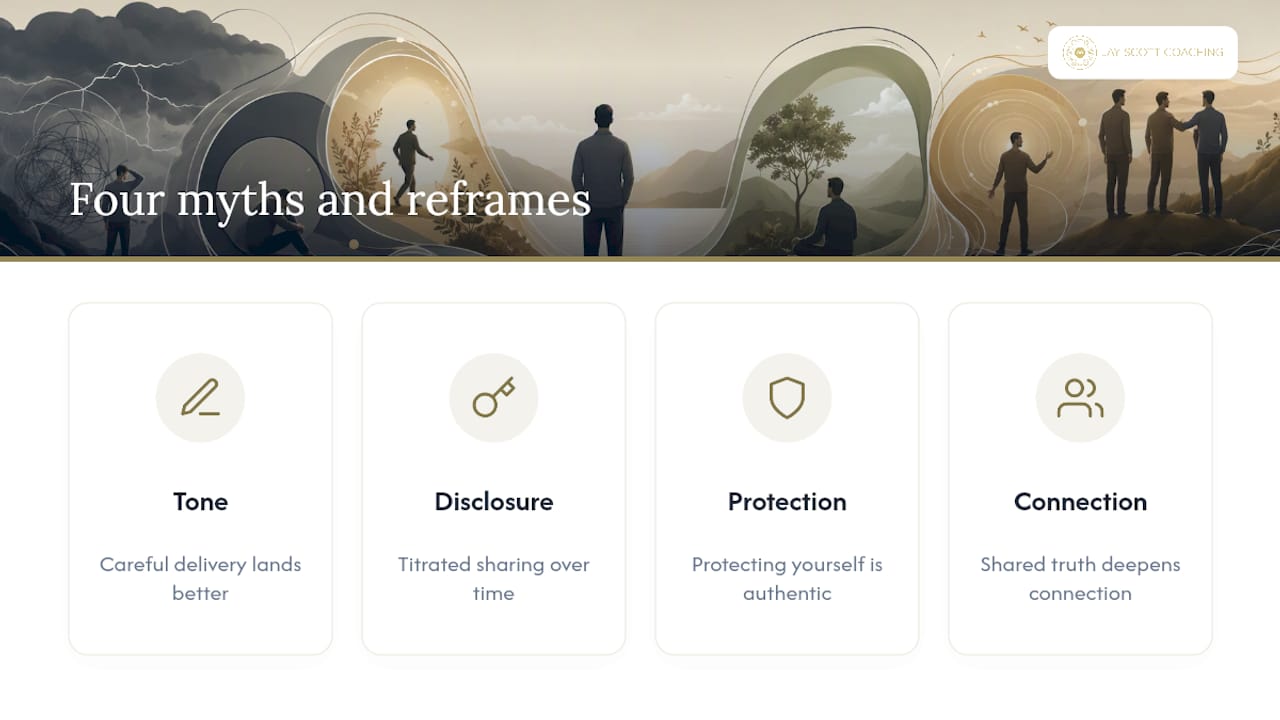
Myth 1: Speaking your truth means being blunt or aggressive. Reframe: truth delivered with care lands better and stays true. Tone is a choice, not a tax on honesty.
Myth 2: It's all-or-nothing, confess everything or say nothing. Reframe: titrated disclosure, sharing pieces over time, is often the smarter and safer path.
Myth 3: Real authenticity means ignoring consequences. Reframe: protecting yourself is part of authentic expression, not a betrayal of it.
Myth 4: Honesty always drives people away. Reframe: it often does the opposite. Shared truth, delivered with intention, tends to deepen connection rather than end it.
What steady practice actually looks like
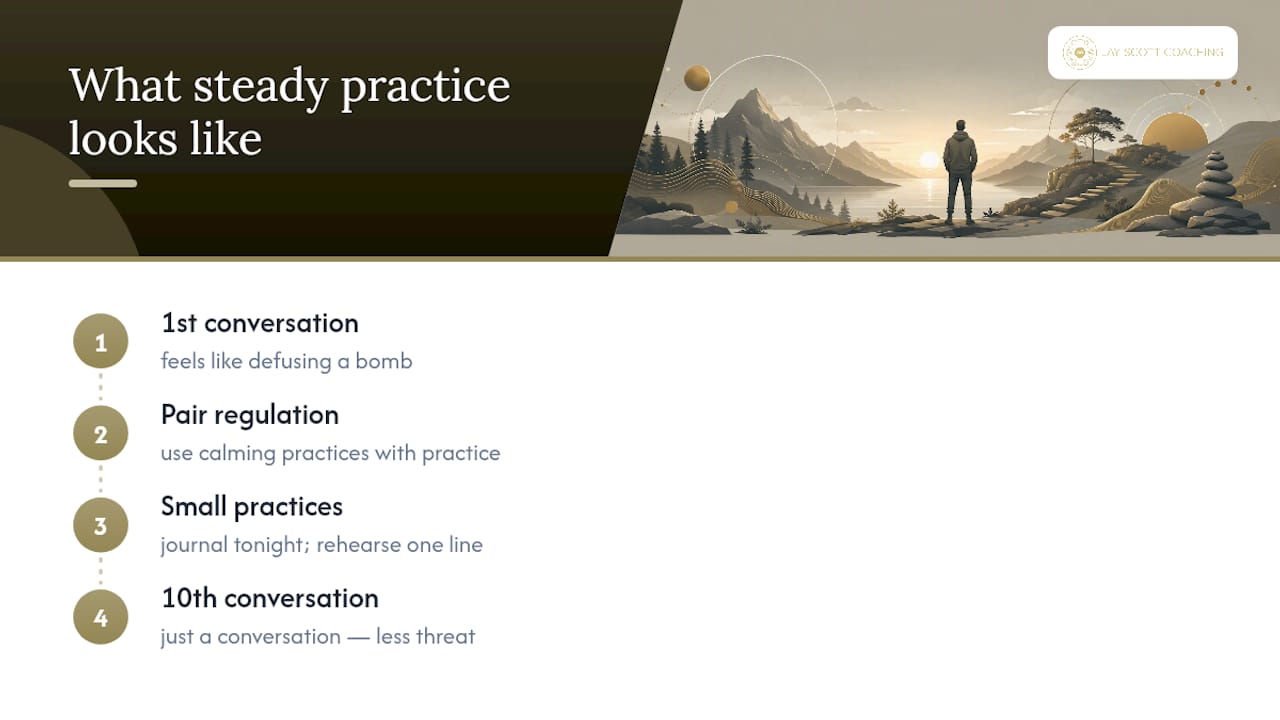
One pattern shows up again and again in men working through this: the first honest conversation feels like defusing a bomb. By the tenth, it's just a conversation. The shift isn't that the stakes got lower. It's that the nervous system stopped treating honesty as danger.
That's the actual work: pairing regulation with repetition until saying the true thing stops feeling like a risk. Start there. A journal prompt tonight, one rehearsed line for tomorrow.
— Jay
Ready to build the nervous-system steadiness behind real conversations
Reading the steps helps, but most men stall at the rehearsal stage because the fear response fires before the words do. That's the gap the Unshakable Man Method™ is built to close: nervous-system training paired with direct coaching, so speaking up stops requiring a crisis to justify it.

This coaching fits high-performing men who already know what they want to say and still find themselves going quiet, over-explaining, or avoiding the conversation altogether. A discovery call assesses where avoidance shows up most, in relationships, at work, under conflict, and maps a first practical step you can use immediately, not months from now. Read more about how this coaching works and what a client's first ninety days typically covers, or go straight to the Jay Scott Coaching home page to start an application.