

You can stop being reflexively defensive by using a mechanical interruption in the moment, usually a five-second pause or one slow breath, and pairing it with regular practice over the following weeks. Most people notice real shifts after a few weeks of consistent practice; the deeper rewiring that makes calm responses automatic tends to take many months of continued effort.
TL;DR:
- Using a five-second pause or slow breath in the moment can re-engage the prefrontal cortex and prevent automatic defensiveness during conflicts.
- Recognizing physical tells such as a racing heart, clenched jaw, or rising voice allows early intervention before defensive reactions escalate.
- Repairing defensiveness involves accepting small parts of the feedback quickly and specifically to rebuild trust and reduce relational damage.
- Consistent practice over months, including low-stakes rehearsals and journaling, gradually rewires the defensive reflex for more automatic calm responses.
- Underlying factors like trauma, attachment patterns, and self-worth influence reactivity, requiring targeted therapy or coaching for significant long-term change.
Table of Contents
- What Causes Defensiveness in the First Place?
- How Do You Interrupt Defensiveness in the Moment?
- What Do You Say After a Defensive Slip?
- How Long Does It Take to Stop Being Defensive?
- Building Emotional Resilience Alongside the Tactics
- Does Mindfulness Actually Reduce Defensiveness?
- Common Misconceptions About Defensiveness
- Why Defensiveness Costs You More Than You Think
- Coaching Perspective: Why Guided Practice Speeds This Up
- Ready to Move Faster Than Self-Guided Practice Alone?
- Sources
What Causes Defensiveness in the First Place?
Defensiveness isn't a character flaw. It's a protective reflex, and it usually feels like accuracy rather than fear. When someone points out something you did wrong, your nervous system reads it as a threat first and a fact second. That's why the counterattack, the explaining, the "well actually" comes out before your thinking brain has a say.
The triggers are predictable once you know what to look for. Identity threats top the list: a comment that pokes at "I'm a good father" or "I'm competent at my job" lands harder than the words themselves suggest. Shame is close behind, since criticism that echoes an old wound (being called lazy, careless, selfish) reactivates the wound faster than the current conversation deserves. Attachment history plays a role too. If you grew up needing to defend your position to be heard or safe, your body learned that defense equals survival. Add in years of reinforced habit, and defensiveness becomes the fastest path your brain knows, not the smartest one.
This is why willpower alone rarely fixes it. Telling yourself "I won't get defensive next time" is a decision made by your prefrontal cortex, the slow, rational part of your brain. But defensiveness fires from a faster system built to react before you can decide anything. Research on emotion regulation backs this up: interventions that combine conscious practice with nervous-system awareness outperform sheer intention every time.
Defensiveness is a nervous-system reflex. Mechanical interruption, like a breath or a pause, combined with repeated rehearsal over months, is what actually rewires it. Therapy or targeted coaching can speed that process up considerably.
Understanding the mechanics matters because it reframes the whole project. You're not trying to become a different person overnight. You're training a reflex, the same way you'd retrain a flinch, one rep at a time.
How Do You Interrupt Defensiveness in the Moment?
The five-second pause is the single most useful tool you have, and it works because of simple biology. A pause of at least five seconds, or one slow breath, gives your prefrontal cortex enough time to regain control from the fight-or-flight response that just fired. Think of it as an emotional speed bump. You're not suppressing the reaction, you're just buying your rational brain a few extra seconds to catch up.
But a pause only works if you catch the moment early enough to use it. That means learning your body's specific warning signs before the words start flying.
Common physical tells include:
- A racing heart or a sudden flush of heat in your face
- Tightness across your chest or a clenched jaw
- An urge to interrupt or start explaining immediately
- Your voice rising in pitch or volume without deciding to raise it
- A flood of counterexamples or justifications lining up in your head
Therapists point to this same pattern: learning your body's "tell," like a racing heart or tight chest, works as an early warning system that lets you intervene before the reflex takes over completely.
Once you notice a tell, you need something to say that buys time without shutting the conversation down. A few options that work well:
- "Give me a second, I want to actually hear this."
- One clarifying question: "Can you say more about what you mean by that?"
- A reflective listening opener: "So what I'm hearing is..."
Pro Tip: Practice the five-second pause in low-stakes moments first, a minor criticism from a coworker, a small jab from a friend, before you try it during a real argument with someone you love. Drilling it when the stakes are low is what makes it available when the stakes are high.
The five-second window isn't arbitrary. It's roughly how long it takes for the prefrontal cortex to reassert itself once the alarm response has fired, which is why psychologists keep landing on that same number across different techniques.
What Do You Say After a Defensive Slip?
You will slip. The measure of progress isn't a perfect track record, it's how fast you recover and how well you repair. Gottman Institute research frames defensiveness as a counterattack, a way of protecting yourself that reads to your partner as an assault back. The antidote is accepting partial responsibility instead of defending the whole position.
This is the "take one part" technique, and it works because it's honest without being total surrender. You find one small, truthful piece of the complaint and own it before you explain anything else.
Here's a simple repair sequence to memorize:
- Notice the slip, ideally within minutes, but hours later still counts.
- Name it specifically: "When you said I never help with bedtime, I got defensive and cut you off."
- Take one part: "The part that's true is I was late two nights this week."
- Reopen with curiosity: "What did that feel like on your end?"
- Ask to try again, rather than assuming the moment has passed.
A few rules make this land better:
- Cut the word "but" entirely. It cancels whatever you said before it.
- Be specific about what you're repairing, not just "sorry I was defensive."
- Repair soon. A repair offered three days later loses most of its power.
Therapists who study repair conversations note that keeping a small set of memorized repair lines matters more than crafting the perfect apology in the moment. Specificity beats eloquence every time.
How Long Does It Take to Stop Being Defensive?
Treat this like strength training, not like flipping a switch. The reflex took years to build, and it won't disappear because you read one good article.
Your daily practice should be small enough that you'll actually do it. A few minutes of breath practice, a mental rehearsal of your pause phrase, and one low-stakes rep of reflective listening (with a partner, a coworker, even a customer service call) build the muscle without requiring a real conflict every day.
Weekly, aim for these three things:
- Track one or two specific triggers you noticed and how you responded.
- Practice a repair script at least twice, even for minor slips.
- Journal two or three lines about what worked and what didn't.
The Calm blog's nine-tip approach to defensiveness recommends this same low-stakes rehearsal strategy, practicing reflective listening and self-soothing in situations where the outcome doesn't matter much, so the skill is ready when it does.
Expect a timeline with two distinct phases. Most people notice initial, sustained shifts in their defensive responses after four to eight weeks of consistent practice, catching themselves faster, recovering quicker, snapping less often. Deeper rewiring, the kind where calm responses start feeling automatic instead of effortful, commonly takes six to twelve months.
If eight weeks pass and you're still blowing up as often as before, that's a signal, not a failure. Persistent reactivity that doesn't budge with mechanical practice usually points to something underneath it: unresolved trauma, an attachment pattern, or a relationship dynamic that needs outside eyes. That's when therapy or targeted coaching earns its cost.
Building Emotional Resilience Alongside the Tactics
Tactics interrupt the reflex. Resilience is what keeps you from needing to interrupt it as often. The two work together, not in sequence.
Self-compassion is the foundation most people skip. If you berate yourself every time you slip into defensiveness, you add a second layer of threat on top of the first one, and that second layer often triggers more defensiveness, not less. Treating a slip as data instead of proof of failure keeps your nervous system calmer the next time criticism shows up.
Cultivating intellectual humility does real work here too. Practices like affirming other sources of meaning in your life, acknowledging the limits of your own knowledge, and actively seeking to prove yourself wrong reduce defensive responses because they lower the stakes of any single criticism. If your entire sense of worth doesn't hinge on being right about one thing, one piece of feedback stops feeling like an attack on your existence.
Diversifying where you get validation matters more than people expect. If your job is the only place you feel competent, criticism at work will hit disproportionately hard. Spread that sense of competence across a few areas, a hobby, a friendship, a physical practice, and any single critique carries less weight.
Does Mindfulness Actually Reduce Defensiveness?
Mindfulness doesn't stop the initial spike of threat response, nothing does that instantly, but it shortens how long the spike controls you. That's the actual mechanism worth understanding, rather than treating meditation as a vague wellness add-on.
Regular meditation practice trains the same skill the five-second pause relies on: noticing a bodily sensation without immediately acting on it. If you've spent time sitting with restlessness or irritation during meditation without reacting to it, that same capacity shows up mid-argument as a slightly longer gap between "I feel attacked" and "I'm now explaining myself loudly."
Breath work deserves specific credit here, separate from formal meditation. A single slow breath activates your parasympathetic nervous system, which is the physiological reason the five-second pause works at all. You don't need twenty minutes of seated practice to get this benefit. You need to know, in your body, what one slow breath feels like, so you can access it fast when your heart rate spikes.
Short daily practice, even five minutes, builds this faster than occasional long sessions. Consistency trains the reflex; intensity doesn't substitute for repetition.
Common Misconceptions About Defensiveness
The biggest misconception is that defensiveness means someone is lying or hiding something. Usually, it means the opposite: they feel exposed by something true, and the exposure itself is what triggers the reaction, regardless of whether the criticism was fair or accurate.
A second misconception treats defensiveness as a fixed personality trait, "I've always been defensive," as if it's permanent. It's a learned pattern, which means it's also an unlearnable one. People who've done this work for years still have moments of reactivity; they just recover in seconds instead of days.
A third misconception assumes staying silent equals staying calm. Silence can be its own defensive move, a wall instead of a counterattack, and it does just as much relational damage as arguing back. The goal isn't to stop responding, it's to respond after the reflex has passed instead of during it.
Finally, people assume acknowledging any fault means losing the argument entirely. The "take one part" technique exists specifically because this isn't true. You can accept one small, accurate piece of a complaint without agreeing to every accusation attached to it.
Why Defensiveness Costs You More Than You Think
At home, defensiveness is one of the clearest predictors of relational breakdown that researchers have identified, largely because it blocks the thing conflict actually requires: being heard. A partner who feels dismissed stops bringing up problems, and a relationship where problems stop surfacing isn't peaceful, it's quietly eroding.
At work, the cost shows up differently but hits just as hard. Defensive responses to feedback signal to managers and peers that you're not coachable, which quietly caps how much responsibility people hand you. Leaders in particular pay for this. A defensive response to a direct report's concern doesn't just end that conversation, it teaches the whole team to stop raising concerns with you at all.
The pattern compounds in both settings for the same reason: defensiveness trades short-term protection for long-term isolation. You win the exchange and lose the access. Over years, that trade adds up to fewer people willing to tell you the truth, which is a cost most people don't notice until it's already expensive.
Coaching Perspective: Why Guided Practice Speeds This Up
Most men can learn the mechanics here on their own: the pause, the tells, the repair script. What's harder to do alone is the nervous-system work underneath it, the part that determines whether those tactics hold up under real pressure instead of collapsing the moment the stakes get personal.
That's the gap the Unshakable Man Method™ is built to close. It pairs the same micro-interruptions covered here, the pause, the breath, the tell-recognition, with structured nervous-system regulation training, so a man isn't just remembering to pause, he's actually capable of staying grounded long enough for the pause to matter. Willpower fatigues under stress. Regulated physiology doesn't.
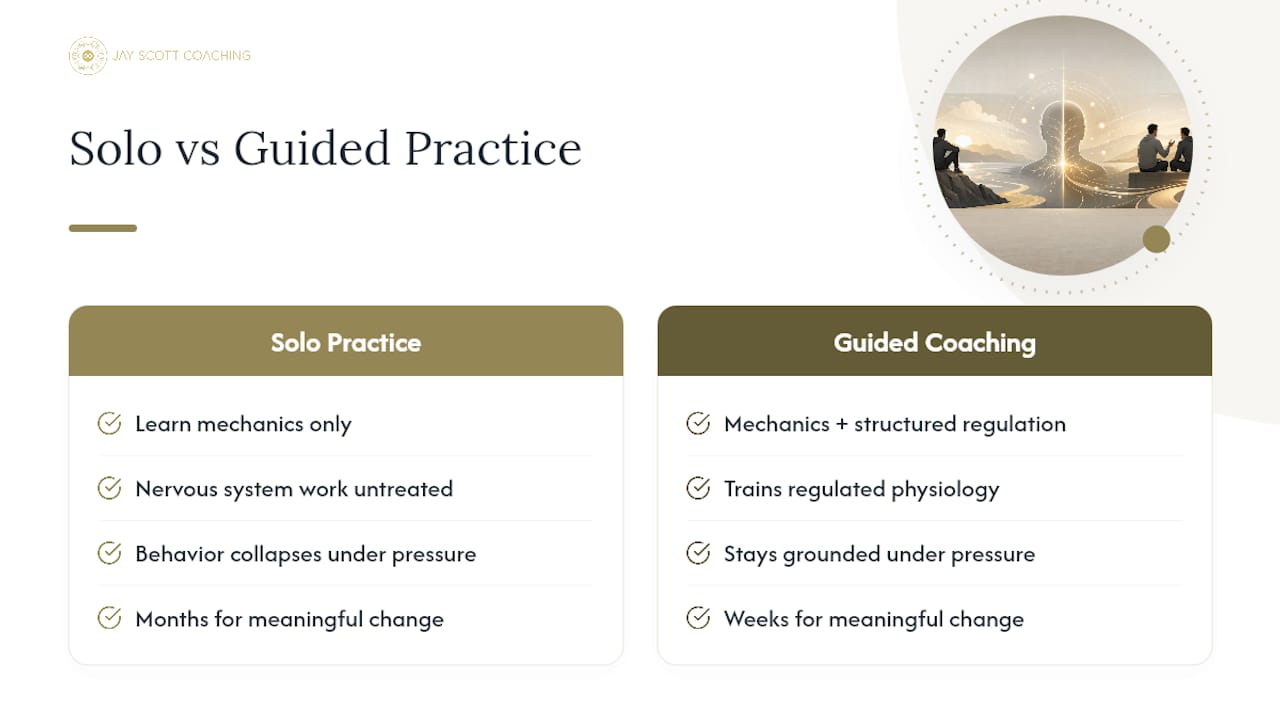
Men who come to coaching stuck in persistent reactivity, the kind that doesn't budge after weeks of trying on their own, tend to have one thing in common: the reflex is tied to a deeper pattern of self-abandonment, not just a bad habit. Naming and mapping that pattern directly, rather than only treating the surface behavior, is usually what shortens the timeline from months to weeks.
Telling your partner or team you're actively working on this also matters more than most men expect. It gives the people around you a shared language to name a defensive moment without it becoming its own fight, which reduces the cognitive load on everyone involved while the retraining is still underway.
— Jay
Ready to Move Faster Than Self-Guided Practice Alone?
The steps above work, but they ask you to be your own coach, your own accountability system, and your own nervous-system expert, all while you're also the person mid-argument trying to remember to breathe. Jayscottcoaching exists for the high-performing men who've tried the pause-and-script approach, seen partial results, and know the deeper reactivity is still running the show underneath it.

The Unshakable Man Method™ works directly with your nervous system, not just your behavior, so grounded responses under pressure stop requiring conscious effort and start becoming your default. An initial consultation walks through where your reactivity actually originates, whether it's identity threat, old attachment wiring, or a pattern of self-abandonment, and maps a coaching plan built around your specific triggers instead of generic scripts. If you're ready to stop managing the reflex and start retraining it, book your consultation with Jay Scott Coaching and see what a guided plan looks like for your situation.
Sources
- Time — How to Stop Being So Defensive During Arguments
- Greater Good — Four ways to cool down your defensiveness
- Forbes — The easy 5-second rule to turn any fight around
- Gottman Institute — Self-care and defensiveness