

Stop the loop right now: do a two-minute breathing reset, name the thought out loud, then ask if you can act on it in the next 24 hours. If yes, take one small step. If no, write it down and schedule a specific time to revisit it. This works because slow breathing calms your nervous system while labeling and postponing shift your attention away from the spiral. The rest of this guide walks through the techniques, the evidence, and the routines that make this your default response instead of a one time fix.
TL;DR:
- Two minutes of slow breathing activates your vagus nerve, calming your nervous system and directly opposing the physical momentum of overthinking.
- Grounding techniques like the 5-4-3-2-1 method and movement disrupt attention from mental spirals to your immediate environment.
- Labeling thoughts and assessing if a concrete step can be taken within 24 hours helps distinguish problem-solving from unproductive rumination.
- Building a worry time routine with structured journaling and environmental supports reduces the frequency and intensity of overthinking episodes.
- If overthinking persists despite self-help routines and impacts daily functioning, professional therapy such as CBT or MCT is recommended.
Table of Contents
- How Do You Stop Overthinking Right Now?
- What's the Science Behind Stopping Overthinking?
- How Do You Build a Routine That Sticks?
- When Should You Get Professional Help for Overthinking?
- How Coaching Complements Therapy for Overthinking
- A Coach's Honest Note on Setbacks
- Ready to Build a Calmer, Steadier Mind?
- Sources
- FAQ
How Do You Stop Overthinking Right Now?
The fastest way to interrupt a thought spiral is to change your body's state before you try to change your mind. Overthinking anxiety runs on physiological momentum. Your heart rate climbs, your breathing shortens, and your brain keeps replaying the same three worries like a scratched record. You cannot out-argue that state. You have to shift it first.
Start with two minutes of deep breathing. Inhale for four counts, hold for two, exhale for six. That extended exhale activates your vagus nerve, which lowers cortisol and adrenaline and produces a calmer physical state that Yale Medicine describes as directly incompatible with active rumination. You cannot stay wound up and fully relaxed at the same time. The body picks one.
Once your breathing settles, ground yourself in the room. The 5-4-3-2-1 method works well here: name five things you see, four you can touch, three you hear, two you smell, and one you taste. It sounds almost too simple, but it forces your attention out of the mental loop and into your actual surroundings. Pair it with thirty seconds of movement, like a short walk or a few stretches, and you interrupt the loop from two directions at once.
Next, label the thought. Say it plainly, even out loud: "I'm worried I said the wrong thing in that meeting." Naming a thought creates distance from it. Then run the diagnostic that separates real problem-solving from rumination: can I take one concrete step on this in the next 24 hours? A practical rule clinicians use holds that if the loop doesn't converge on a specific action, it isn't problem-solving. It's rumination, and it needs to be deferred, not analyzed further.
That's where containment comes in. Keep a single line worry capture, a small notebook or note app where you write one sentence about the worry and close it. Set a fixed worry time, ideally 15 to 20 minutes at the same point each day, where you actually process what you've captured. Outside that window, the rule is simple: it waits.
A short script helps most people remember the sequence under stress:
- Stop. Notice the loop and name it as overthinking, not fact-finding.
- Breathe. Two minutes of slow breathing to settle your body.
- Reflect. Ask if there's a concrete next step available in 24 hours.
- Choose. Either take that step now or write it down for scheduled worry time.
Use the full sequence for big decisions or emotionally loaded worries. Use just Stop and Breathe for smaller, passing intrusive thoughts that don't warrant a full workup.
Pro Tip: Keep your worry capture notebook somewhere visible, like next to your coffee maker. The friction of having to physically write something down, rather than just thinking it, cuts down on how often you engage with a worry impulsively.

What's the Science Behind Stopping Overthinking?
Three evidence-based frameworks explain why these techniques work, and understanding the mechanism helps you pick the right tool for your specific pattern of overthinking.
Cognitive Behavioral Therapy (CBT) treats overthinking as a distortion problem. Your brain generates a thought, assumes it's accurate, and builds a spiral on top of that assumption. CBT's cognitive restructuring uses a four-step process: stop the cycle, breathe to create space, reflect on the actual evidence for and against the thought, and choose a more balanced interpretation. Harvard Health recommends structured thought records for exactly this purpose. You write the trigger, the automatic thought, the emotion it produced, and then a more balanced alternative next to it. Over weeks, this rewires which interpretation your brain reaches for first.
Metacognitive Therapy (MCT) takes a different angle. Instead of challenging whether a specific thought is true, MCT challenges your beliefs about worrying itself. Many overthinkers hold an unspoken belief that worrying more will produce a better outcome or keep them safe from surprises. MCT directly disputes that belief and trains attentional control through exercises like postponing worries to a scheduled time and practicing deliberate attention switching between internal and external focus. Psyche's guide to metacognitive strategies frames this as building voluntary control over where your attention goes, rather than fighting each individual thought as it arrives.
Mindfulness and Mindfulness-Based Cognitive Therapy (MBCT) work through a third mechanism: changing your relationship to thoughts rather than their content. Instead of analyzing or disputing a thought, mindfulness practice teaches you to notice it and let it pass, the way you'd notice a cloud without following it. Psychology Today points to research showing that even ten minutes of daily practice measurably reduces activity in the brain's rumination circuitry over several weeks.
Which one fits your situation depends on your pattern:
- If your overthinking centers on specific negative predictions ("I'm going to fail this"), CBT's evidence-checking approach tends to land fastest.
- If your overthinking feels compulsive, like you can't stop even when you want to, MCT's focus on beliefs about worrying itself often gets closer to the root.
- If your overthinking shows up as background noise that colors your whole day, mindfulness's steady, cumulative practice tends to produce the most durable shift.
None of these are mutually exclusive. Most people benefit from borrowing pieces of all three.
How Do You Build a Routine That Sticks?
Techniques help in the moment, but overthinking rarely disappears from a single good day. It fades when you build a routine your brain can rely on, so it stops treating every stray worry as an emergency.
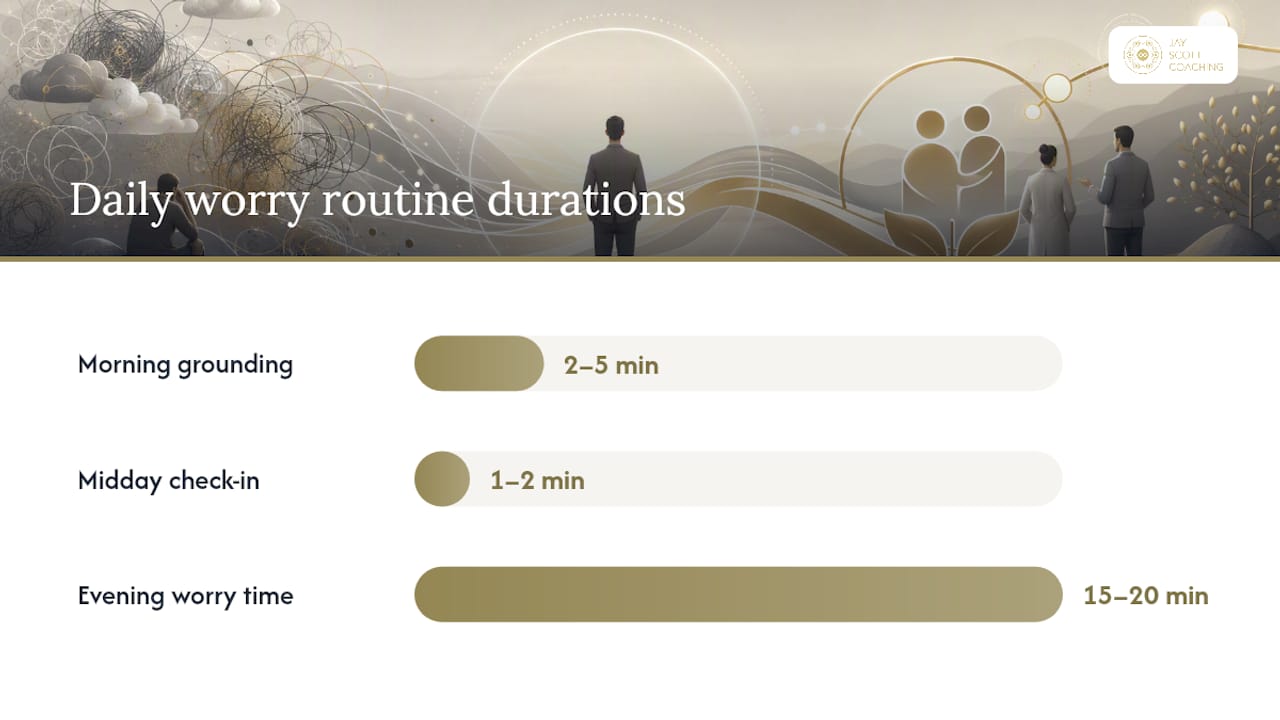
Here's a seven-day starter structure:
- Morning grounding (2 to 5 minutes). Before checking your phone, do a short breathing reset or a quick body scan. This sets your baseline before the day's inputs start arriving.
- Midday check-in (1 to 2 minutes). Pause once, ideally around lunch, and ask yourself what you've been carrying mentally. Capture anything nagging in your single-line worry log instead of letting it run in the background.
- Evening worry processing (15 to 20 minutes). This is your scheduled worry time. Review what you captured during the day and work through each item with the Stop, Breathe, Reflect, Choose sequence.
A few rules make worry time actually work instead of becoming its own spiral. Keep it capped at 20 minutes; open-ended worry time defeats the purpose. Schedule it earlier in the evening, not within two hours of sleep, since processing worries right before bed tends to keep your nervous system activated when you need it to wind down. And treat items outside that window as deferred, not dismissed. The goal isn't to suppress worry. It's to give it a designated container.
For processing worry time entries, structured journaling works better than free writing for most people, because a template forces you toward resolution. Write the situation, the thought, the evidence for and against, and end every entry with one action step, even if that step is simply "revisit this in three days." Free writing has its place for emotional venting, but it can also reinforce rumination if you never land on a next step.
Environmental supports matter more than people expect. Peer-reviewed research connects repetitive negative thinking with higher anxiety and depression risk, and shows that movement, time outdoors, and behavioral activation measurably lower rumination and lift mood. Sleep hygiene plays a similar role. A tired brain has less capacity for the top-down reasoning that reflection and reframing require, which makes late-night scrolling and worry a particularly bad combination. Telling one trusted person about your worry time routine also builds accountability. It's harder to skip a habit someone else knows you're trying to keep.
Pro Tip: If you miss a day of worry time, don't try to double up the next day. Just resume the normal 15 to 20 minute window. Cramming two days of worries into one session usually recreates the exact spiral you're trying to avoid.
When Should You Get Professional Help for Overthinking?
Self-directed techniques handle a lot of every day overthinking, but certain signs mean it's time to bring in a therapist rather than push through alone. Watch for overthinking that's starting to interfere with your work performance, sleep loss that's become chronic rather than occasional, persistent loss of interest in things you used to enjoy, or any thoughts of self-harm. That last one warrants immediate professional support, not a wait-and-see approach.
If you're at that point, CBT, MCT, and MBCT all have strong track records for treating chronic rumination and worry, and a therapist can tailor which one fits your specific pattern faster than trial and error on your own. Progress usually looks like longer stretches between spirals and faster recovery when one does start, not the complete absence of intrusive thoughts.
When vetting a therapist, ask directly about their experience treating rumination specifically, and whether they have formal training in CBT or MCT rather than general talk therapy. If cost or access is the barrier, community mental health centers and telehealth platforms have made those first steps easier to reach than they were even a few years ago.
How Coaching Complements Therapy for Overthinking
Therapy addresses the thought. Coaching addresses the body that's holding the thought hostage. That's the distinction Jay Scott Coaching works from, and it's why nervous-system training pairs so effectively with CBT and MCT rather than competing with it.
Breath pacing, small deliberate exposures to discomfort, and physical anchoring techniques all train your nervous system to recognize pressure without collapsing into avoidance or spiraling into analysis. This approach focuses less on debating individual thoughts and more on building the internal stability that makes overthinking less likely to hijack you in the first place.
Two exercises you can try without any special training: box breathing (four seconds in, four seconds hold, four seconds out, four seconds hold, repeated for two minutes) before a high-stakes conversation, and a "name three sensations" check-in when you notice your chest tightening. Both build the same muscle: noticing your body's state before it runs the show.
Most men who struggle with overthinking aren't lacking insight. They've already analyzed the problem from every angle. What they're missing is the felt sense of safety that lets them act without needing to solve every variable first. That's a nervous-system skill, not a thinking skill, and it's trained differently than most people expect.
Coaching isn't a replacement for clinical treatment when anxiety or depression reaches a diagnosable level. Think of it as the layer above therapy: therapy treats the condition, coaching builds the daily capacity to stay grounded once you're stable enough to practice it.
A Coach's Honest Note on Setbacks
Progress here is never a straight line, and expecting it to be is usually what causes people to quit. You'll have a good stretch of weeks, then a stressful Tuesday undoes it and the old spiral shows up again. That's not failure. That's just how habit change actually works.
Two quick exercises worth trying in the moment: the "three breath check," where you take three slow breaths before responding to anything that spiked your stress, and the "one word label," where you name the emotion underneath the thought in a single word before deciding what to do next. Both take under a minute.
Track small wins instead of waiting for the spiral to disappear entirely. A short daily note, just one line on how quickly you caught yourself and redirected, builds evidence over time that the work is landing even on days that don't feel like it.
— Jay
Ready to Build a Calmer, Steadier Mind?
Self-help techniques get you further than most people expect, but they have a ceiling. If you've tried the breathing resets and the worry time routines and still find your nervous system snapping back into overdrive under real pressure, that's usually a sign the pattern lives deeper than thought habits alone. Jay Scott Coaching works directly with that layer, training your nervous system to stay grounded under the kind of pressure that used to send you straight into a spiral.

This coaching tends to fit high performers who've already done the reading and the reflecting and still find themselves overthinking their way out of decisive action, difficult conversations, or moments that matter in their relationships and careers. An initial engagement typically starts with mapping your specific patterns of self-abandonment and avoidance before building nervous-system practices that address them directly. If that sounds like where you're stuck, read more about why working with a coach makes a difference or visit the Jay Scott Coaching program overview to see what a consultation involves.
Sources
- The power of the breath (Yale Medicine)
- Try this: How to change your negative thoughts (Harvard Health)
- How to stop overthinking with help from metacognitive strategies (Psyche Guides)
- How to stop overthinking (Psychology Today)
- PubMed-indexed study (example entry)
This article is general information, not a substitute for advice from a qualified doctor. Consult a qualified healthcare professional about your own circumstances before acting on anything here.
FAQ
How can I reduce my overthinking?
Combine an immediate physiological interrupt, like two minutes of slow breathing, with a decision rule: if a thought doesn't lead to a concrete action within 24 hours, write it down and defer it to a scheduled worry time instead of analyzing it further.
What is the 3-3-3 rule for anxiety?
A common version of this grounding technique asks you to name three things you see, three sounds you hear, and move three parts of your body; it works similarly to the 5-4-3-2-1 method by pulling attention out of your head and into your physical surroundings.
What is the root cause of overthinking?
Overthinking usually stems from a mix of anxiety, perfectionism, and a mistaken belief that more analysis produces more safety or better outcomes, a belief that metacognitive therapy directly targets and challenges.
How do I stop anxiety thoughts?
Label the thought, run it through the 24-hour actionable check, and either act on it or contain it in a worry log; pairing this with two minutes of deep breathing calms the physical anxiety that keeps the thought looping. If anxious thoughts are interfering with sleep, work, or daily functioning, that's a signal to bring in a CBT or MCT-trained therapist rather than relying on self-help alone.