
Trauma release exercises are body-led practices, like tension and trauma releasing exercises (TRE™), body scan meditation, and progressive muscle relaxation, that help discharge stored muscular tension and calm an overactive nervous system. They can meaningfully ease everyday stress and tension in the short term. They are not a substitute for clinical treatment if you're carrying complex trauma or facing a mental health crisis.
TL;DR:
- TRE-style tremoring can help discharge muscular tension but may trigger overwhelming sensations, so it should be used with caution and not alone in high-risk cases.
- Body scan meditation and progressive muscle relaxation have stronger evidence and are safe options for reducing stress without clinical supervision.
- Practice sessions should be brief, consistent, and in a safe environment, with extra caution advised for individuals with complex trauma, dissociation, or medical conditions.
- Large-scale clinical research on trauma release exercises remains limited, so these methods should complement professional treatment rather than replace it.
- Clinician support is recommended for high-risk individuals, and exercises like tremoring should be paused if sensations become intense or distressing.
Table of Contents
- What Trauma Release Exercises Are and How They Work
- Five Trauma Release Exercises to Try at Home
- How to Practice Safely: Pacing, Red Flags, and When to Get Help
- What the Research Actually Says
- A Coach's View on Somatic Work and Nervous-System Training
- Want Structured Support Instead of Going It Alone?
- Sources
- FAQ
What Trauma Release Exercises Are and How They Work
The idea behind trauma release exercises is simple, even if the biology underneath it is not: your body holds onto stress the same way it holds onto muscle memory. When you can't fight or flee a threat, your muscles brace anyway, and that bracing pattern can outlast the original stressor by months or years. Somatic practices try to reverse that by working through the body instead of only through talk or thought.
The lineage here matters. TRE™, developed by David Berceli, uses preparatory stretches to invite involuntary muscle tremors, a shaking response some researchers compare to how animals in the wild discharge stress after a threat passes. Body scan meditation works differently, guiding your attention slowly through each body region to sharpen interoception, your internal sense of what's happening physically. Progressive muscle relaxation (PMR) tightens and releases muscle groups in sequence to teach your body the difference between tension and ease.
The proposed mechanisms, tremoring, interoceptive awareness, and parasympathetic activation, aren't fully mapped by large clinical trials yet, but the pattern across methods is consistent: slow the body down, and the nervous system often follows. These exercises work best as a self-help layer alongside, not instead of, professional support.
Common techniques you'll encounter include:
- TRE™ (Tension & Trauma Releasing Exercises)
- Body scan meditation
- Progressive muscle relaxation
- Diaphragmatic breathing
- Bilateral stimulation practices like the butterfly hug
Five Trauma Release Exercises to Try at Home
Each of these can be done in a quiet room with no equipment. Go slowly the first few times, and treat any strong reaction as information, not failure.
1. Deep belly breathing. Sit or lie down, one hand on your chest and one on your belly. Inhale through your nose for a count of four, feeling your belly rise more than your chest, then exhale slowly for a count of six. Repeat for four to six breaths. You may notice your shoulders drop or a wave of sleepiness. If you feel light-headed, breathe normally for a minute before continuing.
2. The butterfly hug. Cross your arms over your chest, hands resting on opposite shoulders, and tap gently and alternately, left, right, left, for 30 to 60 seconds. This bilateral tapping is a self-soothing technique often used when anxiety spikes suddenly, at a desk, before a hard conversation, in a waiting room. It can bring a felt sense of being held even though no one else is in the room.
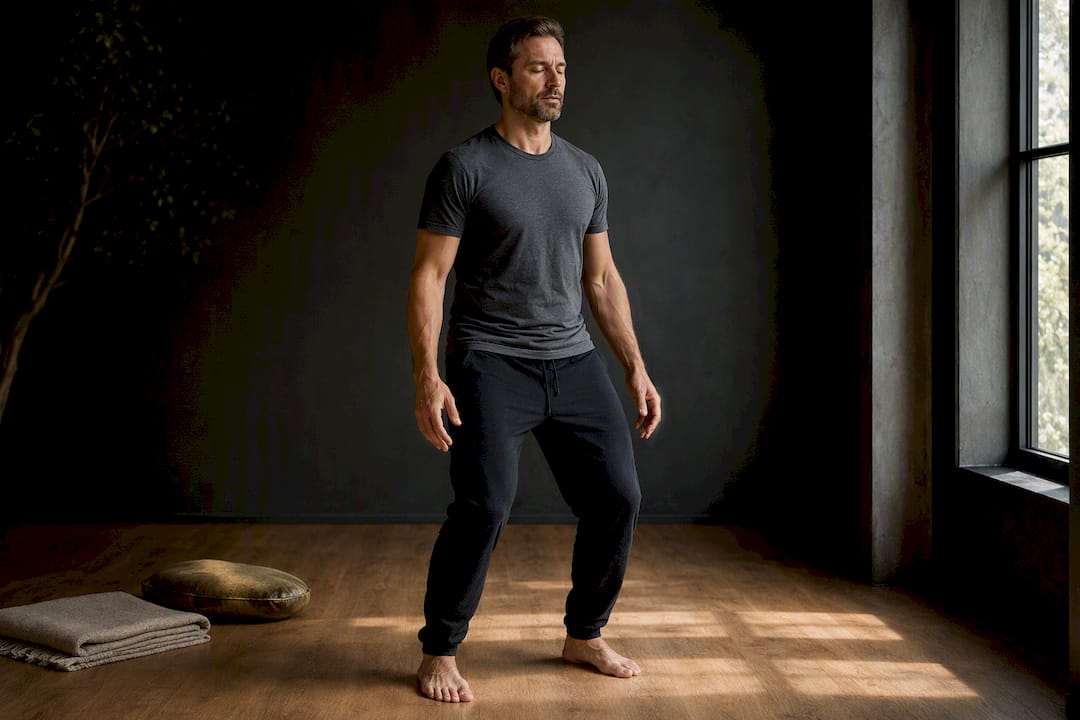
3. Gentle shaking or tremoring (TRE-style). Stand with feet hip-width apart, knees slightly bent, and gently bounce or sway until you feel a natural tremor begin in your legs. Keep sessions short, under 10 minutes for your first several tries, and stop the moment the shaking feels intense rather than gentle. This one carries more caution than the others; ease off if sensations become overwhelming rather than releasing.
4. Progressive muscle relaxation. Starting at your feet, tense each muscle group hard for five seconds, then release and notice the contrast for ten seconds. Work upward, feet, calves, thighs, abdomen, hands, arms, shoulders, face, over roughly 10 minutes. Clinical resources describe PMR as one of the more reliably evidence-backed relaxation techniques available, largely because the tense-and-release contrast is so easy to feel and repeat.
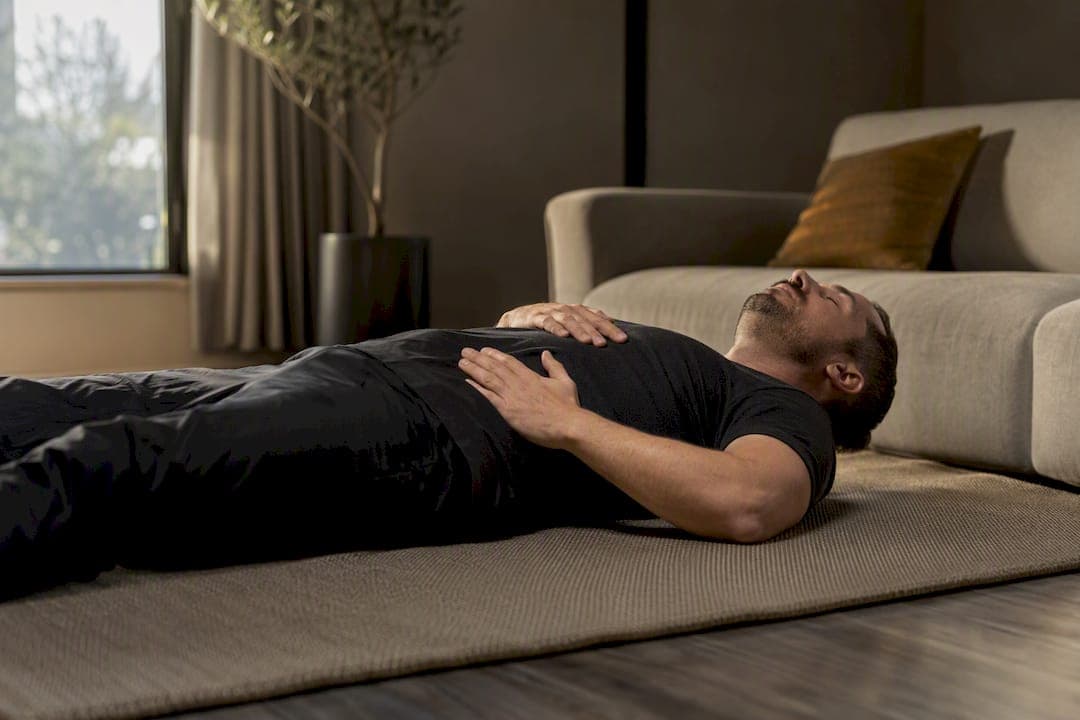
5. Body scan or orienting exercise. Lying down, bring attention slowly from your feet to your scalp, pausing a few seconds on each region without trying to change anything you notice. A five-minute version works fine to start. Short, regular sessions, even five minutes a few times a week, are enough to build the interoceptive skill that makes you quicker to catch tension before it snowballs.
Pro Tip: Pick one exercise and repeat it for a week before adding a second one. Novelty feels productive, but your nervous system responds better to a familiar cue it can predict.
How to Practice Safely: Pacing, Red Flags, and When to Get Help
Set up matters more than people expect. Practice in a quiet space, wear clothing that doesn't restrict movement, stay hydrated, and avoid these exercises right after a heavy meal, when digestion competes with the parasympathetic shift you're trying to create.
Start small. A reasonable dose is:
- short sessions per practice
- several sessions per week
- consistency over duration
Integration, giving your body time to settle after a session, matters more than how long you practice. If tremoring feels too intense, plant both feet firmly, straighten your knees, and take a few slow breaths to interrupt the response. Grounding anchors like naming five objects in the room or pressing your palms together can pull you back if a session brings up more than you expected.
Certain histories call for caution and a conversation with a clinician first, not a solo attempt at home:
- Complex PTSD or a history of dissociation
- Active suicidal ideation
- Epilepsy or seizure disorders
- Cardiovascular conditions
- Recent surgery
- Pregnancy
SAMHSA's trauma-informed care guidance is built on exactly this principle: safety and clinician collaboration come first for anyone with a higher-risk profile. If you're in crisis, contact the 988 Suicide & Crisis Lifeline rather than working through exercises alone. These practices are a complement to trauma-focused therapy, EMDR, or trauma-focused CBT, not a replacement for a trained practitioner.
What the Research Actually Says
The honest summary: promising, but not proven at scale. Small pilot studies on TRE report reduced subjective tension and improved well-being, but there's no large, independent randomized controlled trial confirming those results hold up broadly. A 2023 clinical commentary put it plainly, noting that somatic approaches show preliminary promise for nervous-system regulation, while rigorous, large-scale clinical evidence remains limited.
That gap doesn't mean the exercises don't work. It means the claims should stay modest. What the evidence supports reasonably well:
- Body scan meditation and PMR as low-risk, evidence-informed stress reducers
- TRE-style tremoring as a promising but under-researched adjunct
- Somatic practices generally as useful support, not standalone treatment for PTSD
Clinical reviews on trauma-informed care consistently frame these methods as one part of a larger toolkit, useful for daily stress and tension, valuable as a bridge into deeper work, but requiring clinician oversight when trauma history is complex.
A Coach's View on Somatic Work and Nervous-System Training
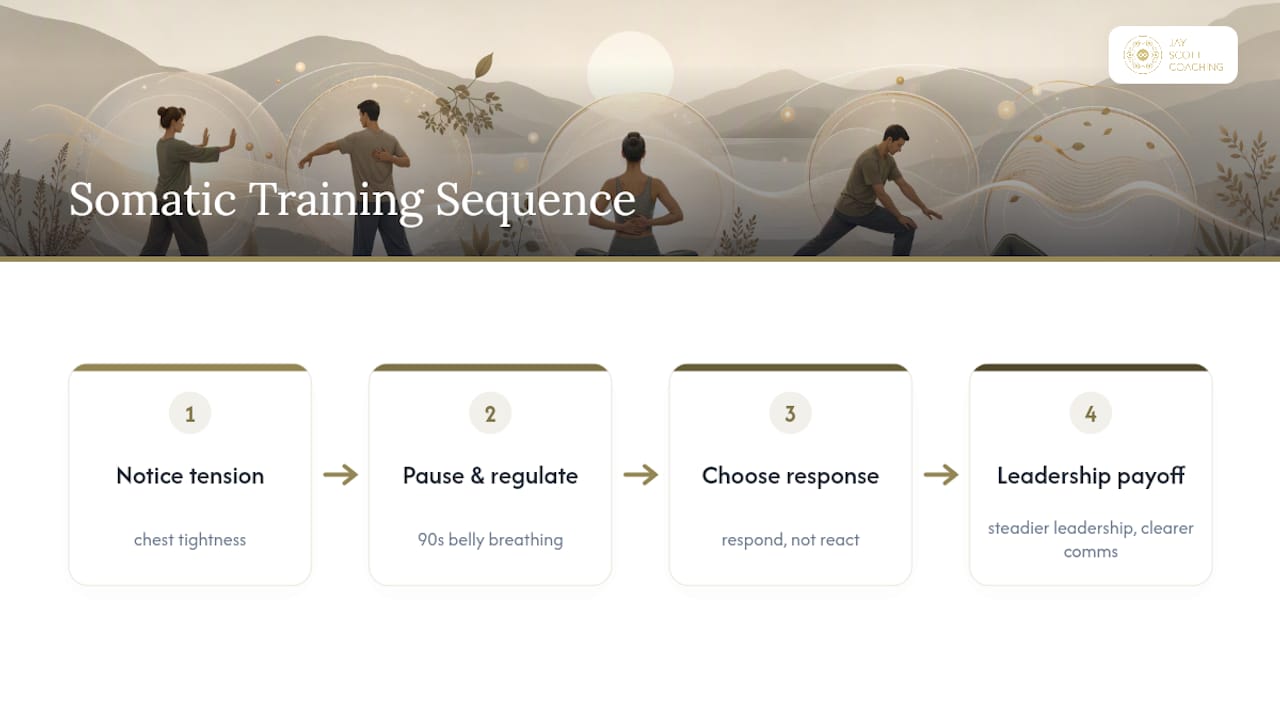
Brief somatic practices can be incorporated into coaching methods as training rather than therapy. A man who can notice tension building in his chest before a hard conversation has a decision point most men never get: pause, regulate, then respond instead of react.
That's the real payoff. Reduced reactivity under pressure translates directly into steadier leadership, clearer communication, and fewer moments of self-abandonment when stakes are high. A common piece of homework: 90 seconds of belly breathing before any conversation you're dreading. Small, repeatable, and it works because the nervous system trusts what it can predict.
— Jay
Want Structured Support Instead of Going It Alone?
Trauma release exercises give you a starting point, but building real nervous-system resilience under real-world pressure, a tense negotiation, a hard conversation with your spouse, a high-stakes decision at work, usually takes more than a solo practice. Some coaching services offer structured, one-on-one or group training to help clients develop skills to maintain a grounded state under pressure, rather than relying on chance.

The Unshakable Man Method™ builds directly on the regulation skills covered here, pattern mapping, guided practice, and direct feedback replace guesswork with a repeatable process. If overthinking, avoidance, or reactivity have been costing you at work or at home, explore how the coaching approach works and see if a consultation makes sense for where you are right now.
Sources
- Body scan meditation
- SAMHSA trauma-informed approaches
- Tension and Trauma Releasing Exercises (Wikipedia summary including research notes)
FAQ
What Are the 7 Trauma Release Exercises?
There's no single official list of seven, but commonly cited practices include TRE-style tremoring, body scan meditation, progressive muscle relaxation, diaphragmatic breathing, the butterfly hug, gentle stretching, and orienting exercises that build present-moment awareness.
What Is the Best Exercise to Release Trauma From the Body?
No single exercise works best for everyone, but TRE-style tremoring and body scan meditation are the two most studied starting points, and both are low-risk when practiced in short sessions.
How Can I Release Trapped Trauma From My Body?
Start with low-intensity practices like breathing exercises, the butterfly hug, or a short body scan, done consistently a few times a week, and work with a trauma-informed clinician if you have a complex trauma history or notice overwhelming reactions.
Are Trauma Release Exercises Real?
The underlying idea, that muscular tension reflects nervous-system stress, is grounded in real physiology, though large-scale clinical evidence for methods like TRE is still limited even as small studies show promising results.
Can These Exercises Replace Therapy for PTSD?
No. These practices work best as a complement to trauma-focused therapy, EMDR, or trauma-focused CBT, and SAMHSA's guidance recommends clinician collaboration for anyone with a complex trauma history.