

A vulnerability hangover is the wave of shame, replaying, and physical unease that shows up after you share something real. It usually peaks within hours and fades within a day or two, and it eases fastest when you calm your body first and reflect second. Brené Brown gave this feeling its name, and NYU researchers have shown why it lingers longer than you'd expect.
TL;DR:
- The duration and intensity of a vulnerability hangover depend on the stakes involved and your attachment style, with high-stakes disclosures lasting longer.
- Brain activity related to emotional processing persists for 20 to 30 minutes after the event, prolonging feelings of shame and arousal.
- Patterns of rumination and shame that last several days or interfere with daily life indicate a need for targeted support, such as therapy or coaching.
- Short-term recovery is most effective when focusing on body regulation through breathing, hydration, and gentle movement before engaging in reflection or reassurance.
- Regular practice of small disclosures with trusted people and grounding techniques builds longer-term resilience and reduces how big vulnerability feels to your nervous system.
Table of Contents
- What a Vulnerability Hangover Actually Feels Like
- The Neuroscience Behind the Emotional Hangover Effect
- How Attachment Style Shapes Your Reaction
- Signs and Symptoms of a Vulnerability Hangover
- A Short-Term Recovery Routine for the Hours After
- Building Real Tolerance for Vulnerability Over Time
- When a Vulnerability Hangover Signals You Need More Support
- A Coach-Informed Routine for Faster Recovery
- Why I Think Most Advice on This Gets the Order Backward
- How Jay Scott Coaching Helps You Build Lasting Resilience
- Sources
- FAQ
What a Vulnerability Hangover Actually Feels Like
You told your partner something you'd never said out loud. You spoke up in a meeting instead of staying quiet. You told a friend the truth about how you've been struggling. Then, hours later, your stomach drops. You start replaying every word, wondering if you said too much.
That reaction has a name now, and it's not the same thing as garden-variety embarrassment. Embarrassment tends to fade once the moment passes. A vulnerability hangover often gets worse before it gets better, because your mind keeps rehearsing the disclosure long after it's over.
Common triggers include:
- Oversharing personal history with someone new
- Admitting a fear, failure, or need for help
- Telling a partner something that could change how they see you
- Speaking up with an opinion that exposes you to disagreement or rejection
The delay itself is part of the pattern. In the moment, adrenaline can mask the discomfort. It's often an hour later, or the next morning, when the shame spike hits. How long it lasts depends on the stakes involved. Confessing something to a stranger you'll never see again tends to resolve quickly. Telling your spouse something vulnerable, or admitting a weakness to your boss, can linger for a day or more, especially if you have a personal history of being punished for openness.
The Neuroscience Behind the Emotional Hangover Effect
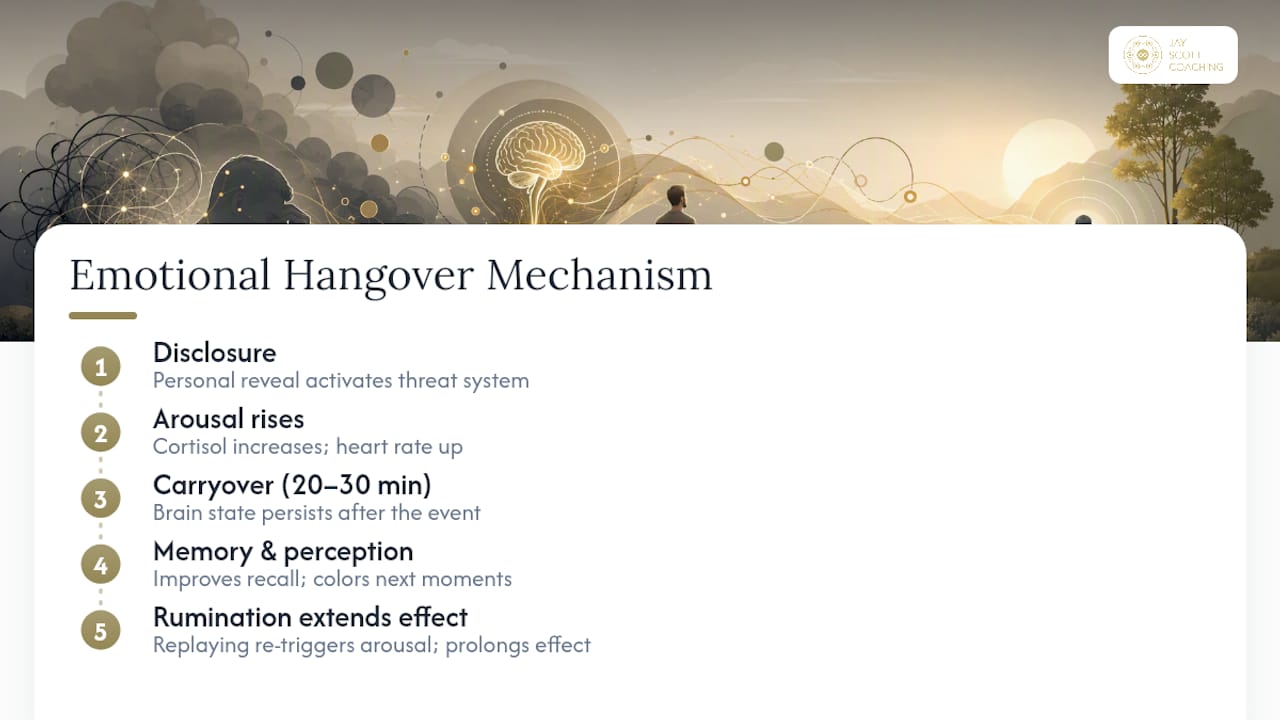
Your brain doesn't clock out the moment a hard conversation ends. Researchers at NYU found that emotional experiences can produce brain states that persist for roughly 20 to 30 minutes after the event, coloring how you process and remember whatever comes next. That's the literal emotional hangover effect: your nervous system stays activated well past the trigger, and it tints unrelated moments that follow.
The brain's emotional afterglow doesn't shut off when the conversation does. It bleeds into the next 20 to 30 minutes of experience, shaping memory and perception even for events that have nothing to do with what just happened.
Here's the mechanism in plain terms. Disclosing something personal activates your threat detection system, the same wiring that reacts to physical danger. Your body treats social risk, being seen, judged, or rejected, almost like a physical threat. Cortisol rises. Your heart rate ticks up. That arousal doesn't shut off on command.
Statistic Callout: Emotional carryover in the NYU study lasted long enough to measurably improve recall of neutral images encountered afterward, evidence that emotional states don't stay contained to the moment that caused them.
Rumination is what stretches that half hour into a full day. Every time you replay the conversation, you re-trigger the same arousal response, which resets the clock on your nervous system settling down. Your mind keeps scanning for danger it already survived, magnifying the perceived risk each time it loops. That's why the third replay at 11 p.m. can feel worse than the moment it actually happened.
How Attachment Style Shapes Your Reaction
Not everyone gets hit the same way, and that's not a character flaw. Your attachment style, the pattern you formed early on for how safe closeness feels, has a lot to say about how intense your hangover gets and how long it sticks around.
- Anxious attachment often produces intense, fast rumination and a strong urge to check in or seek reassurance immediately after disclosing.
- Avoidant attachment tends to show up as withdrawal, a pull to shut down, minimize what happened, or avoid the person entirely for a while.
- Secure attachment usually processes the discomfort faster, with less catastrophizing and a quicker return to baseline.
Shame history matters just as much as attachment style. If openness got you criticized or dismissed growing up, or in a past relationship, your nervous system learned that vulnerability equals danger. That association doesn't disappear because you're an adult now who knows better.
If you lean anxious, resist the urge to seek instant reassurance. Give the moment room to settle before reaching out again. If you lean avoidant, resist the pull to disappear or intellectualize the moment away. Naming the discomfort out loud, even to yourself, matters more than usual. If you're generally secure but still hit hard, the stakes of that particular disclosure were probably higher than normal, and that's worth acknowledging rather than dismissing.
Signs and Symptoms of a Vulnerability Hangover
Recognizing the pattern quickly is what lets you respond to it instead of getting swept up in it. Here's what tends to show up, and roughly in what order:
- Shame and the urge to hide. A sinking sense that you exposed too much, paired with a real pull to cancel plans or avoid the person you opened up to.
- Rumination and replay. Your mind keeps rerunning the conversation, often rewriting your own lines to sound smarter or safer than they were.
- Catastrophic prediction. You jump to worst-case outcomes, assuming rejection or judgment that hasn't actually happened.
- Physical fatigue. A drained, almost hungover feeling, even without alcohol involved, from the sustained cortisol exposure.
- Stomach tension or nausea. Your gut often reacts before your conscious mind catches up to what's bothering you.
- Irritability or restlessness. Some people feel keyed up rather than tired, unable to sit still or focus on anything else.
One pattern worth flagging: if this cycle repeats after nearly every disclosure, small or large, that's a signal worth paying attention to rather than something to just push through.
A Short-Term Recovery Routine for the Hours After
The fastest way through a vulnerability hangover starts in your body, not your head. Trying to think your way out of a nervous system that's still on alert usually backfires, because your prefrontal cortex isn't fully online while cortisol is elevated.
- Regulate your body first. Try slow exhale breathing, four counts in, six counts out, for two to three minutes. Drink water. Take a short walk or do a few minutes of light movement. Clinicians consistently point to grounding, hydration, and gentle movement as the fastest way to metabolize leftover arousal.
- Timebox your reflection. Set a timer for ten minutes and journal with containment in mind, not open-ended spiraling. Try these prompts: What actually happened, in plain facts? What am I afraid it means? What's one thing that's still true about me regardless of how it landed? When the timer ends, close the notebook. This isn't avoidance; it's giving your brain a clear stop signal so it can file the memory instead of looping it.
- Use self-compassion phrases deliberately. Try something like, "I told the truth, and that took something. I don't have to know how it lands yet." Say it out loud if you can. Silent self-criticism tends to keep cortisol elevated longer than a spoken, kinder reframe.
- Decide on contact carefully. One honest check-in with the person, if the relationship calls for it, can help. Repeated apologizing or over-explaining usually does the opposite, since it re-triggers the shame loop for both of you and can read as a bid for reassurance rather than clarity.
Pro Tip: If you catch yourself drafting a fourth follow-up text to "clarify" what you meant, that's usually rumination wearing a productive disguise. One clear message is clarification. A fourth one is often anxiety looking for relief.
Building Real Tolerance for Vulnerability Over Time
Short-term tactics calm the moment. Long-term resilience changes how often you land at that moment at all. The goal isn't to stop feeling exposed when you open up. It's to shrink how big that exposure feels to your nervous system.
Gradual exposure works here the same way it works for any fear response. Practice small, low-stakes disclosures with people who've already shown you they're safe, a friend, a support group, a trusted colleague, before you attempt the highest-stakes version. Each successful rep teaches your body that honesty doesn't always end in disaster. Group support settings can accelerate this because you get to witness other people survive their own disclosures, not just attempt your own.
Pair that practice with a simple pre-disclosure filter:
- Does this person have a track record of handling honesty well?
- What's the actual cost if this lands badly, and is it something you can tolerate?
- Are you sharing to connect, or to be rescued from a feeling you haven't sat with yet?
Clear boundaries make all of this easier, because you're not relying on willpower alone to decide what you share and with whom.
Your nervous system also needs baseline maintenance outside of any specific disclosure. Consistent sleep, regular movement, and a daily breath practice, even five minutes, lower your baseline stress load so any single hard conversation has less fuel to work with.
Therapy and coaching serve different, complementary jobs here. Therapy tends to focus on processing trauma, attachment wounds, or clinical anxiety that predates any single conversation. Coaching, particularly work built around confidence and communication, focuses more on training how you show up and regulate under pressure in real time, career, relationships, leadership moments. Neither replaces the other; many people benefit from both at different points.
When a Vulnerability Hangover Signals You Need More Support
Most vulnerability hangovers resolve on their own within a day or two. Some don't, and that's worth taking seriously rather than pushing through.
Watch for:
- Withdrawal or shame that lasts more than a few days without easing
- Avoidance that's starting to interfere with work, relationships, or daily functioning
- The same intense hangover recurring after nearly every disclosure, not just the high-stakes ones
Clinical literature notes that persistent rumination paired with ongoing physiological arousal can produce distress that benefits from structured intervention rather than self-management alone.
If you're choosing between therapy and coaching, ask direct questions: What's your experience with attachment patterns or shame cycles? Do you use somatic or nervous-system-based methods, not just talk-based reflection? How do you define progress, and how will we know it's working?
A Coach-Informed Routine for Faster Recovery
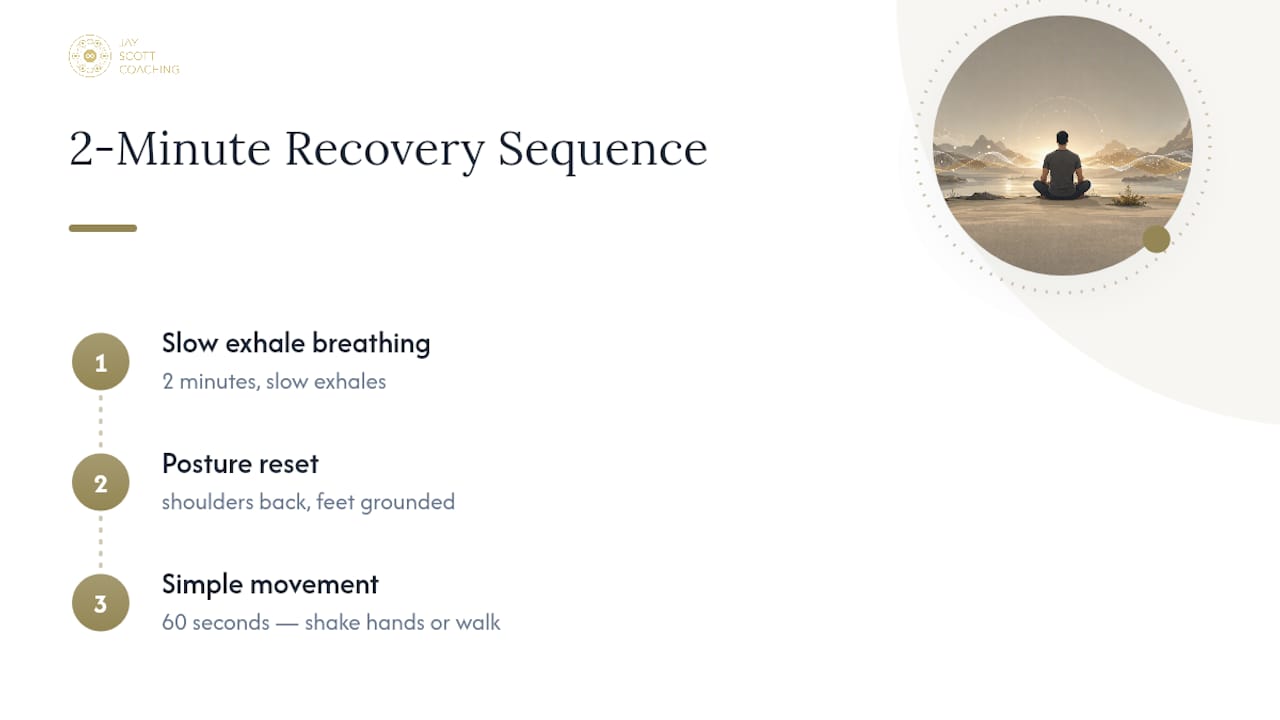
Coaching work built around nervous-system regulation tends to use a short, repeatable sequence rather than a long ritual, because people need something they'll actually do at 11 p.m. after a hard conversation. A version worth trying: two minutes of slow exhale breathing, followed by resetting your posture, shoulders back, feet grounded, followed by sixty seconds of simple movement like shaking out your hands or walking to another room.
Pattern mapping, tracking which situations, people, or topics reliably trigger your hangovers, helps you predict and prepare instead of getting blindsided every time. Group practice speeds this up further, since rehearsing disclosure in a supported setting trains your nervous system that openness can end safely, not just in theory but through repeated real experience.
Why I Think Most Advice on This Gets the Order Backward
Most articles on this topic tell you to "process your feelings" before doing anything else. I think that's backward, and it's the reason so many people stay stuck in the loop longer than they need to.
Your body reacts first. Your thoughts follow the body's lead, not the other way around. Trying to journal or self-reflect your way out of a hangover while your cortisol is still elevated is like trying to have a calm conversation while someone's shouting in the next room. The volume has to come down before the words matter.
That's also why willpower fails here. This isn't a discipline problem. It's a regulation skill, and skills get built through repetition, not insight alone. The men I think about most in this work aren't the ones who lack self-awareness. They're the ones who've never been taught how to bring their body back online before their mind starts making decisions.
Start with the body. Every time. The reflection works better once it does.
— Jay
How Jay Scott Coaching Helps You Build Lasting Resilience
Self-help articles can walk you through the first hour of a vulnerability hangover. What they can't do is train your nervous system to react differently the next ten times you're in that position, and that's the gap Jay Scott Coaching was built to close.

The coaching method focuses on training your nervous system to stay grounded under pressure instead of defaulting to overthinking, avoidance, or shutdown after hard moments. Through coaching, pattern mapping, and direct practice, the work targets issues behind vulnerability hangovers related to nervous system responses to openness. Coaching can't promise a specific outcome or timeline, and it isn't a replacement for clinical therapy when trauma or diagnosable anxiety is in play. What it offers is structured, repeatable practice for men who want steadier ground under high-stakes conversations. If you're ready to stop white-knuckling through disclosure and start training the response itself, visit Jay Scott Coaching to learn more and book a consultation.
Sources
For deeper background, NYU's emotional hangover research covers the neuroscience directly, while The New York Times traces Brené Brown's original framing of the term.
- Is There Such a Thing as an Emotional Hangover? NYU Researchers Find that There is
- How to Recover From an 'Emotional Hangover,' According to a Therapist
- PMC article relevant to emotional arousal and lingering distress
FAQ
How long does a vulnerability hangover last?
Most resolve within a short period, though high-stakes disclosures or a personal history of shame can extend that timeline.
What does a vulnerability hangover feel like?
It typically feels like a mix of shame, an urge to hide, replaying the conversation on a loop, fatigue, and stomach tension, akin to a physical hangover but triggered by emotional exposure rather than alcohol.
What are the symptoms of feeling vulnerable after opening up?
Common symptoms include rumination, catastrophic predictions about the disclosure's impact, irritability, and a drained physical feeling driven by lingering stress responses.
How do you recover from a vulnerability hangover?
Start with your body—breathing exercises, hydration, and light movement—then use timeboxed journaling and self-compassion phrases instead of repeated apologies, which can prolong the shame cycle.
Is a vulnerability hangover a sign something is wrong with you?
No. It's a normal nervous-system response to social risk, though a pattern that recurs after nearly every disclosure is worth addressing with a therapist or coach.