
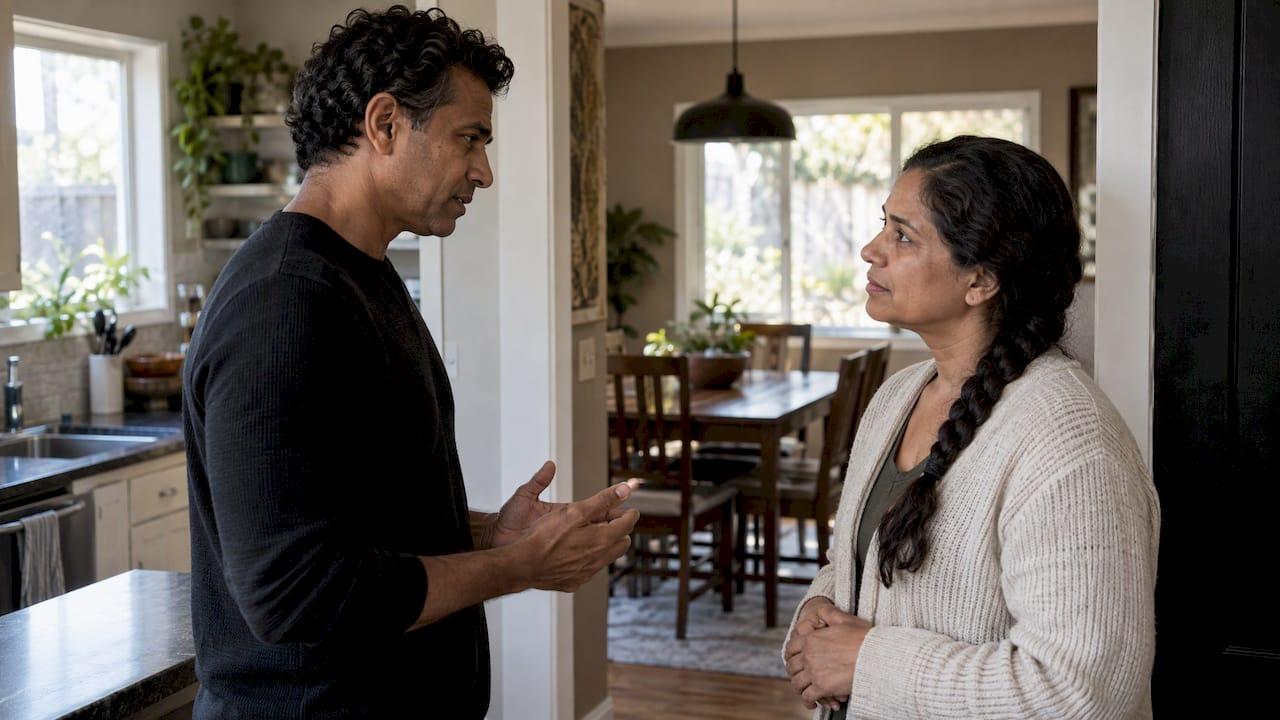
A good apology to your wife does four things: it names what you did, shows you understand how it landed on her, offers a way to make it right, and commits to changing. The words matter less than whether you can stay steady enough to say them without defending yourself. That steadiness is a skill, and it can be trained. We work on exactly that with men who want to stop freezing, over-explaining or running when someone they love is hurt.
TL;DR
- Name the specific behavior and its impact on her. Skip "I'm sorry for everything."
- Leave out "but," "if," and "I'm sorry you feel that way." Each turns the apology back toward you.
- Validate her feelings before you share your side, and share it only if she has felt heard.
- Offer a concrete repair and a change she can watch for over time.
- Don't demand forgiveness. Her timeline is hers.
Table of Contents
- Why a good apology is hard for capable men
- The four parts of an apology that works
- Words that quietly cancel your apology
- How to apologize, step by step
- A short template you can make your own
- What happens after the apology
- Perspective
- Work on the pattern, not just the sentence
- FAQ
- Sources
Why a good apology is hard for capable men
Most men who search for this are not careless. You are often good at solving problems at work, and then you come home and say something that makes things worse. Under pressure the body goes into protection mode. You explain, minimize, go quiet, or reach for "I didn't mean it."
Psychology Today's Tasha Seiter describes defensive statements as self-protection in disguise: they soothe your ego and do little to comfort your wounded partner. GoodTherapy contributor Carolynn Aristone makes a similar point: it is easier to hide behind your intention than to face the consequences of what you did.
That is why we treat a sincere apology as a regulation problem as much as a vocabulary problem. If your nervous system is flooded, even perfect words come out stiff or sharp. Calm first, then speak.

The four parts of an apology that works
Counseling Today reported in March 2026 that most apologies that help repair a relationship share four elements:
- Name the behavior and its impact. "I see that I hurt you."
- Validate her feelings. "I understand how my actions hurt you."
- Offer a repair. "This is how I'm going to make things right."
- Commit to change. "From now on, you can count on me to be honest about where I've been."
Here is how that sounds in a real situation. Say you promised to be home for dinner, missed it again, and didn't call.
"I missed dinner tonight and didn't call. I know that's the third time this month, and I can see it makes you feel like you come last. That's not okay, and I'm sorry. Tomorrow I'm blocking my calendar at 5:30, and I'll text you by 4 if anything changes."
It is specific, it has no "but," and it ends with something she can check.
Words that quietly cancel your apology
Some phrases undo the apology in the same breath.
- "I'm sorry you feel that way." Counseling Today lists it among the blame-shifting phrases effective apologies avoid, along with justifying lines like "This is why I did it."
- "I'm sorry, but you weren't listening." Dr. David Wexler writes in Psychology Today that keeping "but" out matters, because it signals a rationalization and shifts focus to her behavior.
- "I'm sorry for everything." Vague apologies can feel insincere and dismissive. Name the thing.
- "Can we just move on?" and "If you loved me, you'd forgive me." Both pressure her to close the subject for your comfort.
- A gift in place of repair. Flowers can accompany an apology. They cannot replace the change.
If you have a point to make about what happened, hold it. Seiter advises sharing your side only after your partner feels heard, understood and reassured. That may be a different conversation, on a different day.
How to apologize, step by step
1. Settle your body first
If you are angry, ashamed or racing, wait. One guide suggests allowing at least 20 minutes to physiologically settle before returning to the conversation. Slow exhales, a walk, cold water. The goal is not to avoid her. It is to come back able to listen without bracing.
This is the step most men skip, and it is where it goes wrong: you apologize while still activated, and the apology sounds like a negotiation. Our marriage communication exercises walk through ways to calm your system before a hard talk.

2. Choose the setting
Whenever possible, apologize face to face. Marriage.com notes that being present adds weight and shows emotional investment. If she needs space, a short text can open the door without forcing the conversation. Examples from one guide include "I'm sorry for how I spoke to you. You didn't deserve that" and "I'm here when you're ready. No pressure."
Use the text to say you are sorry and available. Save the full apology for when you can look at her.
3. Name exactly what you did
Describe the behavior, not your intention. "I raised my voice and called your concern ridiculous" works. "I'm sorry if I came across badly" does not. Specific naming tells her you actually saw it.
4. Show you understand the impact
This is the validation step, and it is the one most men rush. Validating means telling her that her reaction makes sense given what happened, whether or not you would have reacted the same way. Try:
- "I can see why you feel upset."
- "I can see how that made you feel disrespected. Those words probably really stung."
- "Tell me more about how that felt for you."
The last two come from Seiter's guidance on showing curiosity about her experience. Then listen. Don't correct details. Don't fix. If she says more than you expected, that is a sign she trusts you with it. Reading about mindful listening can help you practice staying present while she talks.
If she isn't ready to share, you can ask: "What else do you want me to know about how this affected you, and what can I do better next time?"
5. Own it without collapsing into shame
There is a difference between guilt and shame. Erika Labuzan-Lopez, a couples counselor in Texas, told Counseling Today that guilt helps people own their behavior, while shame says "I am the problem" and paralyzes repair. She encourages clients to say, "I'm a good partner who handled this thing poorly."
If you spiral into self-punishment, she ends up comforting you. Own it, stay steady, keep the focus on her.
6. Offer a repair and a change
Tell her what you will do differently, in terms she can see. "I'll work on being better" is too soft. "When I notice I'm getting defensive, I'll tell you I need ten minutes, and I'll come back" is concrete.
7. Let go of the outcome
One licensed therapist advises including no expectation of immediate forgiveness. Asking "Will you forgive me?" can be fine as a respectful request. Demanding an answer is not. If she needs time, say, "Take the time you need. I'm here."
A short template you can make your own
Don't copy it word for word. Fill it with your own details.
"I need to apologize for [specific thing]. I can see it made you feel [her feeling], and that makes sense. I'm sorry I hurt you. Here is what I'm going to do: [specific change]. I'd like to hear anything else you want me to know."
Peter Pearson of the Couples Institute describes a written apology formula with five parts: the offense, its effect on your partner, why you did it, why you want to change, and a self-imposed penalty if you don't. A letter can help when you tend to get tongue-tied. Read it to her or hand it over, then listen.
What happens after the apology
The apology starts repair. It doesn't finish it.
Research backs the value of saying it. A 2019 study found that people who received an apology after a trust violation were more likely to trust the other person than those who did not. A 2010 study of couples found that making amends promoted forgiveness, and both amends and forgiveness helped resolve betrayal.
But Wexler cites author Steven Stosny: a partner needs reasons to feel safe in the future, and she cannot feel secure until she sees over time that you have changed. A 2025 analysis of therapists' views likewise found that apologies repeated without meaningful action lose their significance.
So the follow-through is the second half of the apology:
- Do the specific thing you said you would do, every time, including when she isn't watching.
- Check in without fishing for reassurance.
- Stay consistent for weeks, not days.
If trust has been badly damaged, our guide to rebuilding trust in marriage goes deeper, and so does our piece on repairing relationships after conflict.
If she is not ready to accept your apology, that is not a failure. Utah State University Extension notes that acceptance doesn't mean the pain instantly disappears; it means willingness to move forward. Give her room.
Perspective
Almost every man who comes to us says some version of the same thing: "I know what I should say. I just can't say it when it counts."
That is not a character flaw. It is what happens when your nervous system treats her hurt as a threat. You get defensive, or you go blank, or you say yes to end the tension and abandon what you actually feel. We call that self-abandonment, and it is the quiet root of many failed apologies.
Our Unshakable Man Method™ is designed to train your nervous system to stay grounded under pressure. When you have inner safety, you can hear "that hurt me" without needing to win, hide or fix it on the spot. Then the four parts of an apology come naturally, because you are no longer fighting yourself while you say them.
Insight alone rarely gets you there. It takes practice, accountability and tools you can use in the moment, which is what we build with you in sessions.
Jay
Work on the pattern, not just the sentence
If you keep finding yourself back in the same argument, or you know your apologies fall apart in the moment, we can help. Jay Scott Coaching offers private coaching, groups, and workshops and immersions for men who want to respond to conflict with steadiness and clear leadership. Our work includes pattern mapping and tools you take into real conversations. You can see how to work with us.

If people-pleasing and avoiding conflict are part of your story, our Nice Guy Recovery offers include a coach and a men's group.
FAQ
What is the best way to say sorry to your wife?
Be specific, take responsibility and offer a repair. Something like: "I raised my voice and dismissed you. I can see how that hurt, and I'm sorry. Next time I'll take a break instead of snapping." Leave out "but" and anything that blames her.
Should I apologize in person or by text?
In person is usually stronger, because being present shows investment. A brief text is fine to open the door when she needs space, such as saying you are sorry and are here when she is ready. Have the full conversation face to face when you can.
How do I validate my wife's feelings?
Reflect back what she tells you and say it makes sense, without arguing or correcting. Phrases like "I can see why you feel upset" or "Tell me more about how that felt" help. Validation does not mean you agree with every detail. It means you take her experience seriously.
What if she doesn't forgive me right away?
Give her time and don't push. Keep doing what you said you would do. Forgiveness tends to follow changed behavior over weeks, not a single conversation.
Sources
- How to Apologize, According to a Couples Therapist, Psychology Today
- Relationship Repair, Counseling Today (March 2026)
- Apologizing with Intention, GoodTherapy
- Why You Should Keep "But" Out of Your Apology, Psychology Today
- How to Apologize to Your Wife: 10 Practical Ways, Marriage.com
- How to Apologize to Your Wife After a Big Fight, purshoLOGY
- How to Win Your Wife Back After Hurting Her, South Denver Therapy
- How to Write an Apology, Couples Institute
- Apologies Repair Trust via Perceived Trustworthiness
- In the Wake of Betrayal: Amends, Forgiveness, and the Resolution of Betrayal
- Apologies in Couple Relationships: A Thematic Analysis
- How to Apologize to Your Partner, Utah State University Extension
- Tips for Mindful Listening: 9 Ways to Truly Connect