
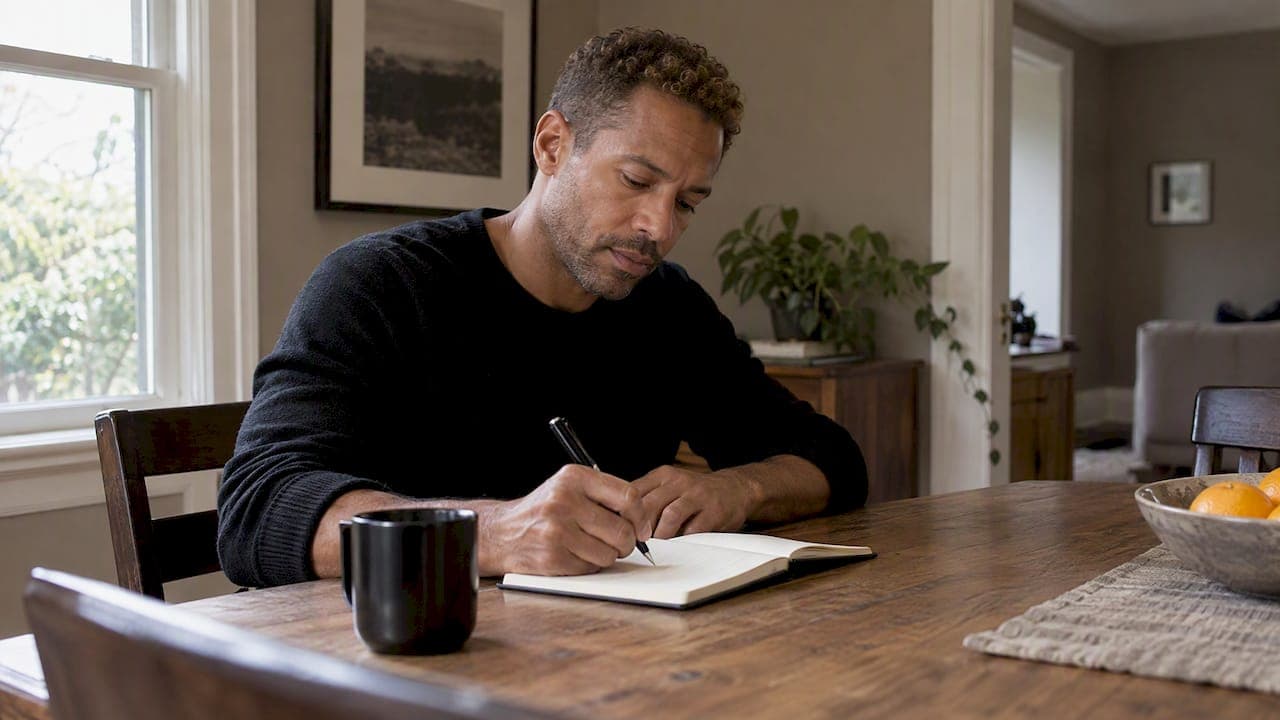
You build self-trust the same way you build trust with anyone else: by making promises you can keep, keeping them, and telling yourself the truth when you don't. It happens in small, repeatable moments, not in one big breakthrough. If you are a driven man who gives sharp advice to everyone else and then second-guesses yourself at home or in the boardroom, this guide gives you the exercises, the reasoning behind them, and a clear sense of when working with a coach speeds things up.
TL;DR
- Self-trust means being reliable, consistent and honest with yourself. It does not mean being perfect.
- Start with one tiny promise you can keep on an average day, track it, and adjust it without self-attack when you miss.
- Use a short self-honesty inventory to name what you are avoiding, what is actually true, and what you want to do about it.
- Under pressure, regulate first and decide second. Your body is part of the decision.
- Self-guided exercises help modestly. Guidance and accountability make them stick.
Table of Contents
- What self-trust actually is
- Why trusting yourself is hard
- Exercise 1: The one-tiny-promise method
- Exercise 2: The self-honesty inventory
- Exercise 3: Act on values while the doubt is still loud
- Exercise 4: Cut back on reassurance-seeking
- Self-trust under pressure
- A 30-day rhythm you can follow
- Our perspective
- Working on self-trust with support
- FAQ
- Sources
What self-trust actually is
Self-trust is trust in your own knowledge, beliefs, commitments and emotions. One philosopher writing in Psychology Today describes trustworthiness as being reliable, consistent and truthful, not flawless. That is good news. You do not have to become a different man. You have to become a man whose word to himself means something.
Most men we work with don't describe it that way, though. They say things like:
- "I know what I should do, and I don't do it."
- "I say yes, then resent it."
- "I ask three people what they think before I decide anything."
- "I go quiet in the moment and replay it all night."
That last list is a pattern, and it has a name in our work: self-abandonment. You leave your own side to keep the peace, avoid conflict or stay in control. Each time, a little more trust drains out.
How it shows up in daily life
Verywell Mind lists the common signs of self-doubt: repeatedly seeking reassurance, delaying decisions, overvaluing other people's opinions, ruminating, comparing yourself to others, and feeling guilty after you choose. If you recognize two or three of those, you are not broken. You are running a pattern, and patterns can be changed.
Why trusting yourself is hard
There are a few honest reasons, and none of them are character flaws.
The future is unknowable. A George Mason University professor told SELF that decisions are hard partly because nobody can see how they will turn out, and that cultural messages can teach people to discount their own feelings, bodies and perspectives. Many men were taught exactly that: ignore what you feel, push through, be useful.
Earlier experiences leave a mark. Cleveland Clinic notes that distrust can develop after someone has been harmed, manipulated, lied to or had boundaries violated, and that unmet needs early in life can make later vulnerability harder. It also points out that this distrust can be protective when it comes from real experience, but that the same protection can spread into relationships where the original danger is absent. Sometimes the guard that kept you safe at 15 is the thing that keeps you from deciding anything at 45.
Broken promises pile up. Every time you say you'll leave work at six, start the hard conversation or stop checking your phone at dinner, and then don't, you teach yourself that your word is cheap. Your mind keeps score, even when you pretend it doesn't.

Exercise 1: The one-tiny-promise method
This is the foundation. Everything else sits on it.
Psychology Today author Mark Travers, Ph.D., recommends tiny, concrete, repeatable promises, such as brief journaling, a walk, or declining an obligation you don't need. In Forbes he adds that a good promise is small enough for an average day, specific enough to measure, and independent of anyone else's approval. Healthline gives similar examples, such as cooking one nourishing meal or finishing a chore you've been putting off, and says repeated follow-through reinforces self-trust.
How to run it for two weeks
- Pick one promise. Make it so small it feels almost silly: ten minutes of a walk before checking email, or one honest "no" a day to something minor.
- Write it down with a time. "After I pour my coffee, I walk for ten minutes" beats "I'll exercise more."
- Track it. A checkmark on a calendar is enough. You are collecting evidence.
- Do it even on a bad day. Shrink it if you must, but keep the promise.
- When you miss, recalibrate. Travers suggests adjusting the promise accurately rather than punishing yourself. Ask: was it too big, too vague, or at the wrong time of day?
That last step matters more than most men expect. Beating yourself up after a miss feels like accountability, but it usually just makes the next promise harder to face. Research on daily behavior points the same way. A peer-reviewed diary study of 104 participants found that how people evaluated themselves after an exercise session related to their later intentions, including after failures. A constructive review leaves the door open for the next try.
Why plans alone are not enough
A word of caution about "just make a plan." In a peer-reviewed study of long-term, self-chosen goals, implementation plans worked better when paired with autonomy support or a self-efficacy exercise, and did not beat a neutral condition on their own. In plain terms: the promise has to be yours, and it has to build your belief that you can do it. A rigid rule you resent is not a trust-builder.
Exercise 2: The self-honesty inventory
Self-trust erodes when you hide from your own truth. This exercise brings it into the light.
Psychologist Gorlin describes a self-honesty inventory: list the truths you fear or avoid, then ask what is actually true, how you know it, and what, if anything, you want to do about it. He suggests reviewing and updating it for a few minutes a day.
Here is a version you can use tonight.
| Step | Question to write down | Example |
|---|---|---|
| 1. Name it | What am I avoiding or afraid to admit? | "I'm not happy in this role." |
| 2. Test it | What is actually true here? | "I dread Mondays, and I've dreaded them for a year." |
| 3. Source it | How do I know? | "I feel it in my stomach every Sunday evening." |
| 4. Choose | What, if anything, do I want to do? | "Talk to my director about scope. Not quit yet." |
Notice step four includes "if anything." Honesty is not an order to blow up your life. It is permission to see clearly first. Often the relief comes from simply stopping the effort of not knowing.
Exercise 3: Act on values while the doubt is still loud
Many men wait to feel confident before they act. It rarely works, because confidence tends to follow action, not lead it.
The U.S. Department of Veterans Affairs' guide to Acceptance and Commitment Therapy defines psychological flexibility as openly meeting your thoughts, emotions, sensations and urges while continuing or changing your behavior according to your values. The same guide recommends values clarification, mindfulness, acceptance and graduated exposure to situations that are objectively safe but avoided. The goal is values-based action, not necessarily making the discomfort vanish.

Berkeley's student wellbeing team gives similar advice for self-doubt: treat mistakes and uncertainty as normal, keep positive feedback as evidence, and act on sound values even when confidence hasn't caught up.
A 10-minute values-first drill
- Write one value you want to lead with this week (honesty, presence, courage).
- Name one small action that expresses it, such as telling your wife what you actually think about the weekend plan.
- Notice the thoughts that show up ("she'll be upset"). Say them to yourself as thoughts: "I'm having the thought that she'll be upset."
- Take the action anyway.
- Write down what actually happened. Keep it as evidence.
That last step builds your record. Your inner critic keeps a very detailed file on your failures. This is how you start your own file.
Don't fight the inner critic. Don't obey it either.
Research in the Journal of Personality and Social Psychology found that habitually accepting thoughts and emotions was linked with better psychological health and lower negative emotion during later daily stressors. Acceptance seems to help because it stops difficult feelings from escalating, not because it erases them. So you don't need to win an argument with the critic. You need to let it speak, check whether any of it is useful feedback, and keep moving.
Exercise 4: Cut back on reassurance-seeking
If you ask your partner, your friend and your colleague the same question before every decision, you are outsourcing your trust. It feels responsible. It quietly teaches you that you can't decide alone.
Try this for a week:
- Before asking anyone for an opinion, write down your own answer first.
- Ask only when you need information, not permission.
- After you decide, notice the urge to check again, and wait twenty minutes before acting on it.
- Say one boundary out loud per day, even a small one, such as "I can't take that on this week."
Boundaries are self-trust in action. Each one tells you that your limits count and that you will defend them. If trust has been damaged in a relationship, our guide on keeping boundaries while you forgive after betrayal walks through how to stay safe and honest at the same time.
Self-trust under pressure
This is where most advice runs out, and where high performers get stuck. You can do the journaling and still freeze when a big call lands on your desk, or go silent when your spouse raises something tender.
A Psychology Today piece on high achievers describes this kind of freeze as a nervous system under pressure rather than a weakness, and notes that decision-making is embodied: your body registers things before your mind explains them. That fits what we see. Overthinking is often your system trying to feel safe, not your intellect failing.
A simple sequence for the hot moment
- Notice the body first. Tight chest, shallow breath, clenched jaw. Name it: "I'm activated."
- Slow your exhale. Let it run longer than your inhale for a few breaths. Give your body a minute before you ask your mind for an answer.
- Ask a different question. Instead of "What if this goes wrong?" ask "Can I trust myself to handle what happens?"
- Take the smallest honest step. One sentence, one email, one "let me think and get back to you by tomorrow."
- Debrief later. What did you do well? What would you change? Keep the feedback accurate, not harsh.
If you want a fuller process for choosing when your mind is busy, our guide to mindful decision-making for men goes deeper. And if you want formal frameworks for structuring complex business decisions, a decision-making frameworks course can give you tools to pair with the inner work. Frameworks help you think. Self-trust helps you commit to what you concluded.
In close relationships
Self-trust in a marriage sounds like saying what you mean before resentment builds. It means telling your wife "I need a few minutes, and I will come back to this tonight" instead of withdrawing or agreeing just to end the tension. Then you come back. That return is the promise that rebuilds trust, with her and with yourself. If your relationship is where the strain shows most, read how to rebuild trust in marriage.
A 30-day rhythm you can follow
| Week | Focus | Daily practice (5 to 10 minutes) |
|---|---|---|
| 1 | Tiny promise | One concrete promise, tracked on a calendar |
| 2 | Honesty | Self-honesty inventory, four questions |
| 3 | Values in action | One values-based action despite doubt, then write what happened |
| 4 | Boundaries and decisions | One boundary, one decision made without polling anyone |
If you would like a more detailed version, our 30-day reset to end self-abandonment and rebuild self-trust lays out the same arc for men.
Our perspective
Here is what we see again and again. The men who come to us are rarely lacking intelligence or drive. They are exhausted from overriding themselves. They say yes when they mean no, go quiet when they have something to say, and then wonder why they feel invisible in their own lives.
We built the Unshakable Man Method™ around one idea: self-trust is not a mindset you think your way into. It is a capacity your nervous system has to be trained to hold. Insight matters, and we use it. But insight alone does not help when your chest is tight and the room is waiting for your answer. So we work on emotional regulation and inner safety first, then on decisive action and honest expression.
In practice that means mapping your patterns so you can see exactly when you abandon yourself, giving you tools you can use in the moment, and holding you accountable while your internal muscles get stronger. You can do much of this alone. Many men find it moves faster when someone who has walked it is in the room with them.
Jay
Working on self-trust with support
Self-guided exercises are a real starting point, and the evidence is honest about their size. A meta-analysis of 13 randomized studies with 2,580 participants found small effects of ACT self-help on depression, anxiety and psychological flexibility, with outcomes improving when a clinician guided the process. That matches what we see in coaching: structure, feedback and someone who notices your patterns help the practice stick.
If you are ready to stop second-guessing and start acting like the man you already know you are, we offer private coaching, groups, and workshops and immersions, all built on the Unshakable Man Method™.
You can see the options and apply on our coaching and workshops page, or start at Jay Scott Coaching. If you are still deciding whether coaching is the right fit, our guide to choosing a confidence coach can help, and transforming self-doubt into inner strength shows what that work looks like.
FAQ
How long does it take to build self-trust?
There is no fixed timeline, because trust grows with the number of promises you keep, not with the calendar. Many men notice a shift in how they feel about themselves within a few weeks of keeping one small commitment daily. Deeper patterns, such as years of people-pleasing, usually take longer and benefit from support.
What if I keep breaking promises to myself?
Shrink the promise until you can keep it on your worst day, and look at why it was breaking: too big, too vague or not really yours. Recalibrate without self-criticism, then try again. If you keep breaking promises that matter, a coach or therapist can help you see the pattern underneath.
Is self-trust the same as self-confidence?
They overlap, but they are not identical. Confidence is a feeling that you can do something. Self-trust is knowing you will show up, be honest and handle the outcome, even when the feeling of confidence is missing. Self-trust often comes first, and confidence follows.
When should I see a professional?
If distrust of yourself comes with persistent anxiety, depression, trauma or harm from past relationships, speak with a licensed therapist or physician. Coaching supports growth and performance, and it is not a substitute for mental health treatment.
Sources
- Why Is It So Hard to Trust Yourself? | Psychology Today
- "I Don't Trust Myself": Why You Feel This Way and What to Do | Verywell Mind
- Trusting Yourself Is Hard | SELF
- Why You Have Trust Issues and How To Heal | Cleveland Clinic
- 5 Steps to Build Self-Respect | Psychology Today
- 2 Habits To Start Trusting Yourself More | Forbes
- 8 Healthy Habits to Improve Your Self-Esteem | Healthline
- The Dynamics of Success and Failure: How Post-Behaviour Evaluations Relate to Subsequent Intentions | PMC
- Implementation plans and long-term goals | Personality and Social Psychology Bulletin, 2006
- 5 Steps to Earning Your Own Trust | Psychology Today
- Acceptance and Commitment Therapy Strategies Guide | U.S. Department of Veterans Affairs
- Impostor syndrome 101 | UC Berkeley Student Wellbeing
- Acceptance and emotion study | Journal of Personality and Social Psychology, 2017
- Why You Don't Trust Yourself When It Matters Most | Psychology Today
- What is the evidence for the efficacy of self-help ACT? | Association for Contextual Behavioral Science