
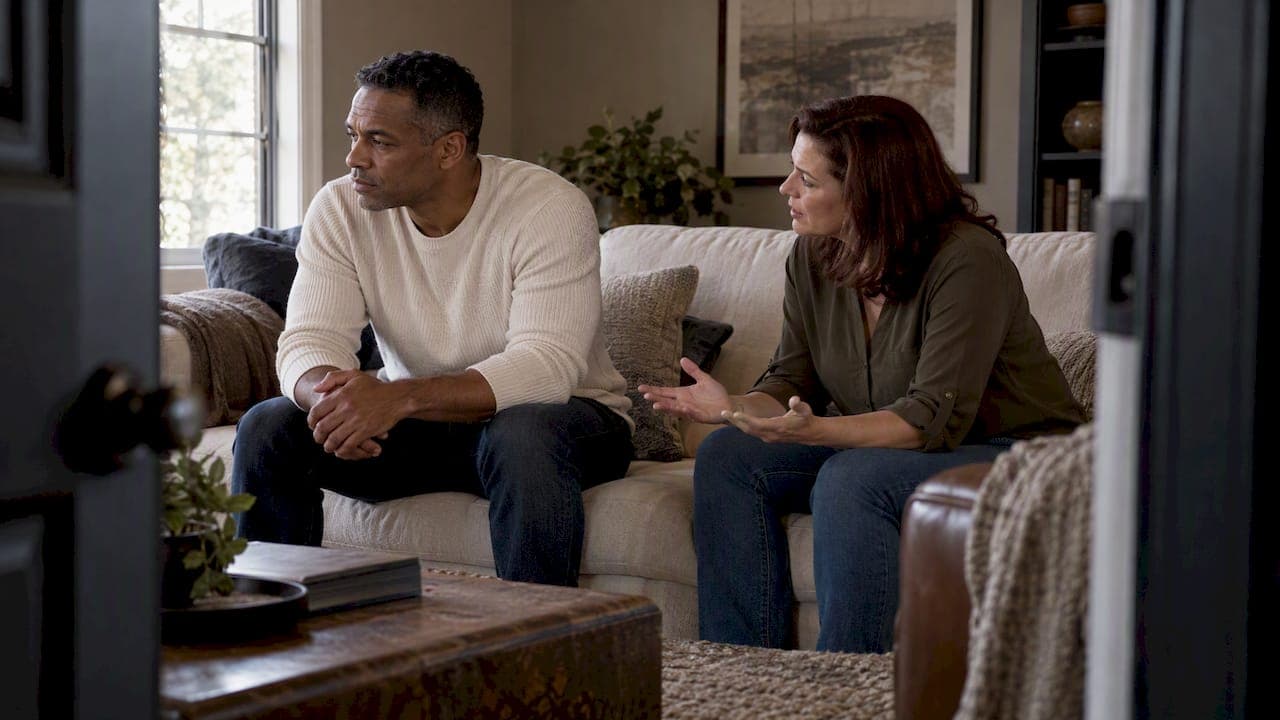
Stonewalling in marriage is when one spouse shuts down during conflict: going silent, leaving the room, or answering with nothing at all. It is often not a decision. For many people it is a body reaction to feeling overwhelmed. Either way, the other spouse is left feeling unheard, and the issue never gets resolved. The good news is that the pattern can be changed once both of you can see it, and this guide walks you through how.
If you are the one who goes quiet, you may feel exhausted, ashamed or simply stuck. If you are the one on the other side of the wall, you may feel invisible. We wrote this for both of you, with a little extra attention to the men who tell us, "I don't know why I just go blank."
TL;DR
- Stonewalling is verbal or nonverbal withdrawal from conflict. It can be deliberate, but it is often a habitual reaction to feeling overwhelmed.
- A healthy break is named, has an end time and comes with a return to the conversation. Stonewalling has none of those.
- If your spouse stonewalls, stay calm, skip the pursuit and ask for a specific time to talk again. If it is you, name the shutdown and take at least 20 minutes to settle your body.
- Repair works when each of you owns your part. Counseling or coaching helps when the loop keeps returning.
- Silence used to control or punish is a different matter and may signal abuse. Support exists for that.
Table of Contents
- What stonewalling looks like in a marriage
- Stonewalling or a healthy break?
- Why people stonewall
- What stonewalling does to a marriage
- How to respond when your spouse stonewalls
- How to stop stonewalling if it's you
- Stonewalling recovery: repairing after a shutdown
- When silence becomes control
- Our perspective on stonewalling
- Working with us on the pattern
- FAQ
- Sources
What stonewalling looks like in a marriage
Cleveland Clinic describes stonewalling as intentional or unintentional, verbal or nonverbal withdrawal from conflict. That covers more than the dramatic slammed door. In everyday marriages it tends to look like this:
- Going quiet mid-argument and staring at the floor, the phone or the TV
- Answering with "fine," "whatever" or "I don't know"
- Walking out of the room, the house or the conversation without saying when you will be back
- Changing the subject, or suddenly getting busy with something else
- Leaving a spouse's text on read for hours during a tense exchange
- Giving a flat, expressionless face that shows nothing
None of these is a crime on its own. A pattern is what matters: every hard conversation ends the same way, with one person talking and one person gone.
Stonewalling or a healthy break?
This is the question most people get stuck on, and it is a fair one. Needing space is not the problem. Needing space and leaving your spouse guessing is.
The difference comes down to how the pause is handled. Cleveland Clinic's advice for stopping stonewalling is to name the shutdown, say the concern matters but you need to calm down, and set a time to come back to the discussion. Here is how that plays out:
| Stonewalling | Healthy break | |
|---|---|---|
| Announced? | No, you just vanish or go blank | Yes, you say you need a pause |
| Message to your spouse | "You don't matter here" | "This matters, and I want to do it well" |
| Return time | None | Agreed, such as later today |
| What you do during it | Replay the argument, rehearse your defense | Calm your body, think about something steadier |
| Result | Issue stays open, distance grows | Conversation resumes with less heat |
If you are not sure which one you do, ask your spouse how your pauses land. Then listen without defending. That answer is information, not an accusation.
Why people stonewall
It helps to know that the motive is not always cold. Cleveland Clinic notes stonewalling may happen when someone has difficulty coping with a conversation or lacks the skills to communicate productively, though some people use it deliberately to assert control or do harm. Research summaries also describe it as frequently an inadvertent, habitual reaction to being overwhelmed.
Flooding: when the body takes over
The Gottman Institute explains that stonewalling often follows physiological flooding, which can raise heart rate and trigger a fight-or-flight response, making a rational, respectful discussion close to impossible. In plain terms: your body decides the conversation is a threat, and the thinking part of you goes offline.

That is why "just talk to me" so rarely works. A flooded person is not choosing silence over words. The words are not available.
Why it shows up so often in men
The Gottman Institute also reports that, based on its Love Lab data, 85% of the stonewallers observed in its studies were men, though both genders use the behavior. We would not read that as "men don't care." In our work, it looks more like many men learned early that showing a feeling was risky, so going still became the safest move. High-performing men are often the best at it, because they are used to staying composed at work.
The cost is that composure at the office can turn into absence at home.
What stonewalling does to a marriage
Left alone, the pattern tends to carry the same effects. According to Cleveland Clinic, stonewalling can leave conflict unresolved, make the other person feel disrespected or undervalued, and create emotional distance.
In practice that often becomes a cycle:
- One spouse raises a concern, sometimes with a sharp edge because they feel unheard.
- The other spouse feels attacked and floods.
- They go silent or leave.
- The first spouse feels abandoned and pushes harder.
- The second shuts down further.
Neither of you is the villain in that loop. Each reaction makes the other one worse. Over time the topics matter less than the dread of the next attempt, and many couples start avoiding whole areas of life: money, sex, in-laws, the kids.
Where children are involved, or a separation is on the horizon, how you talk matters even more. These child-focused communication techniques show how structure and calm wording keep difficult conversations on track.
How to respond when your spouse stonewalls
If you are the one facing the silence, your instinct may be to chase, raise your voice or demand an answer. That usually feeds the loop. Here is a steadier approach.
1. Check your own tone and posture
Cleveland Clinic suggests responding calmly and avoiding raised voices, interrupting or an aggressive posture, and practicing active listening. A softer start often gives your spouse enough safety to stay in the room.
2. Name the pattern without blame
Try: "I notice we both got tense. I'd like to understand what you need." Compare that with "You always shut down." The first invites; the second corners.
3. Offer a pause with a return time
Say: "Let's take a break and come back to this tonight at eight." You are not giving up, you are letting both nervous systems settle. Then actually come back.
4. Give the break real time
The Gottman Institute points to a breaks that last at least 20 minutes so the body's stress response can subside. Texting during that window, even "just one thing," tends to restart the clock.
5. What about stonewalling by text?
A delayed or one-word reply in the middle of a tense exchange is the digital version of walking out. Resist sending a string of follow-ups. Send one clear, kind message: "I want to talk about this, and I'd rather do it when we're both calm. Can we talk after dinner?" Then put the phone down. Anything serious is better handled by voice or in person, where tone is easier to read.
6. Take care of yourself too
Being met with silence hurts. Talk to a friend, move your body, write down what you want to say. If this has become the main way you two fight, couples, marriage or family counseling is a sensible next step, as Cleveland Clinic notes.
For more on handling heated moments, see our guide to managing conflict.
How to stop stonewalling if it's you
If you recognized yourself above, that recognition is the hardest part. Here is where to go next.
Notice the early signs
Your body usually warns you before your mouth goes quiet: tight chest, hot face, racing pulse, a hollow feeling, a sudden urge to leave. Learn your own version. This is the moment to act, not five minutes later.
Name it out loud
Cleveland Clinic's script is simple. Recognize and name the behavior, tell your partner their concern is important but you need to calm down, and set a time to resume. For example: "I'm getting overwhelmed and I don't want to shut you out. I need 30 minutes, and then I'll come find you."
Agree on a signal in advance
The Gottman Institute suggests agreeing on a neutral signal, such as a word or a gesture, to request a timeout. Decide it together when things are calm, so the signal means "I'm coming back," not "I'm done."
Soothe your body, not your argument
During the break, the Gottman Institute recommends physiological self-soothing, such as deep breathing or picturing a calm, safe place, and steering away from repetitive negative thoughts about your partner or the fight. A walk can help, but only if you are not rehearsing your case on it.
Come back when you said you would
This is the part that rebuilds trust. Showing up on time, even if you only say, "I'm calmer and I'm ready to listen," teaches your spouse that your pauses are safe.
Get support for the roots
Cleveland Clinic also says people can change by naming the behavior and may seek counseling to understand underlying issues and practice healthier communication. We would add that the skill is trainable. If you want practice, our marriage communication exercises are a reasonable place to start.
Stonewalling recovery: repairing after a shutdown
A shutdown does not have to end in a cold war. The aftermath is where couples either deepen the pattern or begin to heal it.
According to Cleveland Clinic, couples can work through stonewalling by naming it, empathizing with each other's experience, responding calmly and discussing what each needs during hard conversations. The Gottman Institute adds that couples who repair well are willing to admit responsibility for their part in a conflict and work to heal their bond.
A practical repair conversation might go like this:
- The one who shut down: "I went quiet earlier. I wasn't punishing you. I got flooded. I'm sorry that left you alone with it."
- The one who pursued: "Thank you. I know I got sharp, and that probably made it harder to stay."
- Both: "What do we each need next time? What's our signal?"
Notice what is missing: no scorekeeping, no demand for a perfect explanation. Small, honest repair attempts done often beat one big talk.
Is your marriage salvageable? Nobody can promise an outcome, but Cleveland Clinic's framing is encouraging: stonewalling can be addressed once it is recognized, and changing the pattern can improve the relationship. What tends to matter most is whether both of you are willing to look at your part, and whether you have help when the old loop pulls you back. If you are weighing separation, our piece on coping with divorce stress may offer some steadiness.
When silence becomes control
Not all silence is the same. Cleveland Clinic says the silent treatment may be abusive when it is used to control or punish, while someone who is overwhelmed may simply be struggling with communication and emotional regulation. Relate, a UK relationship charity, similarly says stonewalling may be part of an abusive relationship when it appears alongside controlling behaviors such as intimidation, isolation and constant criticism.
Ask yourself:
- Is the silence used to make me feel afraid, small or to blame?
- Is it paired with threats, monitoring, restricting my contacts or money, or constant criticism?
- Do I change my behavior to avoid the punishment that comes after?
If those sound familiar, this is bigger than a communication habit. The National Domestic Violence Hotline can help with support and safety planning, as Cleveland Clinic points out. A domestic violence advocate or licensed therapist who understands abuse is the right professional here, rather than a communication exercise or a coaching program.
Our perspective on stonewalling
We see stonewalling as a story about safety before it is a story about communication. When a man goes silent, it is almost never because he has nothing to say. It is because his nervous system learned long ago that speaking up under pressure costs something: conflict, rejection, being too much.
So he abandons himself. He overthinks, avoids, swallows the sentence, and leaves the room. We call that self-abandonment, and in marriage it becomes abandonment of his wife too, even though that is the last thing he wants.

Insight alone rarely fixes it. Plenty of men can explain exactly why they shut down and still do it next Tuesday. What changes things is building capacity: learning to feel the surge, stay present in your body, and say one honest sentence anyway. Those internal muscles get stronger with repetition, accountability and a person in your corner who has done the work.
If you are the spouse on the other side, please hear this: his silence is likely not about your worth. And if you are the man, you are not broken. You have a pattern, and patterns can be mapped and changed.
— Jay
Working with us on the pattern
If you keep hitting the same wall, reading about it only gets you so far. At Jay Scott Coaching, we use the Unshakable Man Method™ to train the nervous system to stay grounded under pressure, so you can stay in the hard conversation and speak clearly instead of going blank. We work with men one-on-one and in groups, with tools, pattern mapping and direct support for real situations at home and at work.

You can see how private coaching, groups and workshops work on our coaching options page, and apply there when you are ready. If you want a starting point first, our article on calming your nervous system to end stonewalling goes deeper into the practice side.
FAQ
What type of person stonewalls?
Anyone can, but the Gottman Institute reports that most stonewallers in its Love Lab studies were men. Often it is someone who gets quickly overwhelmed in conflict, never learned to name feelings, or was raised to stay stoic. Some people also use it deliberately to control a partner, which is a separate issue.
How do I deal with a spouse who stonewalls?
Stay calm, avoid raised voices and interruptions, and propose a break with a set time to resume. Keep the first minutes of the return conversation gentle. If the pattern persists, a couples or marriage counselor can help you both break it.
Is stonewalling emotional abuse?
Not by itself. It can become abusive when used to control or punish, especially alongside intimidation, isolation or constant criticism. If you fear your partner or feel controlled, contact the National Domestic Violence Hotline for support and safety planning.
Can a marriage recover from stonewalling?
Many can. Once the behavior is recognized and named, couples can change how they handle conflict, and that often improves the relationship. It takes both people owning their part, practicing pauses with a return time, and sometimes outside help.
How long should a break last?
At least 20 minutes, according to the Gottman Institute, so your body has time to settle. Longer is fine if you agree on when you will resume. The break should end with a return to the conversation, not a quiet end to the topic.
Sources
- What Is Stonewalling and How To Stop, Cleveland Clinic
- The Four Horsemen: Stonewalling, The Gottman Institute
- Repair Is the Secret Weapon of Emotionally Connected Couples, The Gottman Institute
- The Silent Treatment: Causes and Coping, Cleveland Clinic
- Stonewalling, Relate
- Child-Focused Co-Parenting Communication Techniques