
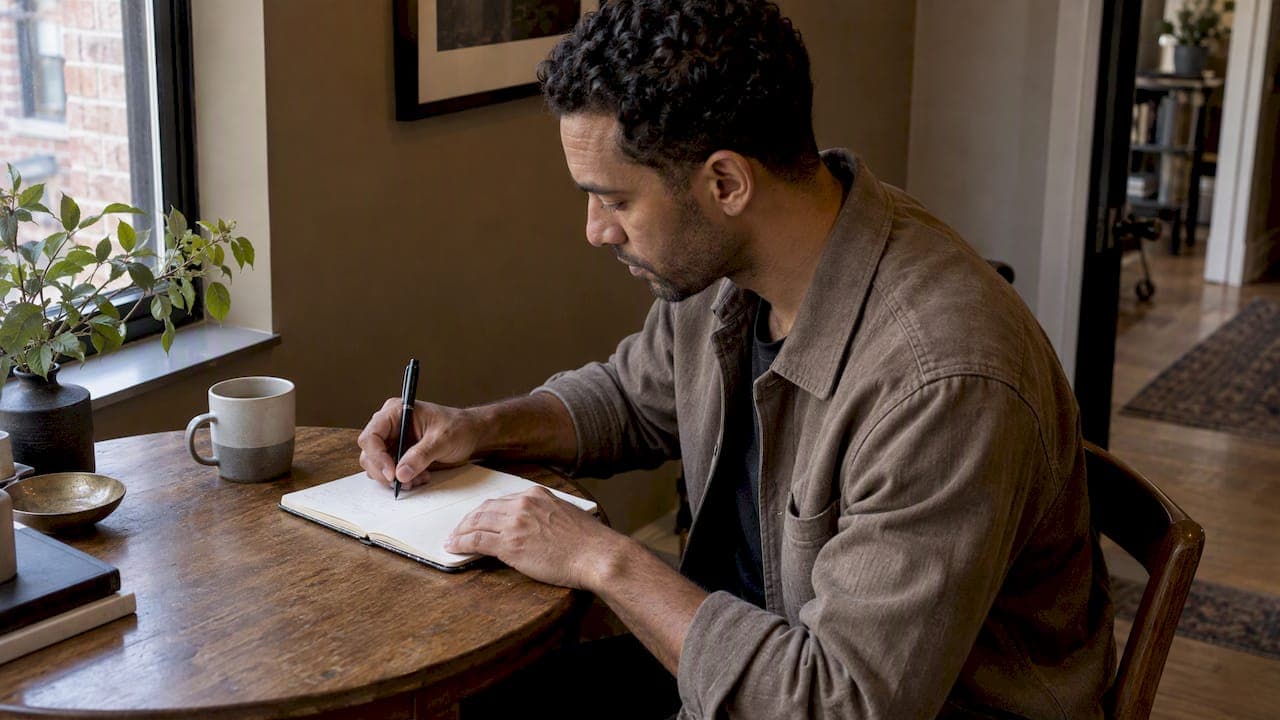
Decisive leadership is the ability to make a clear call in a reasonable time, commit to it, and adjust if you learn something new. It is not speed for its own sake, and it is not never being wrong. For most high-performing men, the real obstacle isn't a lack of intelligence or information. It is what happens in the body and mind when the stakes go up: the overthinking, the avoidance, the quiet pulling away from your own judgment.
This guide covers what decisiveness actually looks like, why pressure erodes it, and a practical set of habits for deciding faster without deciding worse. It also covers how this shows up at home, because the way you decide at work rarely stays at work.
TL;DR
- Decisiveness is a skill you can train: define the decision, set a deadline, choose, and review. It is not a personality trait you either have or don't.
- Stress, information overload, time pressure, complexity and uncertainty are what degrade decisions. Regulating your state comes before sharpening your logic.
- Leaders get faster by deciding how decisions get made, delegating the low-stakes ones, and asking "when" before the process starts.
- Decisive does not mean controlling. At home and at work, taking in other people's input is part of strong leadership.
- If indecision is rooted in self-abandonment or anxiety, working on the nervous system, not just the strategy, is what makes the change last.
Table of Contents
- What decisive leadership really means
- Why good leaders freeze under pressure
- Regulate first, then decide
- A practical process for making decisions faster
- Decisive doesn't mean deciding everything
- Know when waiting is the decisive choice
- Trust makes decisions better
- Decisiveness at home
- Our perspective: capacity before tactics
- Working with us
- A one-week plan to start
- FAQ
- Sources
What decisive leadership really means
The pages that rank for this topic agree on a basic definition: a decisive leader gathers the necessary facts, weighs the options, and makes a call within a sensible window, even when the picture is incomplete. Notice what is missing from that definition. It doesn't say certainty. It doesn't say speed at any cost. It doesn't say always being right.
Three things separate decisive leaders from the rest:
- They know what they are deciding. Many stalled decisions are actually two or three decisions tangled together.
- They set a boundary around the process. A deadline, a set of inputs, a person who owns the final word.
- They commit and stay flexible. They act, watch what happens, and correct without drama.
That third piece matters. A lot of men who struggle with decisiveness aren't afraid of choosing. They are afraid of being wrong, being judged, or disappointing someone. So they keep gathering information, which feels responsible but is often avoidance in a respectable outfit.
Why good leaders freeze under pressure
If you have ever known exactly what the right move was and still didn't make it, you already know this isn't an information problem.
A 2025 review of decision-making research points to four "decision stressors" that hurt decision quality: information overload, time pressure, complexity and uncertainty. The same literature notes that stress exacerbates risk-taking. In other words, pressure can push you in two directions: toward rash moves or toward paralysis. Neither one is decisiveness.
Most leadership decisions contain at least one of those four stressors. Many contain all of them at once. That is why "just be more confident" is such useless advice. Confidence isn't a switch. When your system reads a situation as a threat, the part of you that reasons clearly gets quieter, and the part that wants to protect you gets louder.
Here is how that tends to look in real life:
- You reread the same email five times before replying.
- You ask one more person for their opinion, then another.
- You say yes to avoid a hard conversation, then resent it.
- You say nothing in the meeting, then lay out the perfect argument in the car.
- You postpone the decision and call it "waiting for more data."
We call the common thread self-abandonment: setting aside what you know, want or need in order to keep the peace or avoid risk. It is quiet, it is habitual, and over time it chips away at confidence. A leader who abandons himself in small moments will struggle to be decisive in big ones.
Regulate first, then decide
Before you improve your decision process, you need access to your own judgment. That means getting your body out of alarm.
A few things you can do in the moment, before a hard call:
- Slow your exhale. Breathe in through the nose for four, out for six to eight, for about a minute. Longer exhales help the body settle.
- Feel your feet and your seat. Put your attention on where your body meets the floor and the chair. It pulls you out of the spinning in your head.
- Name what is happening. "I'm feeling pressure and I want to avoid this." Naming it takes some of the charge out.
- Ask one clean question. "What do I already know?" is often more useful than "What if I'm wrong?"
We go deeper on this in our piece on a physiological reset and one rule to decide under pressure, and in a short practice for building leadership presence from the inside out. If you want a slower, reflective approach for choices that deserve it, the guide to mindful decision-making for men is a good companion.
This is practical self-regulation, not medical advice. If anxiety is constant, is affecting your sleep or health, or feels unmanageable, talk with a licensed mental health professional or your physician.
A practical process for making decisions faster
Once you are grounded, structure helps. Here is a simple sequence you can use this week.
Step 1: Name the decision and its stakes
Write one sentence: "I am deciding whether to ___ by ___." Then rate it. Is it reversible or hard to undo? Is the impact small or large? Most decisions are more reversible than they feel.
Step 2: Ask "when" before you ask "what"
According to a tactical guide on making decisions faster, one of the most powerful moves is deciding when a decision will be finalized before the process even begins. The same piece argues that many leaders confuse thoroughness with quality, and that the cost of indecision is often higher than the cost of a slightly imperfect choice that can be corrected later. It also suggests regularly asking why something can't be done sooner.
Put a date and time on every open decision. Open-ended decisions expand to fill whatever time you give them.
Step 3: Limit inputs on purpose
Choose two or three people or sources who actually add something. Information overload is one of the four stressors above, so more input is not automatically better. Ask yourself, "What would change my mind?" If nothing new would, you are ready.

Step 4: Choose, then say it out loud
Tell someone the decision in a single sentence. Spoken commitments are harder to quietly walk back.
Step 5: Set a review point
Pick a date to check how it is going. Knowing you can review makes committing feel safer, and that safety is what lets you act.
| Decision type | Example | Suggested approach |
|---|---|---|
| Low stakes, reversible | Meeting format, vendor for a small purchase | Decide in minutes, delegate when possible |
| Low stakes, hard to reverse | A public statement, a hire for a minor role | Short pause, one trusted check |
| High stakes, reversible | New process, pilot project | Set a deadline, decide, review in 30 days |
| High stakes, hard to reverse | Major hire, big investment, ending a relationship | Slow down on purpose, but with a firm date and a clear owner |
Decisive doesn't mean deciding everything
Many driven men assume that being decisive means being the one who decides every time. That is a fast road to bottlenecks and burnout.
One MIT Sloan Management Review piece frames the leader's job as deciding about deciding: making it clear what you care about, what you need to be told about, and what others should simply move on. Mapping decisions by stakes and urgency shows your team what they can handle on their own and what needs your sign-off. That reduces confusion and keeps you from micromanaging.
This works in any function. If your team runs on live customer conversations, for example, a sales coaching platform for managers can help you spot which calls need your input and which reps can own the next step, so your decisions go where they matter most.
A simple version you can use today:
- You decide: high stakes, hard to reverse, or tied to your core values.
- You decide with input: high stakes, but you need information others hold.
- They decide, you hear about it: moderate stakes, reversible.
- They decide, no report: low stakes.
Say the categories out loud to your team. Then actually let go of the bottom two. The first time someone makes a call you would have made differently, resist the urge to take it back.
Know when waiting is the decisive choice
Fast is not always right. Harvard's Belfer Center describes the need to decide how to decide: who is in the room, and what the context is. Some problems are technical and routine, and restoring order quickly is the right call. Others are adaptive, and the team may need time for disagreement to surface and for learning to happen.
The warning inside that distinction is worth sitting with. When you rush to decide mainly to calm your own discomfort, or your team's anxiety, you can cut short the very learning the situation needs. Decisive leadership means choosing the pace deliberately. Delaying on purpose, with a date and a reason, is a decision. Delaying because you are afraid is not.
A quick test: "Am I waiting because the situation needs time, or because I need relief?" Your honest answer tells you a lot.
Trust makes decisions better
Decisiveness isn't a solo performance. A study of 77 top management teams found that CEO relational leadership improved the quality of strategic decisions through a two-stage path: it raised trust among team members, which supported learning from failures, which in turn led to better decision outcomes. Relational leadership correlated with team trust at r = .37.
The takeaway for you: a leader who is warm, curious and open to hearing the hard thing builds a team that brings him better information, faster. Being unshakable is not the same as being closed.
Decisiveness at home
Most of the men who come to us don't only struggle at work. They struggle in the conversation with their wife that they keep postponing, or the decision about the family they keep avoiding. Avoidance and overthinking travel with you.
Research on couples finds that distressed couples communicate less constructively and lean more on avoidant or demand-withdraw patterns than nondistressed couples. The pattern where one partner pushes and the other withdraws is common, and withdrawing, going quiet and hoping it passes, is its own kind of indecision.
Decisive leadership at home doesn't mean taking control. A university extension resource on managing conflict notes that men who are willing to accept influence from their wives tend to have happier marriages. Accepting influence means listening and sharing power. It is not giving it up.
In practice:
- Say what you think and want, clearly and kindly, before you hear the full list of objections.
- Ask for her view, and let it change yours when it should.
- Agree on how a decision will be made and by when, just as you would at work.
- Follow through on what you said.
If you want more on this, see our guides on assertiveness in personal and professional life and how to rebuild trust in marriage.
Our perspective: capacity before tactics
We see the same story again and again. A capable, driven man has read the books, has the frameworks, and still freezes in the moments that matter. The frameworks aren't wrong. The gap is capacity.
Our view is that decisiveness comes from feeling safe enough inside yourself to choose, to be seen choosing, and to survive being wrong. That safety isn't something you can think your way into. It is trained, the way internal muscles get stronger: through repetition, in real situations, with support and accountability.
That is the heart of the Unshakable Man Method™. We work on training the nervous system to stay grounded under pressure, because insight alone rarely changes what you do at 4 p.m. on a hard day. In sessions we use tools you can take with you, and we map your patterns so you can see them clearly: where you go quiet, where you over-explain, where you say yes when you mean no. Once you can see a habit, you can interrupt it.
The result we aim for is not a harder man. It is a steadier one, who can speak plainly, make the call, and stay connected to the people he leads and loves.
You don't have to be fearless. You need to be able to stay with yourself while you are afraid.
— Jay
Working with us
If you recognize yourself here and want support, we offer private coaching, groups, and workshops and immersions for high-performing men. You can apply or book a consultation call to talk about what you are facing and which format fits. If you want to see what individual work looks like first, read about individual coaching for men seeking change.
A one-week plan to start
- Day 1: List every open decision you are carrying. Rate each by stakes and reversibility.
- Day 2: Put a decision date on each one.
- Day 3: Delegate or release the two lowest-stakes items.
- Day 4: Practice the one-minute slow exhale before your hardest meeting or conversation.
- Day 5: Make one decision you have been avoiding. Say it out loud to someone.
- Day 6: Notice where you abandoned yourself this week: where you said yes, stayed silent or hedged. No judgment, just notice.
- Day 7: Review. What happened? What did you learn? Set next week's dates.
If resistance shows up, that is normal. Our guide on reducing resistance to change in ten minutes a day can help, as can the six-step pathway to embodied leadership.
FAQ
Why is decisiveness essential for leadership effectiveness?
Teams need direction to move. When a leader stalls, work waits, people guess, and small problems grow. Decisive leaders also build trust, because people know where they stand and what happens next.
How can I make decisions faster without making worse ones?
Set a decision date before you start, limit your inputs to the few that matter, and sort the decision by stakes and reversibility. Most choices can be corrected later, so the cost of waiting is often higher than the cost of a small miss. Keep slow, careful thought for the decisions that are both high stakes and hard to undo.
Can you learn to be more decisive, or is it a personality trait?
It can be learned. Decisiveness is a mix of process (deadlines, clear ownership, review points) and capacity (staying steady enough to commit when the stakes feel high). Both improve with practice.
Is being decisive the same as being controlling?
No. A controlling leader decides everything and shuts out input. A decisive one decides how decisions get made, delegates what he can, listens, and then commits. The same holds in marriage, where being open to your partner's influence is part of strong leadership.
What if my indecision feels like anxiety?
Occasional hesitation is human. If worry is constant, disrupts your sleep or health, or you can't function the way you want to, see a licensed mental health professional or your doctor. Coaching can complement that support by building skills and accountability, but it doesn't replace clinical care.
Sources
- Decision making under stress: the role of information overload, time pressure, complexity, and uncertainty
- A Tactical Guide on How to Make Decisions Faster
- Effective Leaders Decide About Deciding
- Good Leadership is Deciding How to Decide
- CEO relational leadership and strategic decision quality in top management teams
- Communication, Conflict, and Psychological Distance in Nondistressed, Clinic, and Divorcing Couples
- Manage (conflict management and accepting influence)