
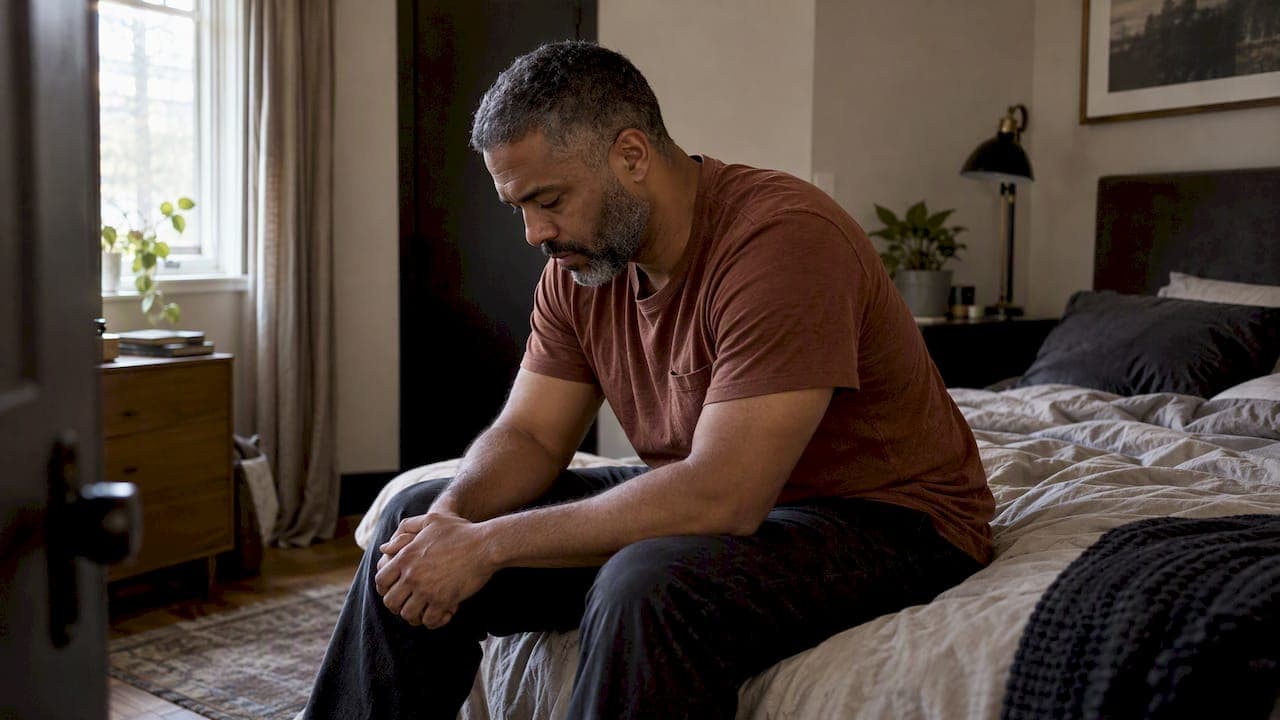
Shame in men rarely announces itself. It shows up as irritability after a hard meeting, a sudden need to fix everything at work, a silence at the dinner table, or a quiet voice that says you are the one thing that is broken. Shame is the belief that something is wrong with you, not just that you did something wrong. It can be healed, and the path runs through your body and your habits as much as through your thoughts.
This guide explains what shame is, why it looks different in men, what it costs high-performing men in particular, and the steps that help you work with it instead of around it.
TL;DR
- Shame is the belief that you are flawed as a person. Guilt is about a behavior you can repair. Mixing them up keeps men stuck.
- Men often cover shame with anger, overwork, withdrawal or perfectionism, so it can go unnoticed for years.
- Masculine norms like self-reliance and "being strong" make it harder to name shame or ask for support.
- Insight alone often stalls. Lasting change usually needs practice that calms the nervous system in real time, plus self-compassion and accountability.
- You can start today: notice the moment, slow down, and treat the feeling as information, not a verdict.
Table of Contents
- What shame actually is
- Why shame looks different in men
- How shame shows up when it does not look like shame
- The high performer's trap
- Why talking about it is not always enough
- A practical path to heal shame
- Building the capacity to stay grounded
- Perspective: what we see in men who carry shame
- Working with a coach on shame
- Signs you are making progress
- FAQ
- Sources
What shame actually is
Most of us use "shame" and "guilt" as if they were the same word. Psychology treats them as different experiences. An umbrella review of shame research describes guilt as focused on a specific behavior, while shame is a painful belief that you are inherently flawed or not good enough as a person.
That difference matters because of where each one leads:
- Guilt says, "I did something wrong." It points toward repair: an apology, a correction, a better choice next time.
- Shame says, "I am something wrong." It points toward hiding, which is why shame so often leads to withdrawal, avoidance or lashing out.
The University of Illinois Counseling Center describes shame as the underlying belief that one is defective or unacceptable, and notes the specific story can be very personal: you might believe you are too much, not enough, too needy, too emotional, or too weak.
Shame is also an internal experience, not only a reaction to events. Psychologist Bret Lyon writes that an incident that brings mild regret to one person can trigger overwhelming shame in someone carrying underlying trauma. So if your reaction feels bigger than the moment, that is not weakness. It is a signal that the moment touched something older.
Why shame looks different in men
Researcher Brené Brown has said that for men, shame comes down to one expectation: do not be perceived as weak. Many men she met described a narrow box in which every emotion except anger was off limits. Whether or not you have read her work, you may recognize the rule. You learned it early, from fathers, coaches, classmates and bosses, and you probably learned it without anyone saying it out loud.
The research on masculinity supports the pattern. A 2026 narrative review of men's mental health points to traditional norms such as emotional repression, self-reliance and "being strong" as factors that can conceal distress and delay treatment. A systematic review on masculinity norms and help-seeking reached a similar conclusion: these norms make men more vulnerable to mental health problems while making support harder to reach.
The stakes are real. According to the National Institute of Mental Health, the suicide rate among U.S. males in 2023 was 22.8 per 100,000, nearly four times the rate among females. Shame is not the only cause of that gap, and we are not saying it is. But a culture where men feel they must handle pain alone, and silently, is part of the picture.
How shame shows up when it does not look like shame
The most useful thing to know about shame in men is that it is often unacknowledged. Researchers describe defensive strategies of withdrawal, avoidance, and attacking the self or others. Here is how that tends to look in daily life.
At work
- You over-prepare, over-check and over-deliver, then still feel one mistake away from being exposed.
- You deflect feedback, argue the details, or go cold in meetings after a critique.
- You stay quiet when you disagree, then replay the conversation for hours. Our post on speaking up at work with nervous system coaching goes deeper on that pattern.
- You treat rest as laziness and busyness as proof of worth.
At home
- You go silent during conflict because anything you say feels like it will make it worse.
- You get defensive when your partner raises a concern, even a gentle one.
- You say "I'm fine" and mean "I don't know how to say what's happening."
- You pull away from intimacy because being fully seen feels risky.
In your own head
- Harsh self-talk that you would never aim at a friend.
- Rumination: replaying a moment and searching for what you should have done.
- A habit of tackling emotional pain as if it were a technical problem. A systematic review of men's anxiety explores how men's distress can show up in ways they do not label as emotional, and why it often goes unaddressed.
If you see yourself here, notice the reaction that follows: "Great, one more thing wrong with me." That is shame again, now aimed at the fact that you have shame. We will come back to how to step out of that loop.
The high performer's trap
High-performing men carry an extra layer. Drive, self-reliance and toughness helped you get where you are. They also work as armor. The armor protects you from feeling vulnerable, but it also keeps people out, which feeds the very shame-and-anxiety cycle you are trying to escape.
This is where many men begin to abandon themselves. You override what you feel, push through what you need, and say yes when your body says no. Over time you stop trusting your own signals. We call this self-abandonment, and shame is often the engine behind it: if the real you is unacceptable, performing someone else feels safer.
There is a hopeful finding here. Research on self-compassion and relationship maintenance found that, for conscientious people, responding to a mistake with self-compassion did not make them lax. It supported more constructive efforts to repair the relationship. In other words, being kind to yourself does not cost you your edge.
And showing emotion does not automatically cost you respect. An APA study on men's emotional displays hypothesized that men can cry or express anxiety without losing perceived masculinity when the emotion signals morally praiseworthy concern, such as caring how a situation affects someone else. Vulnerability tied to what you value is read as strength.
If you also want a clearer, more objective picture of your strengths at work, career assessment tools can give you data to set against the harsh story shame tells about your abilities. Data will not heal shame, but it gives you something firmer to stand on when the inner critic is loud.
Why talking about it is not always enough
Many men try therapy or journaling, get a good insight, and find that nothing changes on Monday morning. That is not a personal failure. Insight is useful, but shame lives in the body as much as in the story. When it fires, your heart rate climbs, your chest tightens, your jaw sets, and the thinking part of your brain goes offline. Understanding why you feel this way does little in the middle of a tense conversation.
The Psychology Today piece cited above makes a similar point: healing means slowing down to identify the specific moments of shame, including the ones you have dismissed, and regulating your nervous system as they happen, instead of only analyzing them afterward.
Men also tend to engage more when support is active. Many men's health experts argue that passive, abstract approaches can feel impersonal to men, and that male-tailored help works better when it focuses on action, concrete problem-solving and regulation. That is an argument for fitting the approach to the person, not a claim that talk therapy has no value. For many men, the strongest plan combines approaches. If you are dealing with depression, trauma, or thoughts of suicide, a licensed mental health professional is the right first step.

A practical path to heal shame
Here is a sequence you can start on your own. It is simple, and it works best when you repeat it often and gently.
- Catch the moment. Shame has tells: a sinking feeling, heat in your face, a sudden urge to defend, flee or go numb. Name it silently: "This is shame."
- Slow your body down. Exhale longer than you inhale, drop your shoulders, feel your feet on the floor. Even a short reset helps you stay in the room. Our guide to 15 second emotional regulation for men shows one way to do it.
- Separate the behavior from the self. Ask: "What did I do, if anything, that I can repair?" If the answer is nothing, the weight you feel is shame, not guilt.
- Treat the feeling as data. Instead of an indictment, ask what it is pointing at. Which old rule was just triggered? Who taught it to you?
- Speak to yourself like someone you lead. Self-compassion is not indulgence. Studies of exercises such as self-compassionate letter writing have found meaningful reductions in shame, self-criticism and anxiety.
- Tell one safe person. Shame depends on secrecy. Saying it to a trusted friend, a group, or a coach takes away much of its force.
- Take one small, decisive action. Send the message, ask the question, make the call. Action tells your nervous system that you are safe even while uncomfortable.
A worked example
Imagine a director whose boss critiques his presentation in front of the team. He leaves the meeting with a tight chest and spends the evening rewriting slides nobody asked him to change. At dinner he is short with his wife, then goes quiet.
With this sequence, he catches the moment on the walk back to his desk and breathes out slowly. He asks himself what is repairable: two slides need tightening. The rest, the sense of being exposed as a fraud, is shame. He sends his boss a short note with the revisions, tells his wife what happened, and sleeps that night. Nothing dramatic occurred. He simply stopped abandoning himself in a hard moment.
Building the capacity to stay grounded
Knowing the steps is one thing. Doing them when your pulse is racing is another. That takes capacity, which is built the way strength is built: repetition, with some resistance, over time. Our post on building resilience for men and the piece on emotional resilience as a secret weapon cover the daily habits that make this possible.
A few places to practice before the stakes are high:
- Small exposures. Share one honest opinion in a low-stakes conversation. Notice what happens in your body, and stay.
- Defensiveness check. When you feel yourself bristle, pause for one breath before responding. We explain why this works in our post on stopping defensiveness.
- Work safety. Notice where you feel unsafe at work, and use short grounding tactics. See three nervous system tactics for emotional safety at work.
- Change in ten minutes. Resistance to change is often shame in disguise. Try the habits in this ten-minute approach to resistance to change.
Perspective: what we see in men who carry shame
We do not believe men are broken. We believe most men learned, very early, that being fully themselves was unsafe, and they built a brilliant set of strategies to cope. Those strategies make you effective. They also cost you.
In our work, the men who arrive at coaching are rarely lacking intelligence or willpower. They are exhausted by holding it all together. They can explain exactly why they react the way they do, and they still do it. What changes things is not more explanation. It is training the nervous system to stay grounded under pressure, so that when the old alarm goes off, you can feel it without obeying it.
That is the heart of the Unshakable Man Method™: build inner safety first, and decisive action, honest communication and clear leadership follow. When you stop abandoning yourself, you stop needing so much armor. Shame loses its grip not because we argue with it, but because you learn you can survive being seen.
— Jay
Working with a coach on shame
There is a time to do this alone and a time to get a guide. If you have tried to think your way out for years, if shame is affecting your marriage or your leadership, or if you keep repeating the same pattern despite knowing better, structured support can shorten the road.
Jay Scott Coaching offers private coaching, groups, and workshops and immersions for high-performing men. The work is built around nervous system regulation, mapping your patterns, practical tools you use between sessions, and accountability for real change at home and at work. You can see how each option works on the coaching offers page, or start from the Jay Scott Coaching home page.
Coaching is not a substitute for mental health treatment. If you are in crisis or thinking about harming yourself, call or text 988 in the United States to reach the Suicide & Crisis Lifeline, or contact a licensed clinician.
Signs you are making progress
Healing shame does not mean you never feel it again. It means the feeling passes through faster and steers you less. Look for these changes:
- You recover from criticism in minutes or hours instead of days.
- You can say "I was wrong" without feeling you are being erased.
- You ask for help earlier.
- Your partner notices you staying in the conversation instead of leaving it.
- You make decisions without waiting for certainty or approval.
- You treat rest as part of the work, not a reward you must earn.
If progress feels slow, that is normal. You are retraining patterns that are decades old. Keep returning to the basic move: notice, slow down, stay, act. For a deeper look at the seasonal side of this, see our note on coaching for men during winter, and browse more on our articles page.
FAQ
How does shame show up in men?
Often as anger, irritability, perfectionism, overworking, silence or withdrawal rather than sadness. Research describes men using defensive strategies such as avoidance and attacking themselves or others when shame feels unfixable. If your reaction is bigger than the situation, shame is worth considering.
What is the difference between shame and guilt?
Guilt is about something you did, and it points toward repair. Shame is the belief that you are fundamentally flawed, and it points toward hiding. Asking "What can I repair?" helps you tell them apart.
Can men really heal shame?
Yes. Shame is a learned response, and learned responses can change. Studies show practices like self-compassion exercises can reduce shame and self-criticism, and many men also benefit from guided support, group work and nervous system practice. Healing means shame loses its grip, not that it never appears.
Does being kind to myself make me weak?
No. Research on self-compassion found it supports constructive problem-solving and repair after mistakes, including in conscientious people. Many men find it makes them steadier, not softer.
When should I see a therapist instead of a coach?
See a licensed mental health professional if you have symptoms of depression, trauma, panic, substance use, or thoughts of suicide. Coaching can work alongside therapy, but it is not treatment for a clinical condition.
Sources
- Conceptualization and Assessment of Shame Experience and Regulation: An Umbrella Review
- Recovering from Shame, University of Illinois Counseling Center
- Three Steps to Healing Shame and Trauma, Psychology Today
- A Narrative Review of Men's Mental Health: The Role of Stigma and Gender-Differentiated Socialization
- Men's Mental Health Matters: Traditional Masculinity Norms and Willingness to Seek Support
- Suicide statistics, National Institute of Mental Health
- Men's anxiety: A systematic review
- Self-compassion and relationship maintenance
- Psychology of Men & Masculinity, APA
- Self-compassionate letter writing and shame, PubMed