
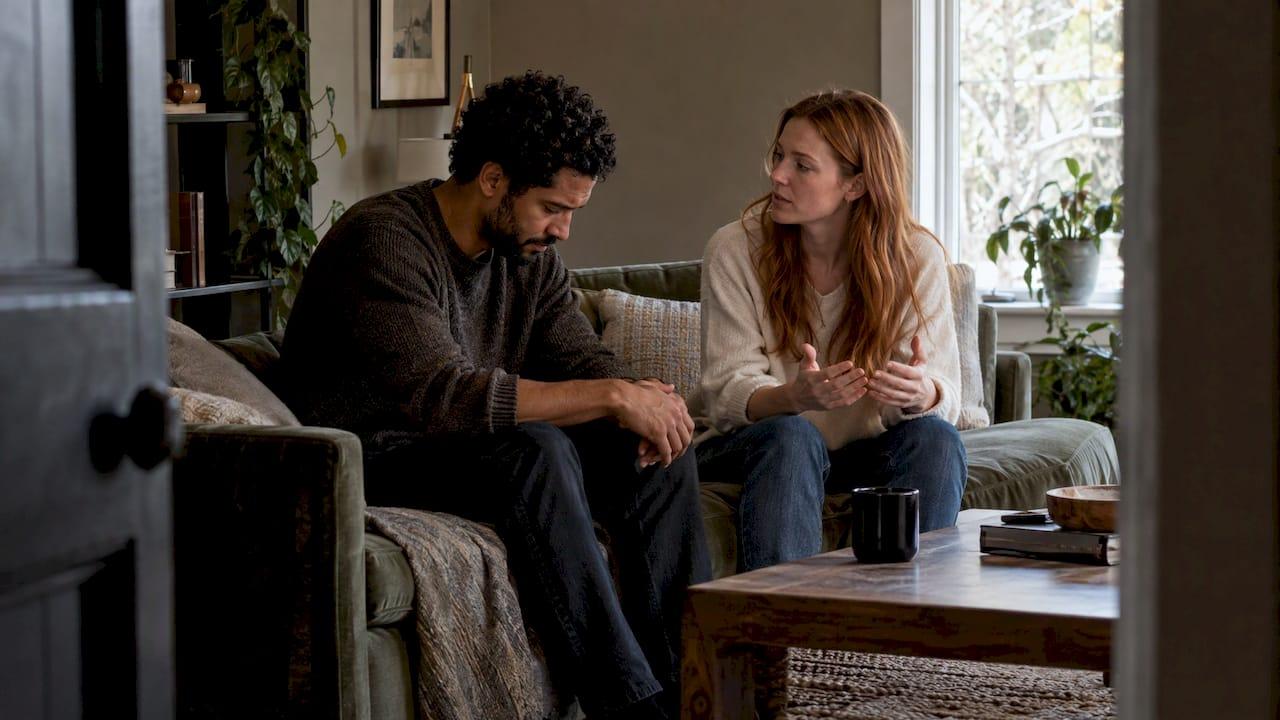
Relationship anxiety in men is persistent worry, doubt or fear inside a close relationship. It often shows up as overthinking, pulling away, irritability or a need for reassurance you would never admit to. It is common, it is not a character flaw, and it responds to practice. Below you will find what it looks like in men, where it comes from, how it connects to fear of intimacy, and the steps that help you feel steadier with the people you love.
TL;DR
- Relationship anxiety is not an official diagnosis, but the pattern is real: persistent worry or doubt that makes closeness feel unsafe.
- In men it often hides behind anger, silence, control or staying busy, not obvious worry.
- Common roots include past hurt, attachment patterns, general anxiety and years of learning to hide vulnerable feelings.
- Noticing the thought, calming your body first, then speaking plainly to your partner is a workable sequence.
- If anxiety is damaging your relationship or daily life, a licensed mental health professional is the right person to see. Coaching can sit alongside that work.
Table of Contents
- What relationship anxiety looks like in men
- Common signs men miss in themselves
- Where it comes from
- Fear of intimacy and relationship anxiety: how they overlap
- What is going on in your body
- A practical sequence for the moment anxiety hits
- Leaning in, a little at a time
- When your partner is part of the picture
- When to get professional help
- Working with us
- FAQ
- Sources
What relationship anxiety looks like in men
Most men do not say, "I feel anxious about us." They say, "I'm fine," or "I'm just tired," or they pick a fight about the dishes. That is part of why this topic is so often missed.
Relationship anxiety is generally described as persistent doubt, fear or worry in a romantic or close relationship, and it is not an officially recognized DSM-5 disorder. That does not make it imaginary. It means it is a pattern, and patterns can be understood and changed.
It also helps to separate it from normal nerves. At the start of a relationship, or before a big step, some jitters are expected. Forbes Health notes that feelings of anxiety, nervousness or stress at any stage are considered relatively normal. Sex and relationship therapist Stephen Snyder, MD, points out in Men's Health that the body responds almost the same way to anxiety, nervousness and excitement. His distinction is useful: good anxiety comes with doing something new and exciting, while bad anxiety is a premonition that something bad is about to happen.
A quick way to tell the difference in your own life: normal nerves rise before a specific event and settle afterward. Relationship anxiety hangs around without a clear trigger, keeps asking "what if," and does not quiet down when things are going well.

Common signs men miss in themselves
Some signs are the ones everyone expects. Others look like personality traits, which is why you may have lived with them for years.
According to Verywell Mind, signs can include:
- Overthinking conversations, calls or texts
- Fearing rejection
- Pushing people away first
- Jealousy
- Trying to control a partner's time or contacts
- Avoiding relationships altogether
Forbes Health adds obsessive checking, repeated reassurance-seeking questions, ghosting when you want distance, mood shifts, and physical signs such as sweating or panic attacks.
For men specifically, there are three disguises worth knowing.
Anger instead of worry
UNC's men's health program notes that men may bottle up anxiety rather than talk about it, and that it can build into explosive anger that harms relationships. If your partner says you snap more than you used to, the anger may be carrying something underneath it.
Silence and withdrawal
Going quiet feels like keeping the peace. To your partner it can feel like a door closing. The same UNC piece observes that a partner can grow tired of feeling like the man's therapist, which often happens when he shares nothing until the pressure spills over.
Control and busyness
Checking, planning, fixing and staying productive can all be ways of managing a feeling you do not want to feel. If you recognize this pattern at work too, we wrote about the anxiety underneath micromanaging.
Where it comes from
There is rarely one cause. Most men carry a mix of the following.
Past hurt. Psychology Today's discussion of fear of intimacy in men lists childhood experiences with an absent, lost or abusive parent, and a partner's abuse, cheating, departure or death, among possible contributors. These experiences can lead a man to avoid emotional closeness even while he still wants it.
Learned silence. Psychologist Avrum Weiss, Ph.D., writes that in Western cultures men are socialized to equate masculinity with self-confidence and to look self-assured even when they do not feel it. Fears of being inadequate go underground, hidden from other men and from themselves. If you were never given words or permission for fear, you were never taught to say it.
Difficulty naming emotions. A study of 175 men found that normative male alexithymia, the inability to put emotions into words, was associated with lower relationship satisfaction, poorer communication and greater fear of intimacy. That is not a verdict on you. It is a skill gap, and skills can be built.
General anxiety and attachment patterns. If worry follows you into work, sleep and health, it will follow you home too. The anxious-avoidant loop, where one person reaches for closeness and the other retreats, is especially common. Our nervous system steps for the anxious avoidant cycle walk through it.

Fear of intimacy and relationship anxiety: how they overlap
Men searching for fear of intimacy and men searching for relationship anxiety are often describing the same room from different doors.
Verywell Mind describes fear of intimacy as fear of sharing a close emotional or physical relationship. People may long for closeness yet push others away or sabotage the relationship. Relationship anxiety tends to be the loud version: the worry, the checking, the what-ifs. Intimacy anxiety tends to be the quiet version: the distance, the deflection, the sudden need for space when things get warm.
There is a useful distinction from psychologist Brenda Wade, quoted in Psych Central. She says emotional unavailability often comes from a fear of losing independence, while fear of intimacy can come from wanting to avoid the pain of being abandoned, heartbroken or disappointed. Men's Health frames one version of relationship anxiety as the dread of losing yourself, the fear that too much closeness will cost you your autonomy.
A few questions can help you see which pattern is yours:
- When things get close, do I get anxious and cling, or restless and distant?
- Do I want closeness and then sabotage it?
- What am I afraid will happen if my partner really sees me?
- Does the fear show up with everyone, or only in romantic relationships?
There is no right answer. The point is to replace a vague dread with something you can name.
What is going on in your body
We approach this as a nervous system issue first and a thinking issue second. When your body reads a conversation as a threat, the thinking part of you narrows. You stop hearing your partner and start defending, withdrawing or fixing.
That is why "just communicate better" so often fails. You cannot reason your way into openness while your body is bracing. The order that works better is: settle the body, then speak.
Two of our short practices cover that first step:
- Five minutes of cyclic sighing for calming anxiety before a hard conversation.
- A 15-second reset for emotional safety you can use in the moment, even mid-argument.
Some men also find that slowing the pace around them helps, for example by understanding how slow music calms the mind and using it during a walk or a drive home before you walk through the door.
A practical sequence for the moment anxiety hits
Here is a simple routine you can adapt. It is built from strategies commonly recommended for relationship anxiety, including noticing anxious thoughts, checking them against concrete evidence and tolerating uncertainty.
- Notice the signal. Tight chest, racing thoughts, the urge to check your phone or leave the room. Name it: "This is anxiety, not a fact."
- Slow your body. Take a few long exhales. Drop your shoulders. Give yourself a minute before you respond.
- Test the thought. What do I actually know? What is the evidence for and against? Is there a more ordinary explanation for what I'm seeing?
- Say one true sentence. Not a speech. Something like, "I'm feeling anxious and I don't want to pull away. Can I tell you what's going on?"
- Choose one action in line with who you want to be. Stay in the room, ask a question, offer a hug, or ask for twenty minutes and then come back.
The last part matters. Asking for space is fine. Disappearing is not. If you take a break, say when you will return and then return.
Leaning in, a little at a time
It is tempting to manage fear by avoiding what triggers it. Experts quoted in Men's Health suggest the opposite: lean into the intimacy you fear rather than running from it, because repeated exposure to what makes you nervous may reduce that nervousness.
Think of it as training, not a leap. Here is a gradual ladder you can adjust:
| Step | Practice | What you are building |
|---|---|---|
| 1 | Share one small feeling a day ("I was stressed in that meeting") | Comfort with saying feelings out loud |
| 2 | Stay in a hard conversation five minutes longer than usual | Capacity to tolerate discomfort |
| 3 | Ask your partner what they need from you this week | Curiosity in place of guessing |
| 4 | Share something you have never said | Trust and being seen |
| 5 | Ask for reassurance directly, once, instead of testing | Honest requests over protest behavior |
If step four feels impossible, that tells you where the work is. Our guide to masculine vulnerability and how to practice it safely can help you choose who, when and how much to share.
When your partner is part of the picture
Relationship anxiety is not only your private experience. It lands on someone you love.
Things that help the two of you:
- Tell them what the pattern is. "When I go quiet, it usually means I'm overwhelmed, not that I don't care."
- Agree on a pause signal. A word or phrase that means "I need ten minutes and I'm coming back."
- Know your triggers. Our piece on emotional triggers in relationships shows how to spot what sets you off before it runs the conversation.
- Practice outside conflict. Short, regular exercises beat one big talk. See our marriage communication exercises for men.
- Do not make your partner your therapist. Support is welcome. Carrying all your emotional processing alone with them tends to wear both of you down.
Mindfulness can support all of this. We cover it in mindfulness for emotional growth and stronger relationships.
When to get professional help
Self-help and coaching are real tools, and there are situations where a licensed professional needs to lead. Verywell Mind advises that if anxiety is hurting your relationships, you should talk to a healthcare practitioner or mental health professional. Treatment options include CBT, DBT, exposure therapy, psychodynamic psychotherapy and couples counseling. Medication such as SSRIs does not cure anxiety but can reduce symptoms and often works best alongside psychotherapy.
See a doctor or licensed therapist if you notice:
- Panic attacks or physical symptoms that frighten you
- Anxiety that disrupts sleep, work or daily life
- Heavy drinking or other secret habits used to cope
- Past abuse or trauma that still drives your reactions
- Thoughts of harming yourself. In the US, you can call or text 988 to reach the Suicide and Crisis Lifeline.
If you are unsure which approach fits you, our comparison of CBT, DBT and coaching for high performing men explains how to match the support to the risk.
Perspective
Over and over, the men we work with are not weak or broken. They are capable, driven, and exhausted from holding it together. What they describe is a quiet pattern we call self-abandonment: they swallow what they feel, overthink every exchange, avoid the hard conversation, and then wonder why they feel alone in their own marriage.
Our view is that insight alone rarely fixes this. You can understand exactly why you pull away and still pull away, because your body learned long ago that closeness was not safe. That is why the Unshakable Man Method™ trains the nervous system to stay grounded under pressure. When you build inner safety, decisive action and honest speech stop feeling like a risk.
In practice that means pattern mapping, so you can see your triggers and habits in plain view, tools you can use in the middle of a real conversation, and accountability so the change holds when life gets busy. We believe an internal muscle gets stronger the same way any muscle does: through steady, supported repetition.
You do not have to become a different man. You get to become the steady one you already are underneath the anxiety.
Jay
Working with us
If you recognize yourself here and you want more than information, we offer private coaching, groups, and workshops and immersions for high-performing men. The work centers on training emotional regulation at the nervous-system level, so you can stay present with your partner, speak clearly and act decisively when the pressure is on.

You can see how the options differ on our coaching, groups and workshops page, or start from Jay Scott Coaching and apply when you are ready. Coaching is not a replacement for therapy or medical care, and many men use both.
FAQ
How long does relationship anxiety last?
There is no fixed timeline, because it depends on what is driving it, such as past hurt, attachment patterns or general anxiety. For many people it comes in waves and eases as they build skills for calming the body and speaking honestly. If it has lasted for months and is affecting your relationship or daily life, a licensed mental health professional can assess what is behind it.
Is fear of intimacy the same as relationship anxiety?
They overlap but are not identical. Relationship anxiety usually involves persistent worry, doubt and reassurance-seeking, while fear of intimacy often looks like pushing people away or sabotaging closeness even when you want it. Many men experience both, and the same skills help with each: noticing the trigger, calming the body and sharing honestly in small steps.
Why do men hide relationship anxiety?
Many men were taught to look self-assured and to treat visible insecurity as weakness. As a result, the fear often goes underground and comes out as anger, silence or control. Naming it to one safe person is usually the first step.
Can men overcome intimacy anxiety on their own?
Many men make real progress with consistent practice: noticing anxious thoughts, checking them against evidence, and gradually leaning into closeness instead of avoiding it. Support from a coach, a group or a therapist speeds this up and keeps you accountable. If trauma, panic attacks or substance use are involved, start with a licensed professional.
Sources
- About Relationship Anxiety, Pfizer
- Relationship Anxiety: How To Overcome It, Forbes Health
- How to Get Over Relationship Anxiety, According to Experts, Men's Health
- Anxiety In Relationships: Signs, Effects, and Ways to Cope, Verywell Mind
- How Anxiety Impacts Men Versus Women, UNC Men's Health
- Fear of Intimacy in Men: Cause, Relationship Problems, Tips, Psychology Today
- Why Men Often Feel Insecure in Their Intimate Relationships, Psychology Today
- Is Normative Male Alexithymia Associated with Relationship Satisfaction, Fear of Intimacy and Communication Quality?
- Do You Have a Fear of Intimacy?, Verywell Mind
- How to Overcome Fear of Getting Too Close to Someone, Psych Central
- Relationship Anxiety: What It Is and How to Deal With It, The Attachment Project
- Why Low BPM Music Calms the Mind: Science Explained