
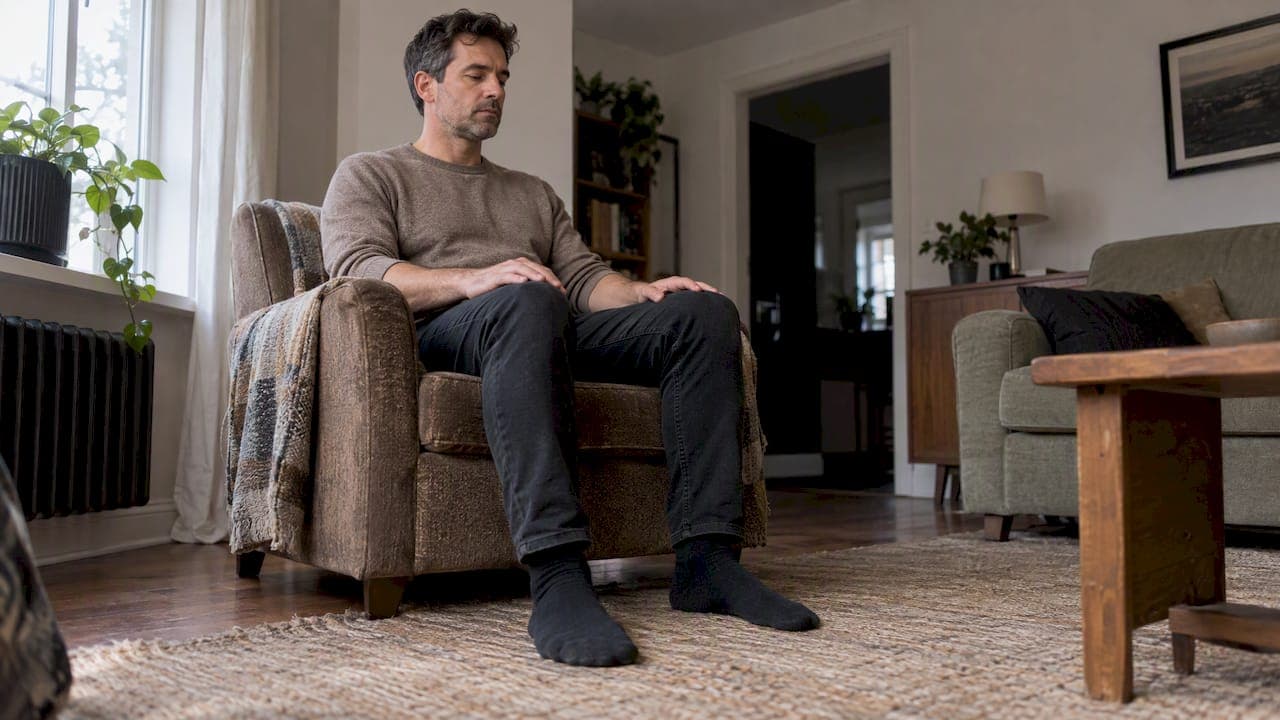
Nervous system training is the practice of teaching your body to move through stress states and come back to steady, instead of getting stuck in them. It is not about staying calm at all costs or pushing feelings down. It is about building the physical capacity to feel pressure, stay present, and still act on what you know is right.
Search for the term and you will find a lot of athletic content about speed and power. This guide is about the other kind: the training that helps you stop freezing in the meeting, snapping at home, or going quiet when it matters.
TL;DR
- Nervous system training builds your ability to shift between activated and calm states. It does not remove stress.
- The best-supported tools are slow paced breathing with a longer exhale, rhythmic physical activity, and sensory grounding for in-the-moment spikes.
- Breathing works best as daily conditioning and recovery. Under acute pressure, pairing it with muscle engagement may work better than breath alone.
- Ten to twenty minutes a day, practiced consistently, beats an occasional long session.
- If overthinking, avoidance, or anxiety keeps running your decisions, structured coaching adds accountability and pattern awareness that solo practice often lacks.
Table of Contents
- What nervous system training actually means
- Signs your nervous system is stuck
- The nervous system exercises with evidence behind them
- Practice versus pressure: why timing matters
- A simple weekly plan
- Our perspective: capacity, not control
- When training on your own is not enough
- Working with us
- FAQ
- Sources
What nervous system training actually means
Your autonomic nervous system runs the background: heart rate, breathing, digestion, and how ready your body is to fight, run, or rest. Two branches do most of the work. The sympathetic branch revs you up. The parasympathetic branch, which includes the vagus nerve, helps you settle.
Training means practicing the shift between those states on purpose, so it becomes easier and faster. A 2025 review of the vagus nerve in mental health and performance describes performance as less about suppressing the stress response and more about modulating autonomic states. That is a useful reframe if you have spent years trying to "just stay calm."
Think of it as strength work for an internal muscle. You do not get stronger by avoiding weight. You get stronger by meeting a manageable load, recovering, and repeating.
What it is not
It is not relaxation as a personality. It is not positive thinking. And it is not a replacement for medical or mental health care when you need it. If you are dealing with panic attacks, ongoing sleep loss, or symptoms that interfere with daily life, talk with your primary care doctor or a licensed therapist first.
Signs your nervous system is stuck
Most high-performing men do not describe it as a nervous system problem. They describe it as a habit: overthinking, over-working, going silent, or saying yes when they mean no.
The NHS describes a dysregulated nervous system as a body stuck in a chronic or maladaptive stress response, with possible effects like anxiety, poor sleep, fatigue, and pain. Common patterns include:
- Fight or flight that will not switch off. Irritability, racing thoughts, tension in the jaw or chest, and difficulty winding down at night.
- Freeze. Your mind goes blank in a high-stakes moment, or you stall on a decision you already know the answer to.
- Fawn. Chronic people-pleasing, smoothing things over, and agreeing to avoid conflict.
If you recognize yourself in the last two, you may know the feeling of leaving a conversation and realizing you abandoned your own position halfway through. That pattern, which we call self-abandonment, is often a body-level response before it is a character flaw. It does not mean something is wrong with you. It means your system learned that staying quiet or staying busy was safer.
The nervous system exercises with evidence behind them
Not every technique online is equal. Here are the ones with the best support, and what each is for.
1. Slow paced breathing with a longer exhale
Slow breathing with a long exhale is the most studied entry point. A review of respiratory vagal stimulation explains that slow breathing with long exhalation signals relaxation through the vagus nerve. The research behind our source set points to rhythms around six breaths per minute (0.1 Hz) as a sweet spot for training heart rate variability (HRV), a common marker of how flexibly your system adapts.
The NHS offers a plain-language breathing exercise for stress that takes a few minutes and can be done anywhere. Its main advice applies to every technique here: you get the most from it by doing it regularly.
If you want a structured version, we walk through five minutes of cyclic sighing for anxiety on our blog.
2. Rhythmic movement
Walking, easy cycling, rowing, and similar steady activity gives your system a rhythmic load and recovery cycle. In the same vagus nerve review, rhythmic exercise is described as one of the primary ways to stimulate the parasympathetic branch. You do not need to train hard. Steady and repeatable matters more than intense.

There is also supporting evidence from a high-stress occupation. A study of law enforcement officers examined how leisure-time physical activity moderates the link between poor sleep and the cortisol awakening response. It was a specific group, so treat it as a signal, not a promise for everyone.
3. Sensory grounding for in-the-moment spikes
When you are spiraling, you often cannot do a calm ten-minute breathing session. That is where quick grounding helps. The 3-3-3 practice asks you to name three things you see, three things you hear, and move three parts of your body. Clinicians interviewed by Upworthy describe it as a quick anchor for anxious thought spirals. It will not solve the underlying pattern, but it can interrupt the loop long enough for you to choose your next move.

4. Breath plus muscle engagement
Here is a nuance most guides skip. A pilot study on paced breathing and dynamic muscle contraction looked at how those two elements affect autonomic reactivity. The takeaway from that line of research is that the pairing may do more under stress than either piece alone. It is a small pilot, so hold it loosely. But it fits what many men notice: breathing alone can feel thin when adrenaline is high, while a breath with a firm press of the feet into the floor feels more usable.
5. HRV biofeedback
HRV biofeedback uses a sensor to help you find your own breathing rhythm. The 2025 vagus nerve review we cited above notes that six weeks of resonance-frequency HRV-biofeedback training has been shown to reduce trait anxiety and depressive symptoms. If you like data, this is a good route. If you do not, the simpler tools above get you most of the way.
6. General relaxation practices
Mayo Clinic notes that relaxation techniques can lower stress symptoms. Meditation, progressive muscle relaxation, and similar practices can sit alongside the tools above if they suit you.
Practice versus pressure: why timing matters
Many men try breathing for the first time in the worst possible moment, find it does not work, and conclude it is not for them.
The research summarized in our source set suggests breathing exercises are often most effective as preconditioning, before the stress arrives, or as recovery afterward. That matches how any skill works. You do not learn to swim during a rescue.
A useful way to organize your training:
| When | Goal | Tool |
|---|---|---|
| Daily, calm | Build capacity | Paced breathing, steady movement |
| Right before a hard moment | Prime your state | A few slow exhales, feet on the floor |
| In the spike | Interrupt the loop | Grounding, breath with muscle engagement |
| After | Recover and learn | Slow breathing, a walk, a few written notes |
The last row matters more than it looks. Noticing what triggered you and what you did next is how you start to see your pattern.
A simple weekly plan
This is a starting point, not a prescription. Adjust it to your health and schedule, and check with your doctor before changing your exercise routine if you have a medical condition.
- Morning, 5 minutes. Sit upright. Breathe in through the nose, out slowly through the mouth, making the exhale longer than the inhale. Aim for a slow, even rhythm.
- Midday, 1 to 2 minutes. Before your first or hardest meeting of the afternoon, take several slow exhales and feel your feet on the floor.
- Three or four times a week, 20 to 30 minutes. A steady walk, easy bike ride, or similar movement where you could still hold a conversation.
- Evening, 3 to 5 minutes. Slow breathing, then write down one moment you felt activated and one moment you stayed steady.
- Once a week, 10 minutes. Review your notes. Look for repeats: a person, a topic, a time of day.
That adds up to roughly ten to twenty minutes on most days. We lay out a similar approach in 10 to 20 minutes a day to build nervous system regulation, and a quicker option in 30 seconds to reset your nervous system.
What progress looks like
Do not expect to feel nothing. Expect smaller changes first:
- You notice the spike sooner.
- You recover in minutes rather than hours.
- You pause before sending the sharp email.
- You say the true thing at the meeting, and your voice is steadier than you expected.
Those small wins are the point. They build trust with yourself, which is what self-abandonment erodes.
Our perspective: capacity, not control
We work with men who are good at what they do. They are decisive in a spreadsheet and hesitant in a hard conversation. They can lead a team and still go silent with a spouse. In our experience, this gap is rarely about knowledge. They already know what they should say or decide. What is missing is the physical capacity to stay with the discomfort long enough to act.
That is why we train the nervous system directly rather than relying on insight alone. Insight tells you why you freeze. Training changes what happens in your body when the moment arrives. The Unshakable Man Method™ is built around that idea: emotional regulation and inner safety first, so decisive action and honest self-expression become possible.
We also believe the work does not happen in isolation. Solo practice is a great start. But most men we meet have been running these patterns for decades, and a pattern you cannot see is hard to change. Having someone shine a light on your habits, map them, and hold you accountable to the next small action is often the difference between knowing and doing. Our somatic coaching approach is built for that gap, and the way we think about decisions in the heat of the moment is in one rule to decide under pressure.
If you are tired, stretched thin, and feel unseen even when everything looks fine from the outside, you are not broken. Your system is doing what it learned to do. It can learn something new.
— Jay
When training on your own is not enough
Self-guided practice is a good fit when your stress is manageable and you are consistent. It tends to stall when:
- You do the exercises but still avoid the same conversations.
- You understand your patterns but cannot change them in real time.
- Anxiety shows up in your marriage, your leadership, or your sleep.
- You start and stop programs because nothing holds you to the plan.
It is also worth separating two things. Coaching is not therapy and does not treat medical or mental health conditions. If you have persistent anxiety, depression, trauma symptoms, or thoughts of harming yourself, see a licensed mental health professional or your doctor. In the US, you can call or text 988, the Suicide and Crisis Lifeline, at any time. Many men do both: a therapist for clinical care, a coach for building skills and follow-through.
Working with us
We offer private one-on-one coaching, group coaching, and workshops and immersions for high-performing men in the United States. The work combines nervous system regulation practices, pattern mapping, tools you use between sessions, and direct, actionable support for the relationships and career situations you are facing right now.
If you want to see whether it fits, you can read about private coaching, groups, and workshops and apply from there. Our homepage gives a broader picture of the method.
If you would like more reading first, try training focus and calm in six weeks or a short emotional regulation practice for men.
FAQ
How do you train your nervous system?
Start with three habits: slow breathing with a longer exhale, steady rhythmic movement, and a short daily check-in on what activated you. Practice when you are calm so the skills are available when you are not. Consistency over several weeks matters more than intensity.
What are signs of a dysregulated nervous system?
Common signs include persistent anxiety, poor sleep, fatigue, chronic people-pleasing, going blank under pressure, and difficulty winding down after stress. The NHS nervous system regulation page lists several of these. These signs also overlap with medical conditions, so a doctor's visit is a sensible first step if they persist.
What is the 3-3-3 rule?
It is a quick grounding practice: name three things you see, three things you hear, and move three parts of your body. It is meant to interrupt anxious thought spirals by bringing your attention back to the present. Think of it as a first-aid tool, not a long-term fix.
Can breathing exercises alone regulate my nervous system?
They help, especially when practiced daily, but they are often strongest as conditioning before stress or recovery after it. In a high-pressure moment, pairing breath with movement or muscle engagement may serve you better. Combining these with pattern awareness and support is what usually makes the change last.
How long does nervous system training take to work?
Some men feel a shift in a single session, but lasting change generally takes weeks of regular practice. One cited study found six weeks of HRV-biofeedback training reduced trait anxiety, though results vary by person. Track small signs like faster recovery and clearer decisions rather than waiting for a dramatic change.
Sources
- The vagus nerve: a cornerstone for mental health and performance optimization (PMC, 2025)
- Nervous System Regulation (NHS)
- Breath of Life: The Respiratory Vagal Stimulation Model of Contemplative Activity (PMC)
- Breathing exercises for stress (NHS)
- Sleep quality and the cortisol awakening response among law enforcement officers (CDC Stacks)
- Experts say the 3-3-3 Rule can help people break out of anxious thought spirals (Upworthy)
- Pilot study of paced breathing and dynamic muscle contraction on autonomic reactivity (CDC Stacks)
- Relaxation techniques: Try these steps to lower stress (Mayo Clinic)