
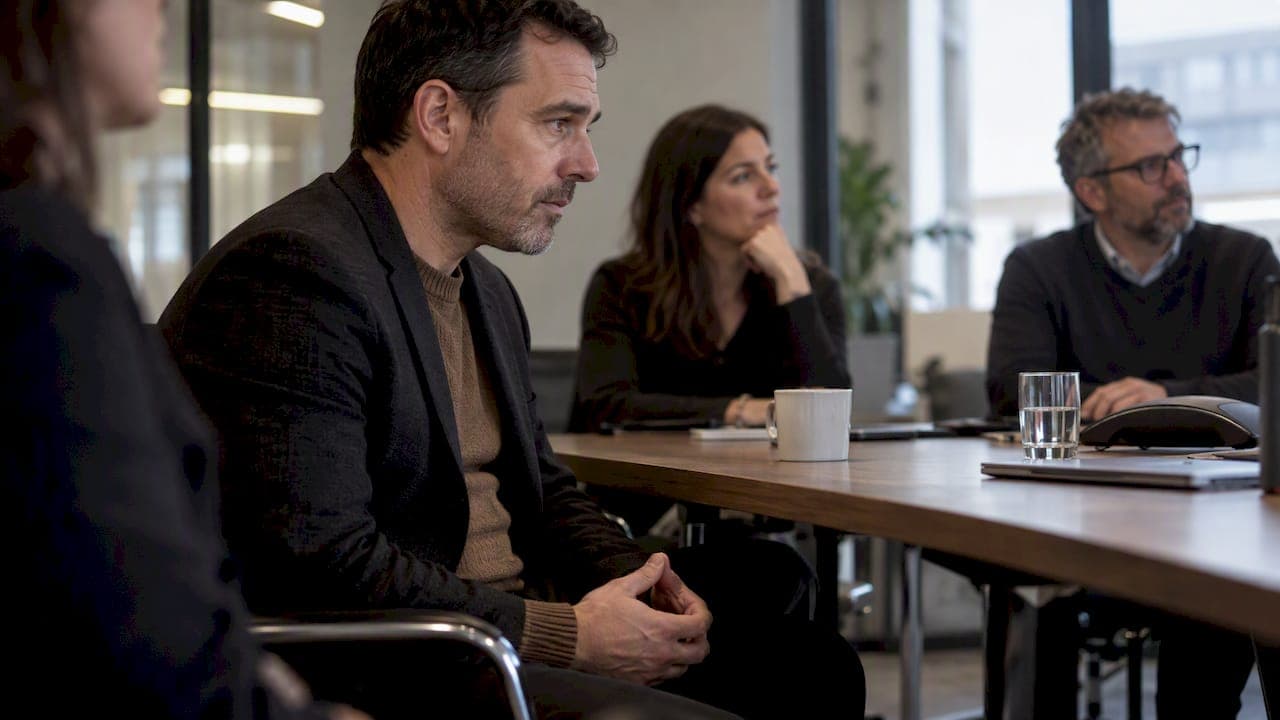
Performance anxiety at work is the dread that shows up before a presentation, a review, a hard conversation or a high-stakes decision, the feeling that everyone is watching and you are one mistake from being found out. It is common, it is not a character flaw, and it responds to training. The most reliable shift we see is this: stop trying to think your way out of it, and start teaching your body that it is safe.
This guide covers what performance anxiety is, why strong performers so often carry it in silence, what to do in the moment, how to build steadier nerves over time, and when it is time to bring in a clinician.
TL;DR
- Performance anxiety is an outsized fear response around specific tasks, and it is widespread: one Canadian workplace report cites 87% of people experiencing it at some point.
- Many high performers get results despite it, but the private cost (rumination, over-preparing, avoidance) adds up.
- It is a body problem as much as a thinking problem. Breath, slow movement and grounding work faster than another round of worrying.
- Small daily practice beats emergency fixes. Build capacity before the big meeting, not during it.
- If anxiety is constant, spreading, or hurting your sleep, health or relationships, see a licensed professional.
Table of Contents
- What performance anxiety at work actually is
- Why high performers carry it in silence
- Why thinking harder does not fix it
- What to do in the moment
- Building steadier nerves over time
- Work habits that lower the baseline
- Our perspective: you are not trying to get rid of the feeling
- When it is time to see a professional
- Working with us
- FAQ
- Sources
What performance anxiety at work actually is
The Cleveland Clinic describes performance anxiety as outsized fear, nervousness and dread around completing specific tasks, the same thing people call stage fright. At work, the stage is rarely a stage. It is a Monday leadership meeting, a client call, a performance review, a pitch, a Slack message you have rewritten six times.
It is also not limited to big events. A review of workplace research from the Canadian Centre for Occupational Health and Safety's partner library notes that ordinary workplace situations can trigger it, not only headline moments. That matches what men tell us: the dread often attaches to routine moments where someone might judge them.
How it shows up in the body
The Cleveland Clinic lists the familiar signs: a faster heart rate, shaky hands, legs or voice, sweating, and feeling cold. You may also notice a tight chest, a dry mouth, or a mind that goes blank right when you need it.
How it shows up in behavior
This is the part high performers rarely name:
- Over-preparing until the work is bloated, then still not trusting it.
- Replaying a conversation for hours afterward.
- Avoiding the call, the email or the decision, then calling it prioritizing.
- Staying quiet in meetings and saving your real opinion for the drive home.
- Getting defensive when feedback lands.
- Going flat or irritable at home because you spent everything holding it together at work.
Why high performers carry it in silence
If you are the person others rely on, anxiety feels like a risk to your reputation. So you hide it, and hiding takes energy.
The research is a little surprising. A study of work-related anxieties found that interview anxiety and workplace anxiety were not simply tied to worse job performance once individual differences were considered. The CDPC summary adds that some employees reported their anxiety even seemed to help their output.
That is both good news and a trap. Good news, because feeling anxious does not mean you are failing. A trap, because when the adrenaline gets results, it is easy to mistake that surge for focus. You keep running on it. Meanwhile the cost shows up elsewhere: poor sleep, a short fuse, a spouse who feels shut out, a sense that you are performing your own life instead of living it.
We call the underlying pattern self-abandonment. You put other people's expectations, or your fear of their judgment, ahead of your own inner steadiness. You say yes when you mean no. You stay silent when you have something to say. You push through signals from your body until it forces a stop. On the surface it looks like diligence. Underneath, it chips away at confidence.
Why thinking harder does not fix it
Most men we talk with have already tried to reason their way out. They list the facts, make a plan, build a backup plan, and tell themselves it is irrational. Sometimes that helps. Often it feeds the loop, because the part of you that is alarmed is not responding to logic. It is responding to a perceived threat.
This is why we work at the level of the nervous system. When your body reads a meeting as danger, your heart rate rises, your breathing gets shallow and your attention narrows. Planning more does not change that signal. A slower exhale does.
A caution on how far the evidence goes: the strongest research on workplace anxiety is on structured approaches such as cognitive behavioral therapy. A meta-analysis of occupational stress management interventions found a medium effect overall, and cognitive-behavioral approaches did best among the individual-level methods it examined. Body-based practices like breathwork and grounding are widely used as complements, and we use them heavily, but we would never tell you they replace clinical care when you need it. More on that below.

What to do in the moment
When anxiety spikes at work, you do not need a philosophy. You need something you can do in a conference room without anyone noticing. Here are four options, from fastest to slowest.
1. One or two physiological sighs
Take a full inhale through the nose, add a short second sip of air on top, then let a long, slow exhale go through the mouth. The long exhale is the point. It takes under 30 seconds. We walk through the method in our guide to the physiological sigh.

2. Lengthen your exhale
In for four, out for six to eight. Do this under the table before you speak. If you like a structured pattern, box breathing works, though we are honest in that piece that a few minutes is a starting point, not the whole job.
3. Feel your contact points
Press your feet into the floor. Feel the chair under you and your hands on the desk. Name three things you can see. This pulls your attention out of the imagined future and back into the room.
4. Discharge the charge
Tension builds in the body before, during and after a stressful moment. Walk to the printer the long way. Shake out your hands in the restroom. Take the stairs. Rhythmic movement gives the energy somewhere to go. The Cleveland Clinic also suggests that healthy action such as a short walk is part of breaking the cycle.
If you want a fuller routine, we have two short ones: a 30-second reset for a dysregulated nervous system and five minutes of vagus nerve breathing.
A quick before-the-meeting routine
- Ten minutes before, step away from your screen.
- Do two physiological sighs, then six slow breaths with a longer exhale.
- Stand or walk for one minute and let your shoulders drop.
- Write the single point you most want to land. One, not five.
- Walk in at a normal pace, and take one slow breath before you speak.
Building steadier nerves over time
In-the-moment tools are first aid. What changes your baseline is regular, small practice, the kind that makes your internal muscles stronger. Waiting until anxiety feels crippling makes everything harder, the same way you would not wait for a knee injury to start strength work.
Make regulation a daily habit
Five minutes in the morning is enough to start. Cyclic sighing is a simple option. The goal is not to feel blissful. The goal is to practice returning to steady, again and again, when nothing is at stake, so the skill is there when something is.
Map your patterns
Anxiety is rarely random. Keep a short log for two weeks: where you were, who was in the room, what you were afraid of, what your body did, and what you did next (over-prepared, went quiet, snapped, avoided). Patterns appear fast. Maybe it is always when a particular executive is present. Maybe it is the unstructured moments, not the formal ones. Once you can see the loop, you can interrupt it.
Practice the hard thing in small doses
Avoidance teaches your nervous system that the situation was dangerous. Do the opposite, in steps. Speak first in a low-stakes meeting. Send the email after one read-through, not five. Ask the question you were saving. Pair each rep with a slow exhale and notice that you survived it. We cover this progression in speaking up at work.
Prepare for difficult conversations
A lot of workplace anxiety is really conversation anxiety: asking for a raise, giving hard feedback, disagreeing with your boss. Short scripts help because they lower the demand on your working memory when your body is already busy. See short scripts for difficult conversations.
Notice defensiveness
When feedback feels like an attack, your body is treating criticism as a threat. Catching that moment, and breathing before you respond, changes how others experience you. Our piece on stopping the defensive reflex goes deeper.
Create emotional safety around you
You cannot always change the culture, but you can shape your own corner of it. OSHA's guidance for employers points out that workplace stressors can make it harder for people to get work done, and it encourages environments where people can ask for support. If you manage people, say out loud that nerves before big moments are normal, and say it about yourself too. We share three practical tactics in emotional safety at work.
Work habits that lower the baseline
A few practical changes make the body's job easier:
- Protect sleep. Anxiety and short sleep feed each other.
- Trim the over-preparing. Set a time limit for prep and stop when it ends.
- Cap reassurance-seeking. Asking three colleagues if the deck is fine trains your brain to need them.
- Schedule recovery. Put a ten-minute break after every high-stakes moment, not only before it.
- Move daily. Walking or lifting gives stress hormones a place to go.
- Tell one person. A trusted peer, mentor or spouse. Shame thrives in secrecy.
Our perspective: you are not trying to get rid of the feeling
We will say what most articles will not. The goal is not to be a man who never feels this. The goal is to be a man who can feel it and still act on what matters to him.
In our work with high-performing men, the anxiety is rarely about the presentation. It is about what the presentation means: whether you are respected, whether you are safe, whether you are enough. The nervous system treats those questions like emergencies. So we do not start with positive thinking. We start with capacity: training your body to stay grounded under pressure, then using that steadiness to make cleaner decisions and say the true thing sooner.
That is the idea behind the Unshakable Man Method™. We look at where you leave yourself, whether through overthinking, avoidance or people-pleasing, and build practices around those exact moments. We use tools in sessions, pattern visualization so you can see your loop, and accountability so the change survives a busy quarter. Men often tell us the first surprise is not that the anxiety shrinks. It is that they stop being afraid of it.
Talk alone rarely does it, which is why we pair insight with practice. And when something needs clinical care, we say so, plainly.
— Jay
When it is time to see a professional
Coaching builds skills and accountability. It is not treatment. Please talk to a licensed clinician, such as a psychologist, psychiatrist or your primary care doctor, if:
- Anxiety is present most days, not just around specific events.
- You are having panic attacks, or you are avoiding work, meetings or situations because of fear.
- Your sleep, appetite, relationships or drinking have changed.
- You feel hopeless, or you have thoughts of harming yourself.
The National Institute of Mental Health says that when anxiety starts causing problems in everyday life, such as avoiding situations at work, it is time to seek professional help. If you are in crisis, call or text 988 in the US, the Suicide & Crisis Lifeline, which is free and available around the clock. Many employers also offer an employee assistance program, which is worth checking in your benefits materials.
It is not either-or. Many men do both: a therapist for diagnosis and treatment, a coach for practice and accountability. Our article on coaching versus therapy for men explains how to tell which fits.
Reaching out is not admitting defeat. It protects your long-term clarity and leadership, and it is a strong move, not a weak one.
Working with us
If you recognize yourself here, and you want more than tips, that is what we do. We offer private coaching, groups, and workshops and immersions for high-performing men who want to stay steady under pressure, speak up sooner and bring more of themselves home. You can see the options and apply on our Private Coaching, Groups, Workshops & Immersions page, or start from our home page.
FAQ
How do you cure performance anxiety at work?
It is better to think of it as something you train than something you cure. Slow breathing with a long exhale, grounding, movement and gradual exposure to the situations you avoid all reduce its grip. If it is severe or constant, cognitive behavioral therapy has the strongest research support among individual approaches, and a licensed clinician can help you decide.
What is the 3-3-3 rule for anxiety?
It is a quick grounding exercise: name three things you see, three sounds you hear, and move three parts of your body. It pulls your attention out of the spiral and into the room. It is a calming tool, not a treatment.
Does anxiety hurt job performance?
Not always. Research on workplace anxiety suggests the link to performance is weaker than most people assume. But strong output can hide a real cost in sleep, health and relationships, so it is worth addressing even if your results look fine.
How do I stop dreading going to work?
Start by finding what the dread is attached to: a person, a task, a meeting, or the feeling of being judged. Then work on your body first, with a short morning regulation practice, and act on one small thing you have been avoiding. If dread is daily and heavy, speak with a clinician.
Sources
- Performance Anxiety at Work, CDPC
- Performance Anxiety: Breaking the Cycle, Cleveland Clinic
- Effects of occupational stress management intervention programs: a meta-analysis
- Are Work-Related Anxieties Associated With Reduced Job Performance?
- Workplace Stress: Guidance and Tips for Employers, OSHA
- Social Anxiety Disorder: What You Need to Know, NIMH