
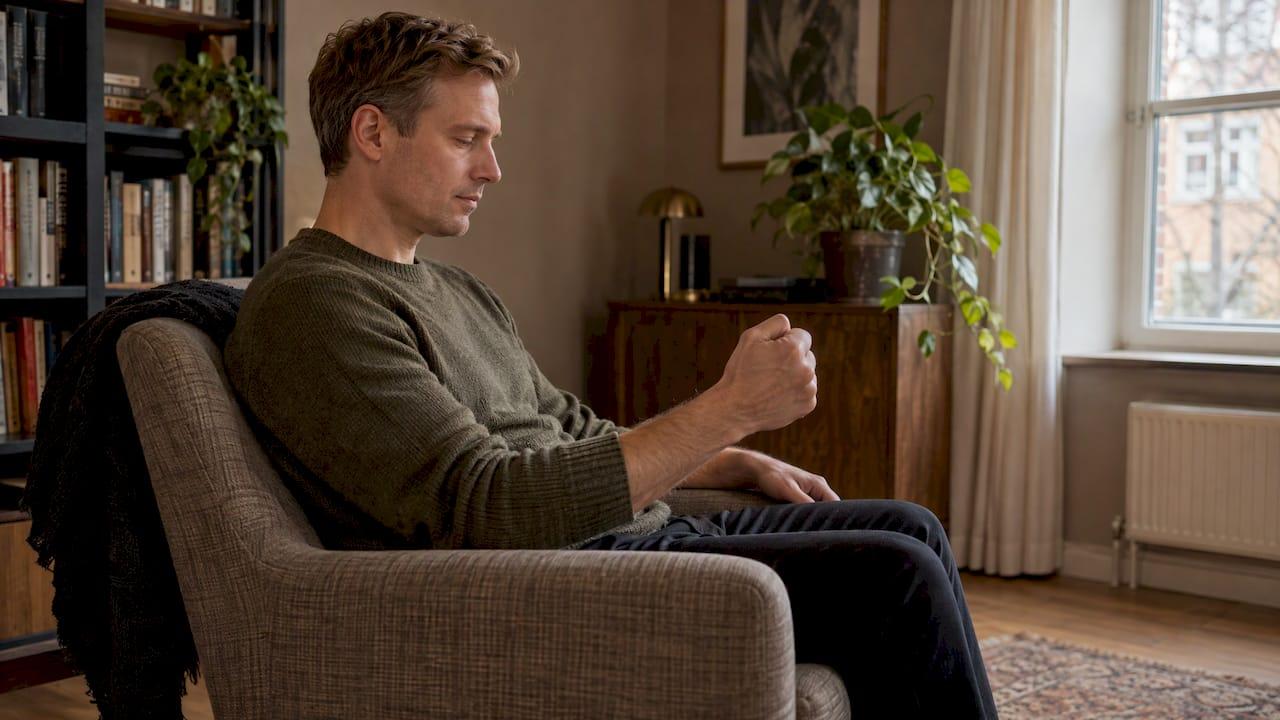
Progressive muscle relaxation (PMR) is a simple practice: you tense one muscle group at a time, then release it, and move through the body in order. Done regularly, it teaches you to notice tension you have been carrying for hours or years, and to let it go on purpose. Most people need 10 to 20 minutes, a quiet spot, and nothing else.
If you are a man who runs on adrenaline, keeps going when you are exhausted, and only notices your jaw is clenched at 9 p.m., this exercise is a gentle way to start listening to your body again. Below you will find the exact steps, the timing, the safety notes, and how to make it work when life is loud.
TL;DR
- PMR means tightening a muscle group for about 5 seconds, then releasing it, and working through the body in a set order.
- Plan on 10 to 20 minutes. Practice when you are calm first, so the skill is there when you are not.
- Tense with gentle effort, never to the point of pain. Stop if anything cramps or hurts.
- Research links PMR to lower stress and anxiety and better sleep, and it tends to work even better alongside other approaches.
- It is a body-level skill. Pairing it with breathwork and nervous system training builds steadiness under pressure.
Table of Contents
- What progressive muscle relaxation is
- How to prepare
- Muscle relaxation steps, in order
- How long to tense, how long to release
- If tensing feels uncomfortable
- What the research says
- Why a relaxed body changes how you handle pressure
- Our perspective
- Build calm that holds under pressure
- FAQ
- Sources
What progressive muscle relaxation is
PMR alternately tenses and relaxes your muscles, starting at one end of the body and working to the other. Cleveland Clinic notes that Dr. Edmund Jacobson introduced it in the 1920s, which is why you will sometimes see it called Jacobson's relaxation technique. The idea is that physical relaxation encourages mental relaxation, so a calmer body helps quiet an anxious mind.
There is a second benefit that gets less attention. The University of Melbourne's counseling service explains that learning to tell a tense state from a relaxed one helps you drain tension, spot your trouble areas, and reach a deeper level of relaxation. In other words, the tensing is not the point. The contrast is.
For many men, that contrast is new. When you spend years bracing for the next demand, tension becomes the baseline and stops registering at all. PMR shines a light on it.
How to prepare
A little setup makes the first sessions much easier. The VA suggests finding a place where you will not be bothered, sitting or lying comfortably, removing contact lenses if you wear them, closing your eyes or resting your gaze on one point without straining, and taking several slow, deep breaths.
A few more details from clinical sources:
- Time: Verywell Mind recommends setting aside 15 to 20 minutes, in comfortable clothing, and starting when you already feel calm.
- Distractions: Johns Hopkins Bayview Medical Center suggests limiting things like your phone and either putting on soft music or sitting in silence first.
- Warmth: Cedars-Sinai points out that people often feel cooler as they relax, so keep a blanket nearby. They also suggest a few minutes of stomach breathing before you begin.
If your breathing is the part you want to sharpen first, our guide to five minutes of cyclic sighing pairs well with this exercise.
Muscle relaxation steps, in order
The VA lists 14 muscle groups. Work through them in this order:
- Hands (make fists)
- Biceps
- Triceps
- Shoulders
- Forehead
- Eyes
- Jaw
- Mouth
- Neck
- Lower back
- Abdomen
- Buttocks
- Thighs
- Lower legs
For each group, the VA instructions are to inhale and tighten the muscles for about 5 seconds, notice how your body feels, then exhale and release for about 5 seconds before moving on.
Here is how that looks in practice:
- Settle. Sit or lie down. Take three slow breaths, letting the exhale run longer than the inhale.
- Tense one group. Breathe in and squeeze, say your right hand into a fist, with firm but comfortable effort.
- Hold. Stay with it for about 5 seconds. Notice where you feel the squeeze.
- Release. Breathe out and let go completely. Do not ease off slowly. Drop it.
- Notice. Spend a few breaths feeling the difference: warmth, heaviness, tingling, quiet.
- Move on. Go to the next group and repeat.
- Finish. When you reach the lower legs, rest for a minute. Scan your body for any leftover tightness, then open your eyes slowly.
You do not have to start at the hands. Mayo Clinic says you can go from the toes up to the neck and head, or from the head and neck down to the toes. Pick one direction and stick with it, because a familiar order frees your mind from planning the next step.
Other versions of the sequence
Not every source uses the same list. EBSCO Research Starters describes a typical sequence that runs through the hands, biceps and triceps, shoulders, chest, neck, mouth and lips, eyes, forehead and scalp, back, stomach, thighs, calves, feet, and toes. The groups are slightly different, but the logic is the same: cover the whole body, one region at a time, without skipping the places where you hold stress, such as jaw, shoulders and forehead.

How long to tense, how long to release
You will see different numbers depending on where you look. That is normal. These are all reasonable starting points:
| Source | Tense | Release | Notes |
|---|---|---|---|
| VA | About 5 seconds | About 5 seconds | About 10 to 15 minutes the first time |
| Mayo Clinic | About 5 seconds | 30 seconds | Repeat |
| Children's Hospital of Philadelphia | 5 to 10 seconds | A few seconds of rest | Repeat 3 to 5 times per muscle group |
| EBSCO Research Starters | About 10 seconds | 10 to 15 seconds | Full procedure about 20 to 30 minutes |
A practical way to choose: begin with 5 seconds of tension and a longer release, closer to 15 to 30 seconds, so you have time to feel the contrast. Once the routine is familiar, shorten the release to move faster.
How often to practice
UCSF Nursing recommends about 15 minutes per session, twice a day for the first week or two. They also say it is better to learn it while you are calm, so it is easier to do when you feel anxious. Johns Hopkins Bayview suggests planning for around 20 minutes of relaxation each day.
That advice matters more than any detail of technique. A skill you rehearse in calm moments becomes available in hard ones.
If tensing feels uncomfortable
The tension should be deliberate and gentle, not a test of strength. UCSF Nursing says you should never feel intense or shooting pain. The Andrew Weil Center for Integrative Medicine advises contracting until you feel tension but not pain, and if you feel significant pain, letting go and breathing deeply.
The VA adds that if you feel pain, cramping or discomfort, you should stop, then use less tension next time, or try progressive relaxation, a version that does not involve tightening the muscles.
A few safety points worth knowing:
- Injuries and chronic pain. The VA says that if you have a history of muscle spasms, serious injuries or chronic pain, you may not want to do PMR and should talk with your health care team first. UCSF Nursing gives the same advice for pulled muscles, broken bones or any medical issue that would hinder physical activity.
- Trauma history. The University of Melbourne strongly recommends that people who tend to dissociate, have a history of childhood abuse or trauma, or experience psychosis use PMR only with the help of a mental health professional.
- Difficult reactions. NCCIH says relaxation techniques are generally considered safe for healthy people. Occasionally people report increased anxiety, intrusive thoughts or fear of losing control, and there are rare reports of symptoms worsening in people with epilepsy or certain psychiatric conditions. If that happens, stop and talk with your doctor or a licensed mental health professional.
If you notice a wave of emotion while you relax, that is not a sign you are doing it wrong. Quiet can bring up what busy-ness kept down. Go slowly, shorten the session, and get support if it feels like too much.
What the research says
PMR has been studied widely, and the findings are encouraging.
Stress, anxiety and depression. A 2024 systematic review in PMC covered 46 publications from 16 countries and more than 3,402 adults. It found PMR effective in reducing stress, anxiety and depression, with stronger results when combined with other interventions. Cleveland Clinic similarly notes that PMR can help control the body's anxiety response, especially alongside cognitive behavioral therapy. NCCIH reports that a 2015 systematic review of two studies in adults over 60 (275 participants) found PMR promising for anxiety and depression, with depression benefits maintained 14 weeks after treatment.
Sleep. A meta-analysis of 14 studies with 957 participants found that PMR improved sleep quality, in both cancer and non-cancer groups. In a 2024 study in China, 94 healthcare workers did a daily 30-minute PMR session for seven days. Both their anxiety scores and sleep scores improved significantly.
Headaches and blood pressure. Cleveland Clinic cites the American Migraine Foundation as describing PMR as an accepted technique for controlling and preventing headaches. It also reports that research shows PMR can improve systolic blood pressure, even in people who already have high blood pressure.
Cancer care. NCCIH cites a 2023 guideline from the Society for Integrative Oncology and the American Society for Clinical Oncology. It says relaxation therapies may be offered to people with cancer to improve anxiety symptoms during active treatment.
The VA's patient handout lists anxiety, headaches, insomnia, irritable bowel syndrome and high blood pressure as conditions PMR may help with. Treat PMR as a supportive skill. It does not replace medical care for any of them.

Why a relaxed body changes how you handle pressure
When your body stays braced, your mind follows. You get short-fused, indecisive, or you go quiet and avoid. Relaxing muscles is one doorway into shifting out of that state. Mayo Clinic's list of relaxation benefits includes a slower heart rate, lower blood pressure, slower breathing, less activity of stress hormones, easier muscle tension, better focus and mood, and more confidence to handle problems.
If you are curious about the wider picture of how body-based practices influence the stress response, this overview of how massage affects the nervous system looks at the shift from fight-or-flight toward rest-and-digest, the same shift PMR practices on your own.
Taking PMR into a busy day
Once the full 14-group routine feels familiar, you can use shortcuts:
- Three-group version: Just do the shoulders, jaw and hands before a hard conversation.
- Desk reset: Squeeze both fists for 5 seconds, release on a long exhale, then drop your shoulders.
- Before sleep: Do the full sequence lying down, and let your breathing slow as you go.
- After a stressful call: Run the jaw, forehead and neck, then take five slow breaths.
For quick tools, try our 30 second reset. For a broader routine, see 10 to 20 minutes a day to build nervous system regulation.
Our perspective
We see the same pattern in high-performing men again and again. You are good at pushing through. You are less practiced at noticing what pushing through costs you: the clenched jaw, the tight chest, the short temper at home, the decision you keep putting off.
PMR is a good first lesson because it is concrete. You squeeze, you release, you feel the difference. That small act of paying attention is the opposite of self-abandonment, which is the habit of overriding your own signals to keep everyone else comfortable.
Our work with the Unshakable Man Method™ goes a step further. We train the nervous system itself to stay grounded under pressure, so that calm is not something you hunt for after the blow-up but something you carry into the room. Relaxation drills like this one are a piece of that. Pattern mapping, accountability and real-world practice are the rest.
Insight alone rarely changes how your body responds when the stakes are high. Capacity does, and capacity is built by repetition, with support, in the situations that matter to you.
Jay
Build calm that holds under pressure
PMR is a solid daily habit. If you want to go further than a self-guided routine, we offer private coaching, groups, and workshops and immersions for men who want to train nervous system regulation and act decisively when it counts. Sessions are built around your own patterns, with tools you can use between calls.

You can learn how each format works and apply on our coaching page. If you would like more to read first, start with nervous system training for calm under pressure or our guide to calm under pressure.
FAQ
How long does progressive muscle relaxation take?
The VA says it takes about 10 to 15 minutes the first time. Other clinical sources suggest 15 to 20 minutes, and longer versions can run 20 to 30 minutes. Once you know the order, shorter versions that cover only your trouble spots work well.
How long should I tense each muscle?
A common starting point is about 5 seconds of tension followed by a release of 5 to 30 seconds, depending on the source. Use gentle effort, never pain. If a muscle cramps, stop and try less tension next time.
When is the best time to practice?
Practice when you are already calm, so the skill is easy to reach when you are stressed. UCSF Nursing suggests twice a day for the first week or two. Many people also like it at bedtime, since research links PMR to better sleep quality.
Is PMR safe for everyone?
It is generally considered safe for healthy people. If you have a history of muscle spasms, serious injuries or chronic pain, talk with your health care team first. If you have a trauma history or tend to dissociate, work with a mental health professional.
Sources
- Benefits of Progressive Muscle Relaxation, Cleveland Clinic
- Progressive Muscle Relaxation and Progressive Relaxation, U.S. Department of Veterans Affairs
- Mind and Body Approaches for Stress and Anxiety, NCCIH
- Efficacy of Progressive Muscle Relaxation in Adults, PMC
- Progressive muscle relaxation exercises, University of Melbourne
- Progressive Relaxation, Johns Hopkins Bayview Medical Center
- Anxiety with Cancer: Progressive Muscle Relaxation and Guided Imagery, Cedars-Sinai
- How to Practice Progressive Muscle Relaxation, Verywell Mind
- Progressive muscle relaxation, EBSCO Research Starters
- Relaxation techniques: Try these steps to lower stress, Mayo Clinic
- How to do Progressive Muscle Relaxation, UCSF Nursing
- Tools to Help with Stress: Progressive Muscle Relaxation, Children's Hospital of Philadelphia
- Progressive Muscle Relaxation, Andrew Weil Center for Integrative Medicine
- The effects of progressive muscle relaxation on sleep quality, Frontiers in Public Health
- Progressive muscle relaxation alleviates anxiety and improves sleep, PMC